Quick answer
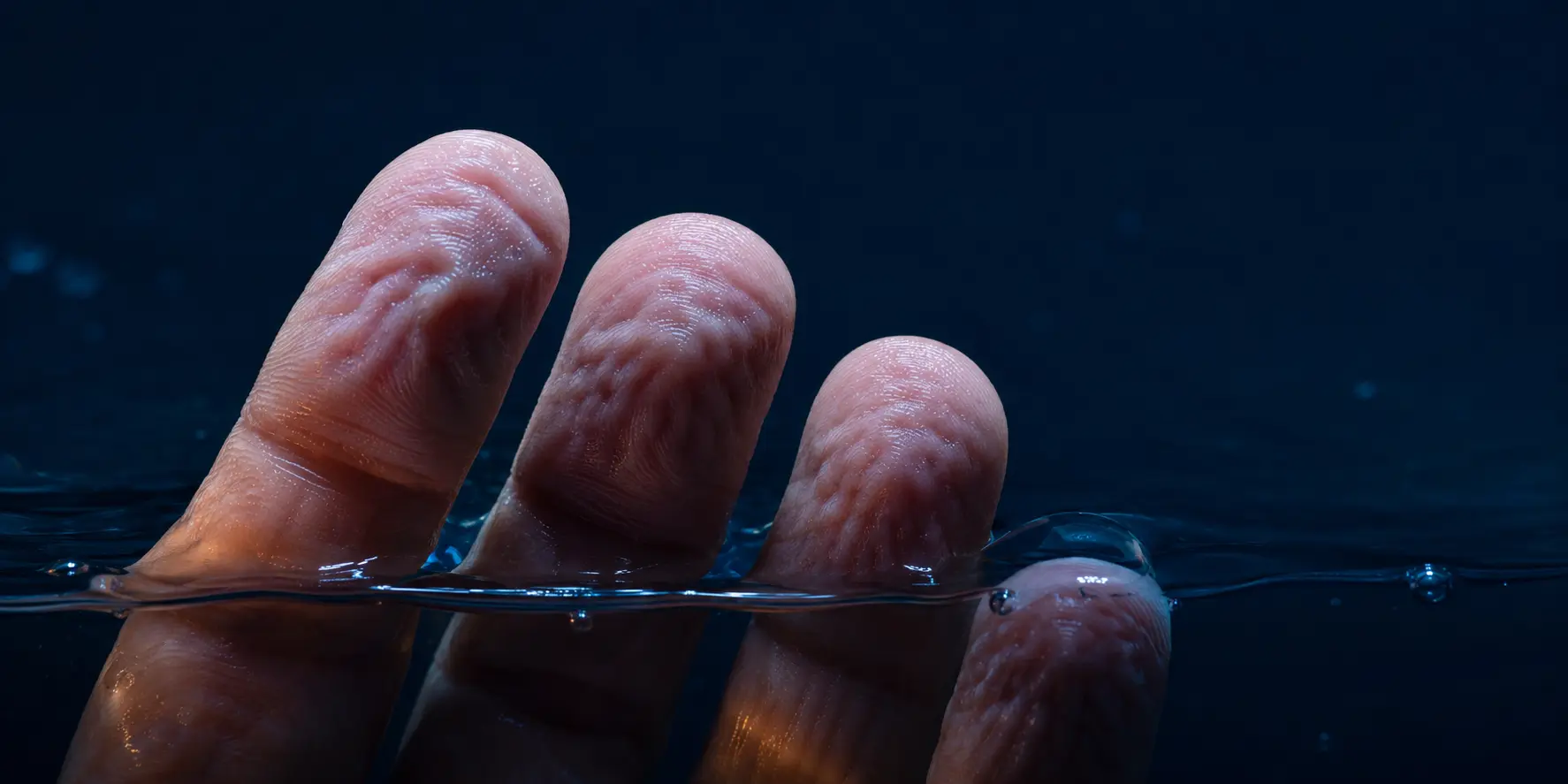
Your fingers wrinkle because the sympathetic nervous system narrows small blood vessels beneath the skin. As the tissue volume below the surface decreases, the skin folds into ridges. It is an active response—not just water swelling the outer layer.
Leave your hand in water for long enough and a topographic pattern appears across the pads of your fingers. The grooves arrive slowly, deepen, and then disappear after your hand dries. For years, the simple explanation was osmosis: water entered the skin and made it puff unevenly.
That idea does not explain one important observation. Fingers with damaged or disconnected autonomic nerves often do not wrinkle normally. In a study of 20 replanted fingers, blood flow in the matching healthy fingers fell by an average of 27.6% after immersion and the skin wrinkled. Blood flow in the replanted fingers rose instead, and the skin did not wrinkle. That contrast points to intact sympathetic nerves—not passive swelling alone—as a necessary part of the response.
What is happening inside your fingertips
The surface skin of your palms and fingertips is thick, hairless and anchored tightly to the layers below. Water moving into sweat ducts appears to help trigger a sympathetic nerve response. Those nerves tell tiny blood vessels in the fingertip to constrict.
Less blood in that vascular bed means slightly less volume beneath the surface. Because the skin is tethered rather than free to shrink evenly, it buckles. The familiar valleys are the visible result.
Why does the effect stand out on fingers and toes?
The strongest wrinkling appears on glabrous skin: the thick, hairless skin of the palms, fingertips and soles. These surfaces contain many sweat pores and are mechanically anchored to deeper tissue so they can resist sliding while you grip or walk. When the tissue volume beneath them changes, the fixed surface cannot simply contract as a smooth sheet. It bends into a patterned network of ridges.
Water still matters, but it acts as the trigger rather than the whole explanation. Researchers found that more concentrated salt solutions delayed the appearance of wrinkles compared with less concentrated solutions. That supports a role for water moving through the outer skin and sweat-duct system before the sympathetic nerves and blood vessels complete the response. Scientists agree more strongly on the final vasoconstriction than on every step that starts it.
Why would your body do this?
The strongest idea is grip. Channels in wrinkled skin may help move water away from the contact surface, a little like drainage treads. A 2013 experiment found that people moved wet objects faster after their fingers wrinkled. A larger 2021 study found that wrinkling reduced the extra grip force people used on wet objects.
That does not mean wrinkled fingertips become universally better tools. The 2013 advantage appeared for wet objects, not dry ones. A 2014 experiment found no improvement in fine touch or dexterity, while the 2021 work measured more economical grip force rather than a dramatic increase in speed. Different tasks, surfaces and measurements produce different results.
The evolutionary explanation is therefore plausible, not settled fact. Scientists can describe the nerve-and-blood-vessel mechanism with much more confidence than they can explain why natural selection retained it.
Try it yourself
Compare one wet hand with one dry hand.
- Soak one hand in comfortably warm water until clear wrinkles appear.
- Leave the other hand dry as a comparison.
- Pick up the same smooth, wet object with each hand. Notice grip force—not just speed.
Use a light, unbreakable object and avoid very hot water.
Why it matters
Water-induced wrinkling has been studied as a simple window into sympathetic nerve function. That does not make a home bath test diagnostic. Wrinkling varies with temperature, time and individual biology, and unusual results need clinical context.
Timing also depends on the conditions. Research protocols often use warm water and immersion periods of up to 30 minutes so results can be compared consistently. A quick change in your own bathroom is not equivalent to a controlled nerve test. Likewise, one hand appearing slightly more wrinkled than the other does not identify a disease on its own.
Your fingertips are not passively surrendering to water.
A hidden nerve reflex changes blood flow beneath the skin, and the folds on the surface reveal the structure moving below.
Research behind this story
We prioritize primary research and indexed scientific literature. Findings about the grip advantage remain mixed.
01