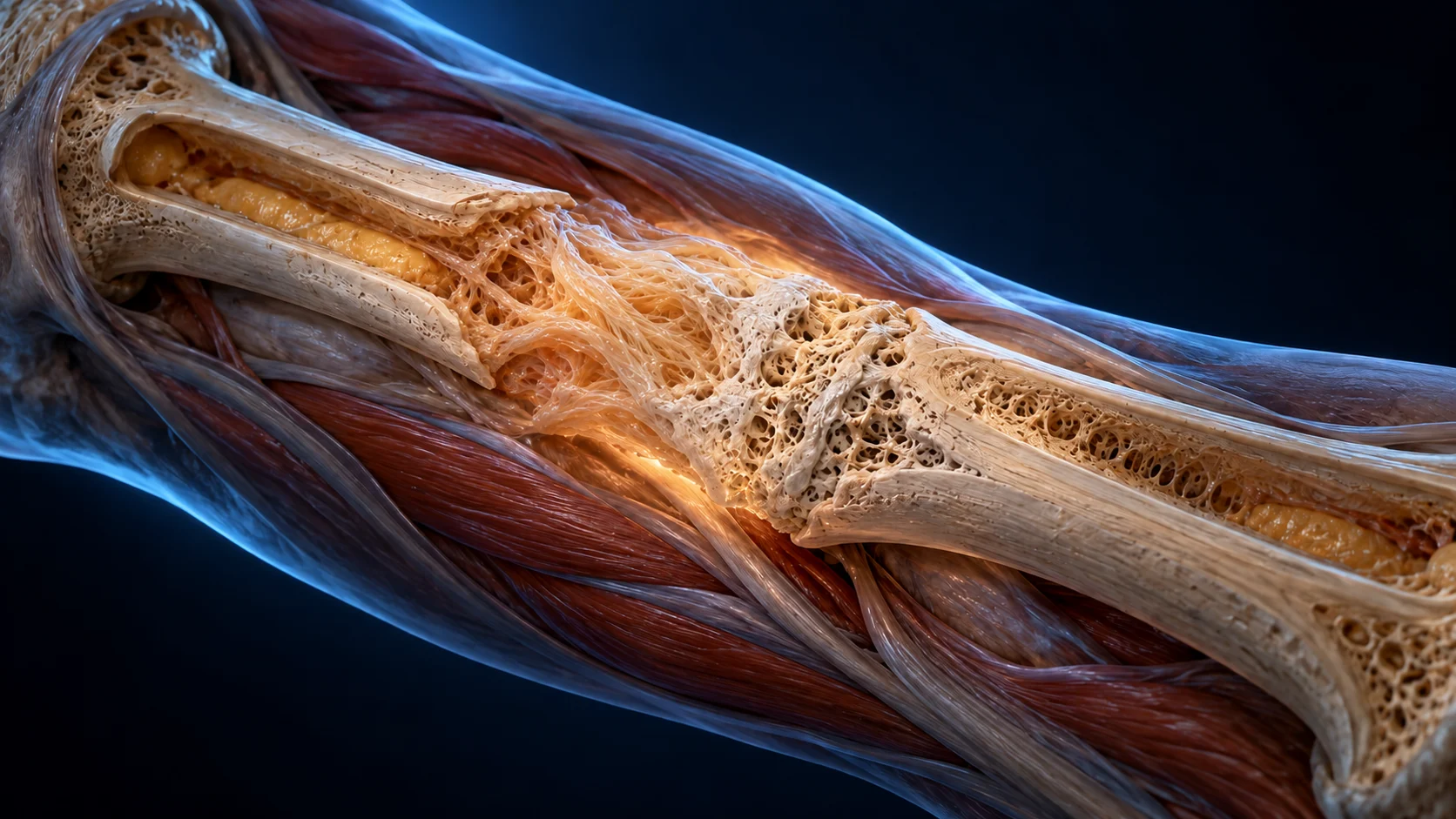
Why Humans Can't Regrow Limbs
Healing seals damage. Regeneration must rebuild bone, muscle, nerves, vessels and skin in the right places—a much larger biological instruction set.
New explanations and experiments, ordered by publication. Every story includes sources and a clear path into the mechanism.

Healing seals damage. Regeneration must rebuild bone, muscle, nerves, vessels and skin in the right places—a much larger biological instruction set.

Fever is not the body losing control of temperature. It is the control system temporarily choosing a higher target.

An antibiotic can hit a bacterial wall, ribosome or enzyme. A virus brings a different set of parts—and borrows many of yours.

Babies learn constantly. What disappears is access to early autobiographical episodes in the form an older mind expects.

Late nights are not explained by phones or willpower alone. Adolescence changes the timing systems that decide when sleep feels possible.

A newborn does not see a blank blur. The visual system is already working, then calibrates itself through months of growth and experience.

A busy afternoon and a remembered decade use different kinds of time judgment. Aging changes both, but not through one simple ratio.

Two dark marks above a line can be enough. A visual system tuned for faces would rather make a fast false alarm than miss one.

The moment feels remembered, but no memory arrives. Déjà vu may be the brain noticing that mismatch in real time.

Your brain does not replay the whole recording. It reconstructs a compact loop that is easy to cue and difficult to complete.

It is small and removable, but not blank. The appendix sits where immune tissue and the intestinal microbiome meet.

The visible strand is not bleaching from the tip. A follicle begins producing new hair with less pigment than before.

A tiny patch of muscle moves without permission because a motor nerve and the fibers it controls have fired as a unit.

One word—crack—covers several sounds. A pulled knuckle is a pressure event; a moving tendon can make a different kind of pop.

The color belongs to the optical path between vessel and eye. Inside the vein, the blood remains dark red.

The sound comes last. First, a reflex jerks the breathing muscles; then the airway closes against the incoming air.

For some people, stepping into bright sun recruits a nasal defense reflex even when nothing has entered the nose.

The pain feels deep in the forehead, but the trigger begins on the roof of the mouth where cold meets a densely wired sensory surface.

An onion turns tissue damage into airborne chemistry. Your tears are the eye's fast attempt to dilute the warning.

The limb is not sleeping. Pressure has briefly distorted the electrical conversation between peripheral nerves and the brain.

Your skeleton is permanent enough to hold your shape and alive enough to remove, rebuild and adapt its own material.

A newborn skeleton contains more separate pieces. Growth does not only enlarge them—it joins many into stronger adult structures.

After an infection fades, selected cells remain—ready to recognize the same molecular pattern faster next time.

Behind your left ribs, one organ inspects blood, recycles old cells and helps catch threats before they spread.

A musical expectation resolves, reward circuits respond, and the body marks the moment with a wave of autonomic arousal.

Seeing, hearing or even reading about a yawn can recruit the urge to copy it. The reason remains scientifically unsettled.

A trace of scent can retrieve a whole scene because smell enters networks where emotion, context and memory meet.

Shivering turns muscle into a temporary heater when conserving warmth is no longer enough.

Your stomach does not fall alone. A sudden change in acceleration retunes weight, balance and visceral sensation at once.

Excitement reaches the gut through autonomic signals that change movement, sensation and the rhythm of digestion.

Embarrassment becomes visible when an involuntary autonomic response sends more warm blood through facial skin.

Cabin pressure changes faster than your middle ear can follow. The pop is the moment the two sides reconnect.

The sound is not your stomach asking for food. It is the noise of a digestive tract still moving between meals.

Chili heat is a chemical alarm. Your nose answers by turning on a fast, watery cleaning system.
Stare at one color, then remove it. Adapted visual pathways can make its opponent appear on a neutral surface.
Both eyes build the scene, but one may control alignment when you point through a small opening.
Name the ink, not the word. Reading is so practiced that it competes with the answer you are trying to give.
Wait for the signal, then respond. A few hundred milliseconds reveal a chain from light to decision to muscle.
Each eye contains a place that cannot see. Your brain quietly paints over it all day.

The ridges are not swollen skin. They are an active response controlled by your nervous system.