
Quick answer
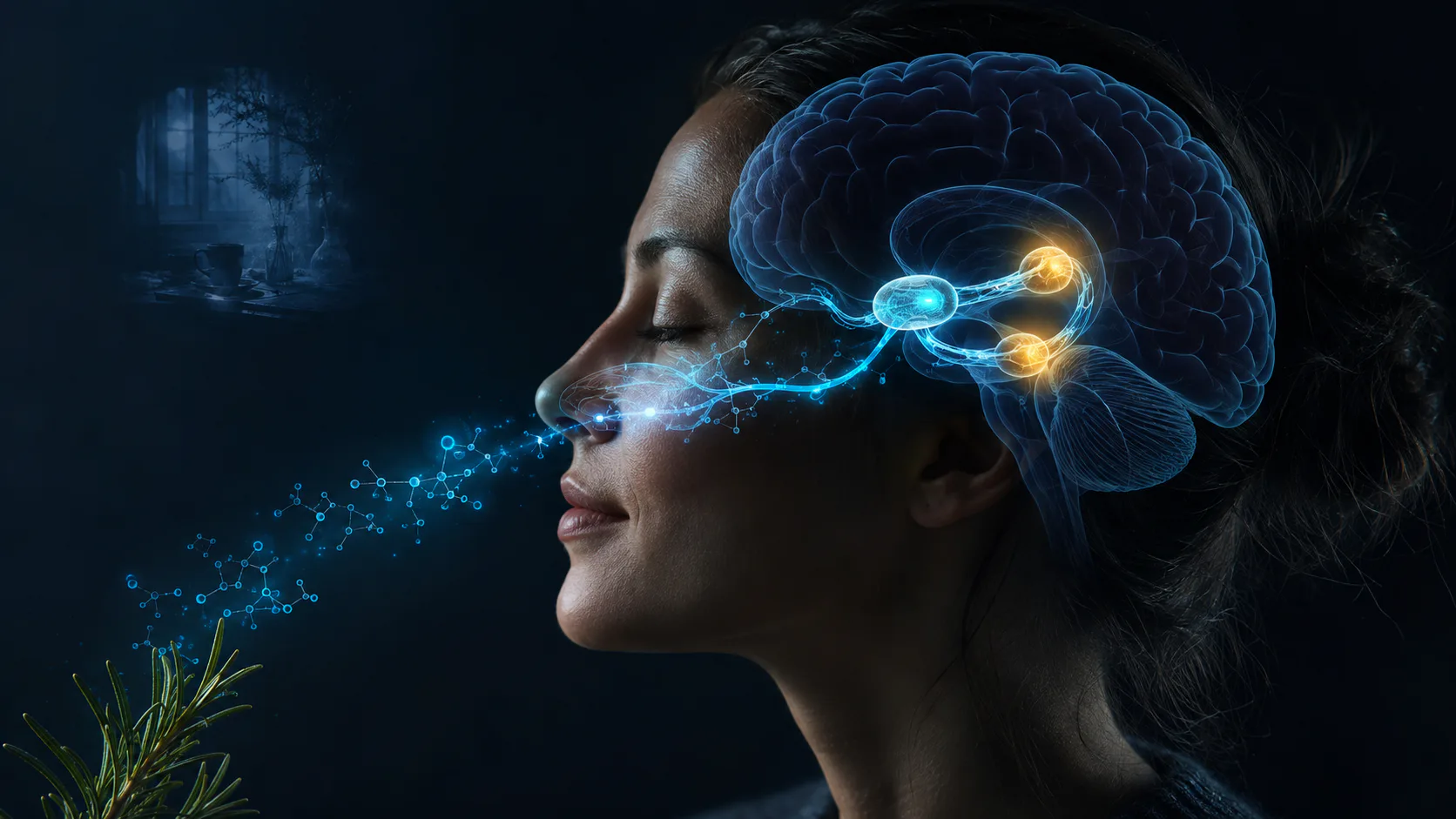
Smell signals reach primary olfactory regions that are tightly connected with the amygdala, hippocampus and orbitofrontal cortex—systems involved in emotion, memory and value. An odor encountered during a meaningful event can later act as a precise retrieval cue, bringing back the scene and its feeling with little deliberate search.
A hallway smells faintly of floor polish and suddenly you are back at school. A spice opens a kitchen that no longer exists. The memory does not arrive as a list of facts; it appears with place, mood and a sense of being there.
Odor-evoked memories are often called Proustian after the literary scene in which a madeleine dipped in tea releases a childhood world. Neuroscience does not reduce that experience to one shortcut, but the anatomy of smell helps explain its speed and emotional force.
Smell enters a different kind of sensory route
Airborne molecules bind to receptors high in the nasal cavity. Receptor neurons send patterned signals to the olfactory bulb, where information is organized before traveling to olfactory cortex and connected limbic regions.
Most sensory systems route major early signals through the thalamus before primary cortex. Olfaction is unusual: projections from the olfactory bulb reach primary olfactory areas without that first thalamic relay. The pathway is closely intertwined with the amygdala and entorhinal regions that communicate with the hippocampus.
That does not mean smell bypasses thinking or has a single direct wire to memory. Conscious identification, attention and context recruit broader networks, including orbitofrontal cortex. The key point is anatomical proximity and dense connectivity, not a magical exception to brain processing.
Why a forgotten scent can retrieve an old scene
Memory retrieval works through cues. A cue is effective when it overlaps with the information present during learning. Odors are distinctive and often remain in the background, so the same scent can later recreate a rare pattern that points toward one episode.
Studies comparing odor-evoked memories with memories prompted by words or pictures find recurring differences: odor memories tend to feel more emotional, more vivid and more involuntary, and often come from earlier in life. Those are group-level patterns, not rules for every person or every smell.
Emotion strengthens the sense of importance. The amygdala helps assign emotional salience, while the hippocampal system reconstructs a scene in time and place. When both are recruited by a familiar odor, a small chemical cue can reopen a large autobiographical network.
Odors are also difficult to name. People can often judge that a smell is familiar or pleasant before finding the word for it. That gap gives an odor time to activate associations without being immediately narrowed by a label. Once someone says hospital disinfectant or orange peel, the interpretation becomes more constrained.
Early experiences may be overrepresented partly because smell preferences and autobiographical knowledge develop together in childhood. But researchers do not find a hidden perfect archive. A scent can blend several episodes, and later knowledge can reshape what feels like a direct return to the past.
From molecule to remembered moment
Odor receptors encode a molecular mixture. The olfactory bulb transforms that activity into a distributed pattern. Connected cortical, emotional and memory networks compare the pattern with prior experience, and a strong match can trigger reconstruction before you have named the smell.
This is why recognition can lag behind feeling. You may experience comfort, unease or familiarity first, then identify the source a second later.
Neuroimaging work finds that odor-evoked autobiographical memories recruit emotion and memory networks.
Try it yourself
Use a scent without naming it first.
- Ask someone to place a familiar, non-irritating scent in an opaque container.
- Smell briefly with eyes closed and write the first place, person or feeling that appears.
- Only then identify the scent and compare recognition with the memory it produced.
Avoid substances that trigger allergies, asthma or migraine. Do not inhale unknown chemicals or concentrated essential oils.
Why it matters
Smell shows that remembering is not a file lookup. It is a reconstruction guided by current cues, body state and emotion.
Odor can support autobiographical recall, but vividness is not proof of accuracy. A memory that feels immediate can still contain omissions or later revisions.
Smell is a compact key for a distributed memory.
Olfactory pathways sit close to emotion and memory systems. When a scent matches an old pattern, the brain can rebuild a scene before words catch up.
Research behind this story
We link to the primary study or an authoritative indexed review wherever possible. Caveats in the text reflect the limits of that evidence.
01