
Quick answer
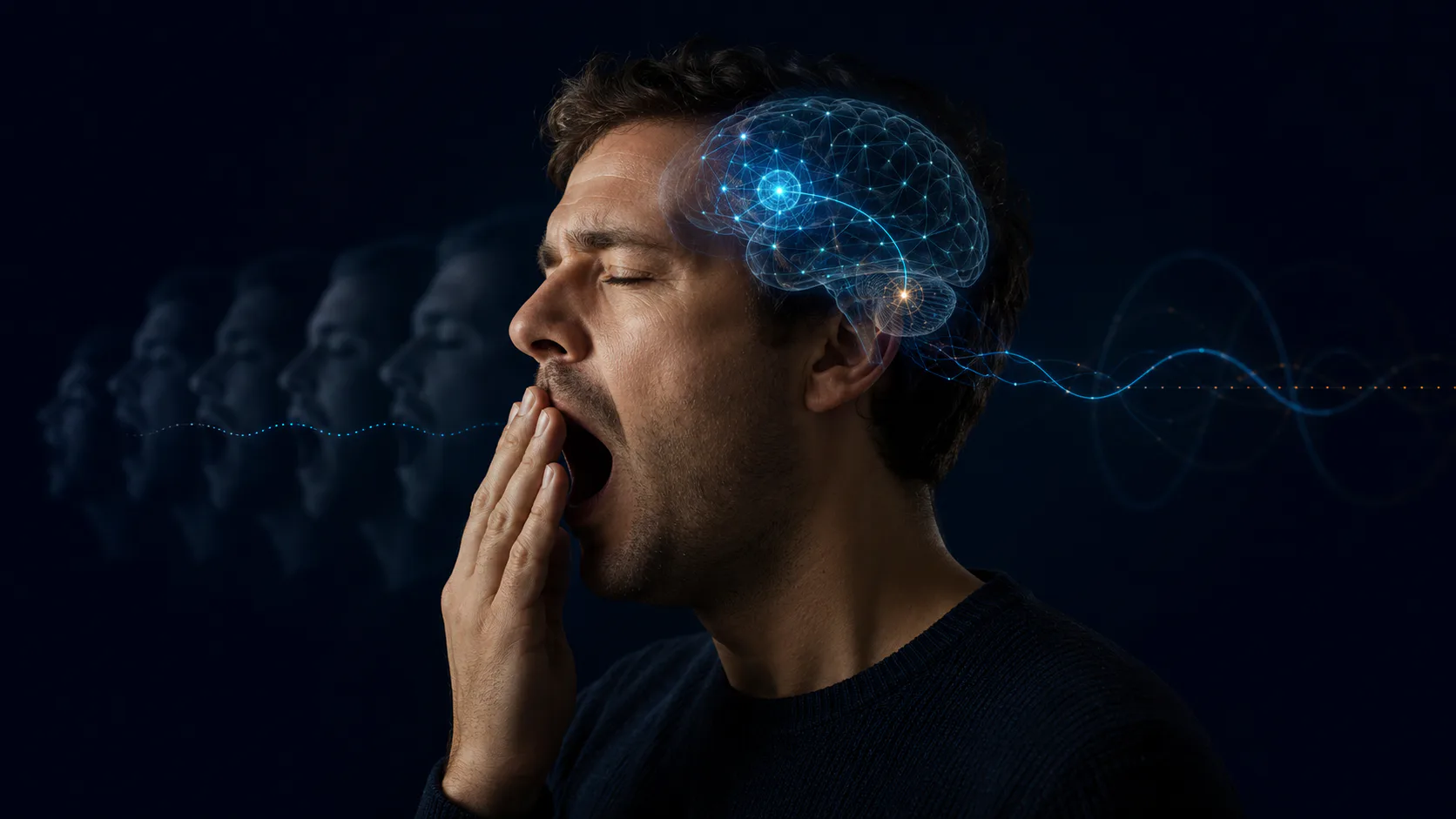
Contagious yawning is an involuntary tendency to yawn after seeing, hearing or thinking about another yawn. Experiments link it to attention and the excitability of motor systems that translate observed actions into an urge to act. Social closeness and empathy may influence it in some settings, but the evidence is mixed and no single explanation is proven.
A person across the room opens their mouth, inhales and stretches their jaw. You recognize the action, feel pressure building behind your own face, and within seconds you are doing it too. Sometimes the word yawn is enough.
The effect is measurable, but it is not universal. In laboratory studies, many people do not yawn during the test, and the same person’s susceptibility can be fairly stable. That variation is one reason researchers have tested explanations ranging from attention to empathy and motor control.
An observed action becomes an urge
Contagious yawning belongs to a wider family of echophenomena: automatic tendencies to mirror observed sounds or actions. Watching a yawn activates visual and action-processing networks, and the motor system represents the movement before any visible response occurs.
A transcranial magnetic stimulation study found that individual differences in cortical motor excitability helped predict contagious-yawning propensity. Telling participants to resist changed how yawns were expressed and increased the reported urge, but did not erase susceptibility.
Attention matters earlier in the chain. You must detect the relevant facial or vocal pattern. Studies in which participants were guided to look at the eyes or became better at detecting yawns suggest that reduced contagion can sometimes reflect what was noticed, not an absence of social feeling.
The empathy idea is interesting—not settled
Some studies report that contagious yawning is more likely between familiar individuals or correlates with particular empathy measures. Others find weak, inconsistent or absent relationships. Empathy is also not one ability: emotional concern, perspective-taking and social attention are related but separable.
Early reports of lower contagious yawning in autistic children were widely interpreted as evidence for an empathy mechanism. Later work showed that directing attention toward the yawning stimulus could reduce or remove that group difference. Using yawning as an empathy test is therefore scientifically and ethically unjustified.
Other proposals include action synchronization, vigilance and brain-temperature regulation. These may generate useful experiments, but none currently explains all findings in humans and other animals.
Contagious yawning must also be separated from spontaneous yawning. Spontaneous yawns follow daily rhythms and changes in state such as waking, fatigue or boredom. A contagious yawn is defined by the cue that precedes it, yet the response is still more likely when the observer is already in a yawn-prone state. Experiments therefore need control conditions and careful timing.
The old claim that yawning simply brings in more oxygen has not held up well. Changing oxygen or carbon-dioxide levels does not reliably produce the predicted effect. That leaves room for functions related to state change or temperature, but the basic purpose of spontaneous yawning remains under study too.
What researchers can say with confidence
A yawn cue must be detected and represented. The observed action then interacts with motor excitability and inhibitory control, producing anything from no response to a strong urge or a completed yawn.
Social context may tune the process, but its role varies across methods and species. The responsible explanation should remain plural until experiments can separate attention, familiarity, arousal and motor response more cleanly.
A controlled stimulation study found that motor-cortex excitability predicts part of contagious-yawning susceptibility.
A separate experiment showed how yawn-detection sensitivity changes apparent contagion.
Try it yourself
Test the urge, not just the yawn.
- Watch a short, silent clip containing several genuine yawns.
- Count both completed yawns and moments when you feel the urge without yawning.
- Repeat another day while focusing on a non-face detail. One person’s result cannot settle the theory, but it reveals the role of attention.
Yawning varies with fatigue, time of day and context. This is a demonstration, not a psychological assessment.
Why it matters
The question tests how cautiously science should move from behavior to inner traits. A visible response can be shaped by perception, motor thresholds, inhibition and context before it says anything about character.
Contagious yawning is valuable precisely because the answer is unfinished. It shows how researchers compare competing explanations instead of turning the most appealing story into fact.
Yawns spread through a real but unresolved action-perception circuit.
Attention and motor excitability clearly matter. Empathy may contribute in some contexts, but contagious yawning is not proof of it.
Research behind this story
We link to the primary study or an authoritative indexed review wherever possible. Caveats in the text reflect the limits of that evidence.
01