Quick answer
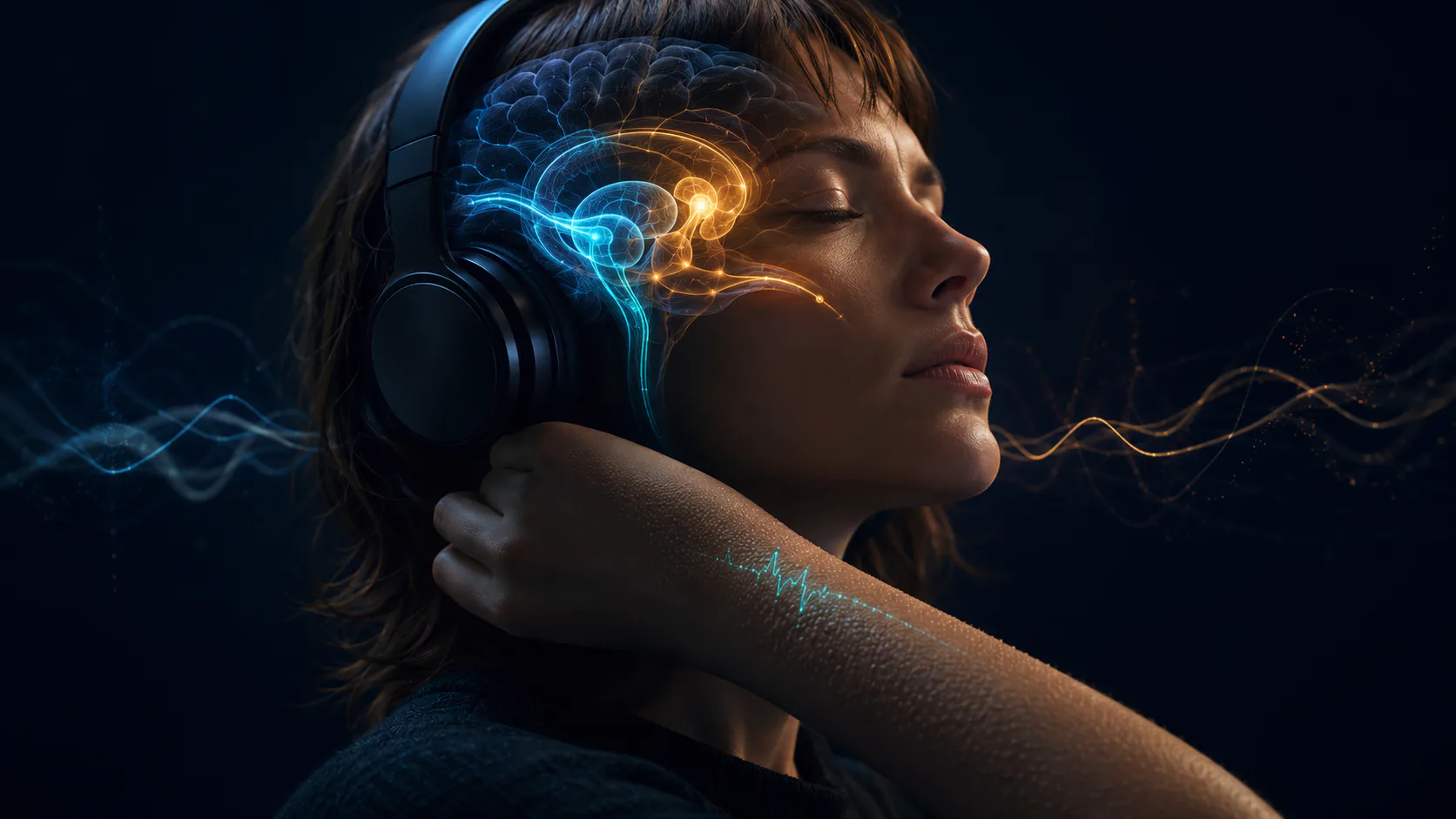
Music can create chills when a meaningful musical event—such as a long-awaited entrance, harmony change or sudden dynamic shift—interacts with prediction and reward systems. Dopamine-related activity contributes during anticipation and peak pleasure, while the autonomic nervous system produces bodily changes such as goosebumps, tingling, altered breathing and a faster heart rate.
The chorus opens, one voice enters above the others, and a wave travels from the scalp down the arms. Nothing touched the skin and the room did not get colder, yet the hair rises as though the body has met a sudden physical event.
Researchers call the experience musical chills or frisson. It is not one fixed sensation: people report shivers, tingling, a lump in the throat, chest warmth or goosebumps. What unites these moments is intense emotion paired with measurable autonomic arousal.
Music builds expectations in real time
As you listen, the brain tracks rhythm, harmony, melody, timbre and learned style. It continuously predicts what is likely to happen next. Composers and performers can satisfy those predictions, delay them or violate them in ways that remain coherent enough to feel meaningful.
Chill moments often appear at structural changes: a new voice enters, volume expands, harmony shifts, a theme returns or a delay finally resolves. There is no universal recipe. Familiarity, personal memory and musical training change what each listener predicts and values.
That individuality is essential. A technically dramatic passage may do nothing for you, while a rough recording associated with one important year can produce an immediate response.
Anticipation and pleasure use different moments
A PET study combining brain imaging with physiological measures found dopamine release in the striatum during intensely pleasurable music. Activity was anatomically distinct across time: the caudate was more involved during anticipation, while the nucleus accumbens was more involved around the peak emotional response.
Earlier imaging work linked increasing chill intensity with changes in regions involved in reward, emotion and arousal, including ventral striatum, midbrain, insula and orbitofrontal areas. These studies used music selected by participants because it reliably moved them, which makes the response powerful but also deeply personal.
Dopamine should not be reduced to a pleasure chemical. It participates in learning, motivation, prediction and the value of anticipated outcomes. Music chills arise from a network, not a single molecule flooding the brain.
Not every chill is pleasant. Sudden voices, harsh textures or threatening film sound can produce shivers with a different emotional tone. Researchers distinguish several varieties of aesthetic chills, and self-report remains important because goosebumps alone cannot tell whether a listener felt awe, fear, nostalgia or simple cold.
Even within pleasurable frisson, piloerection is only one marker. Some listeners report an unmistakable internal wave without visible hair movement, while cameras can detect goosebumps that the listener did not report as a peak. The experience and the skin response overlap, but they are not interchangeable measurements.
Why pleasure appears on the skin
Peak emotion recruits the autonomic nervous system. Heart rate, respiration and skin conductance can change, and sympathetic pathways can contract tiny muscles attached to hair follicles, producing piloerection or goosebumps.
Goosebumps are an old mammalian response that helps furry animals trap air and appear larger. In humans, music can recruit part of that body program even though the stimulus is symbolic and the response no longer provides useful insulation.
Combined PET and physiological measurements found distinct dopamine release during musical anticipation and peak pleasure.
Earlier imaging also linked chill intensity with brain regions involved in reward, emotion and arousal.
Try it yourself
Find the musical event, not just the feeling.
- Choose a track that has reliably given you chills before.
- Listen once and mark the exact second the response begins.
- Replay the previous 20 seconds. Notice what changed: harmony, volume, voice, rhythm, memory or expectation.
Use a comfortable listening level. Loudness can increase arousal but can also damage hearing; intensity is not the same as volume.
Why it matters
Music chills reveal that abstract patterns can reach ancient systems for reward and bodily arousal. No food, threat or temperature change is required; organized sound and learned meaning are enough.
They also show why averages cannot fully explain aesthetic experience. The mechanism is shared, but the trigger is built from an individual listening history.
A chill is prediction, meaning and physiology converging.
Music shapes expectation, reward circuits register a valued moment, and the autonomic nervous system makes the pleasure physically visible.
Research behind this story
We link to the primary study or an authoritative indexed review wherever possible. Caveats in the text reflect the limits of that evidence.
01