Quick answer
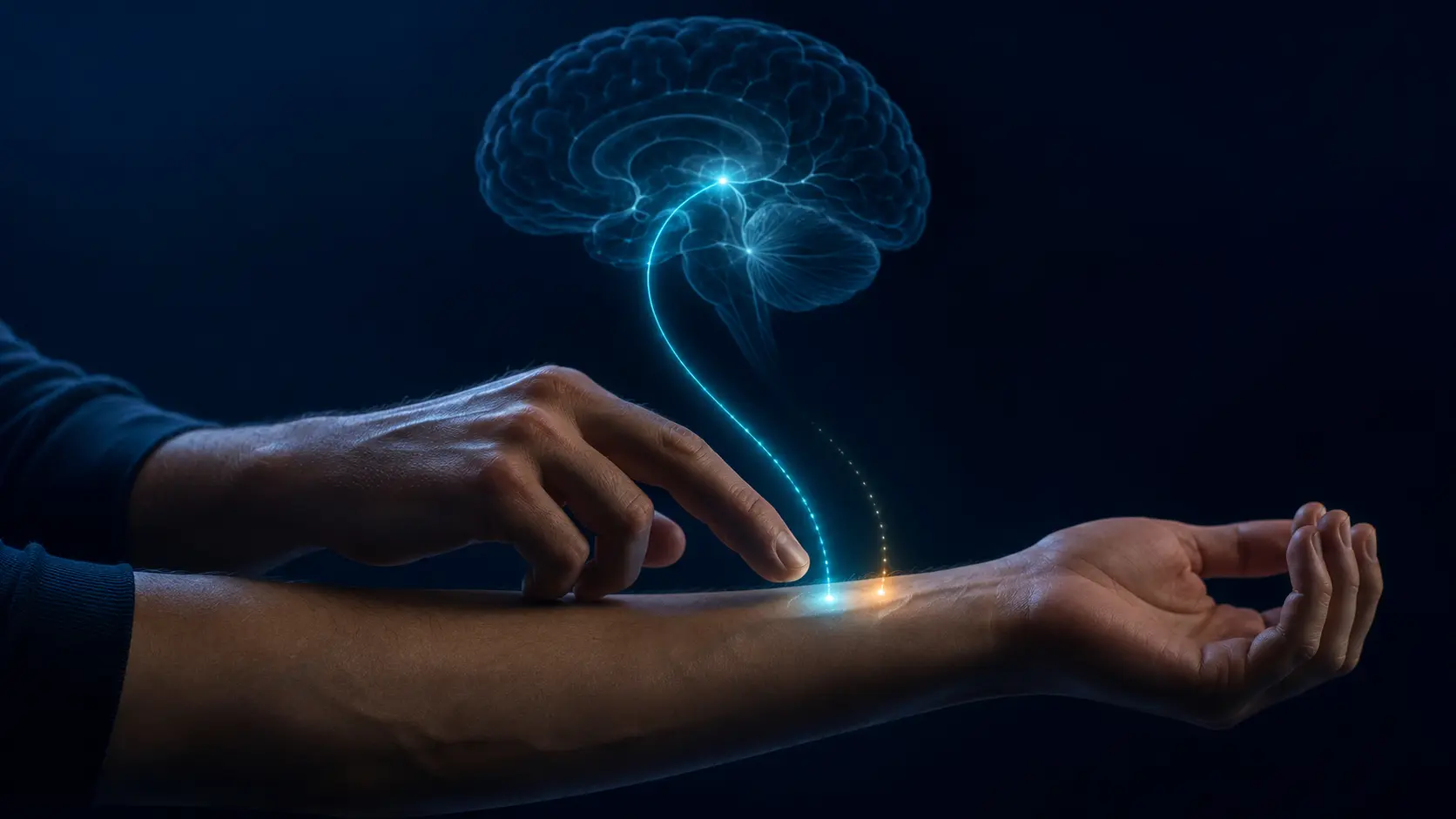
Self-generated touch is usually less intense and less ticklish because the brain predicts it. A copy of the motor command helps estimate where and when your movement will touch the body. When the incoming sensation matches that prediction, activity in sensory networks is reduced relative to the same touch produced externally. Adding a delay or changing the path makes the result less predictable and can restore some ticklishness. Self-touch is attenuated rather than completely switched off, so light self-tickle can still be felt.
You know the exact place that makes you recoil when someone else reaches it. Your own fingers can repeat the movement, pressure and location, yet the result feels like ordinary touch. The skin has not changed. The nervous system has changed how much weight it gives the signal.
The usual answer is that tickling needs surprise. Surprise matters, but it is only the visible edge of a more specific process. Before your hand moves, motor systems generate information that allows the brain to predict the sensory consequences of that movement. When touch arrives as predicted, its intensity is attenuated.
Not every tickle is the same
Researchers often separate two experiences. Knismesis is the light, moving sensation produced by a feather, an insect or a faint stroke across the skin. It can feel itchy or make you want to brush something away, and people can produce some version of it on themselves. Gargalesis is the stronger, laughter-producing response associated with repeated touch to areas such as the ribs, soles or armpits. This is the form that is difficult to create with your own movement.
That distinction prevents an absolute claim. You can feel your own fingers and may produce a faint ticklish sensation, especially with very light contact. What is strongly suppressed is the intense, externally driven form. The nervous system keeps the information needed to control the hand while reducing the part that would otherwise feel surprising and intrusive.
Ticklish laughter is also not a simple measure of pleasure. People can laugh while trying to escape the touch, and consent matters in any playful interaction. The involuntary response reflects sensory and motor systems interacting with context, not proof that the person wants the stimulation to continue.
The brain predicts your hand before it lands
To control movement, the brain must estimate what a motor command will do before slow sensory feedback has fully returned. One useful model says that a copy of the outgoing command—often called an efference copy—is fed into a forward model. That model predicts the movement’s sensory consequences: which patch of skin will be contacted, with what timing and approximate force.
The predicted signal can then be compared with actual sensory input. If they match, self-generated touch is attenuated. This helps the nervous system distinguish changes caused by its own actions from events that may require attention. Without such filtering, every movement of clothing, every contact between fingers and every self-produced sound could compete more strongly with unexpected information from the outside world.
Classic brain-imaging work found more activity in somatosensory cortex when a tactile stimulus was produced externally than when participants produced it themselves. Activity patterns in the cerebellum also supported a role in predicting the sensory outcome of movement. Later studies have connected cerebellar and somatosensory networks more directly rather than assigning the entire process to one isolated region.
Why a small delay changes the sensation
Prediction depends on timing. In laboratory experiments, a participant moves one hand while a device delivers touch to the other. When the touch follows the expected movement immediately, it feels less intense and less ticklish. Introduce a delay or a spatial mismatch, and the sensation becomes more external because the incoming signal no longer matches the forecast precisely.
The system is adaptable rather than fixed. Repeated exposure to a consistent delay can teach the brain a new relationship between action and consequence, altering attenuation. Remove the delay and the prediction can change again. This learning shows why “you know it is coming” is not the whole explanation: the nervous system is calibrating the detailed sensorimotor link, not asking a conscious yes-or-no question about surprise.
A 2022 study added another nuance. Self-tickle suppression may involve broad attenuation of sensations that occur at the same time as self-generated movement, not only a perfectly detailed cancellation signal. The field continues to refine how prediction, timing and general sensory gating combine. The reliable observation remains that self-produced touch is processed differently from matched external touch.
From motor command to muted tickle
The intention to move generates a motor command and predictive information. A forward model estimates the touch that should follow. When the skin signal arrives at the predicted place and time, sensory pathways give it less weight.
External touch is harder to predict in the same detail. Its timing, pressure and path contain more error relative to the model, so the signal remains stronger and more likely to produce the full tickle response.
A landmark imaging experiment found that the cerebellum helps predict and attenuate the sensory consequences of self-produced touch.
Modern experimental work proposes that self-tickle suppression includes broader attenuation of temporally coincident sensory input.
Try it yourself
Compare predicted and less-predictable touch.
- Make one slow, light stroke along your own forearm and notice the exact location and intensity.
- With consent, ask another person to make a similar gentle stroke while you look away. They should vary the starting moment rather than increase pressure.
- Compare how clearly the second touch captures attention. The purpose is unpredictability, not trying to force laughter.
Stop if the touch is uncomfortable. Tickling should never be used without consent, and this comparison is not a neurological test.
Why it matters
Sensory attenuation is part of a larger solution to a difficult problem: the brain must separate events caused by the body from events arriving from the world. The same principle helps explain why self-produced sounds, movements and touch are processed differently from external ones.
The phenomenon also demonstrates that conscious expectation is not the whole of prediction. The comparison occurs within fast sensorimotor networks before you explain the experience to yourself. A tiny failure to self-tickle exposes a system that continuously labels the consequences of your own actions.
Your hand is predictable, so the brain lowers the gain.
Motor systems forecast the touch your movement should produce. When reality matches, sensory networks attenuate the signal; when timing or location becomes less predictable, more of the tickle returns.
Research behind this story
We link to the primary study or an authoritative indexed review wherever possible. Caveats in the text reflect the limits of that evidence.
01