Quick answer
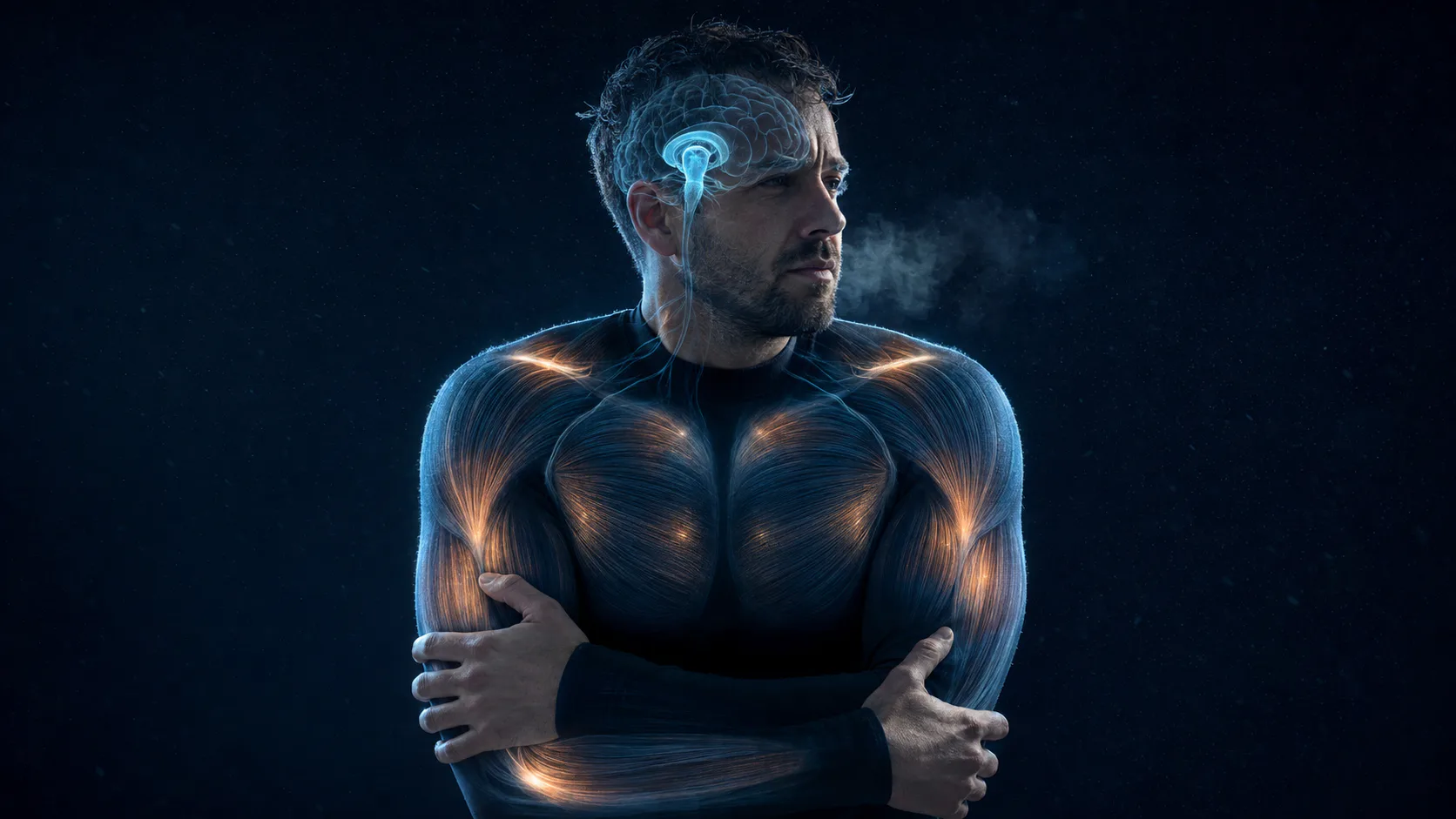
Goosebumps, or piloerection, form when sympathetic nerves activate tiny smooth muscles called arrector pili muscles. Each muscle contracts and pulls its attached hair follicle toward the surface, raising the hair and dimpling the surrounding skin. Cold, threat and some intense emotional experiences can recruit this automatic pathway. In furry mammals, raised hair helps trap air or makes the animal look larger; in humans, with much less body hair, the visible effect is limited.
A cold gust crosses your arm. The skin tightens, a field of bumps appears and fine hairs lean upward almost at once. The visible change feels broad and sudden, but it is assembled follicle by follicle by thousands of microscopic muscles.
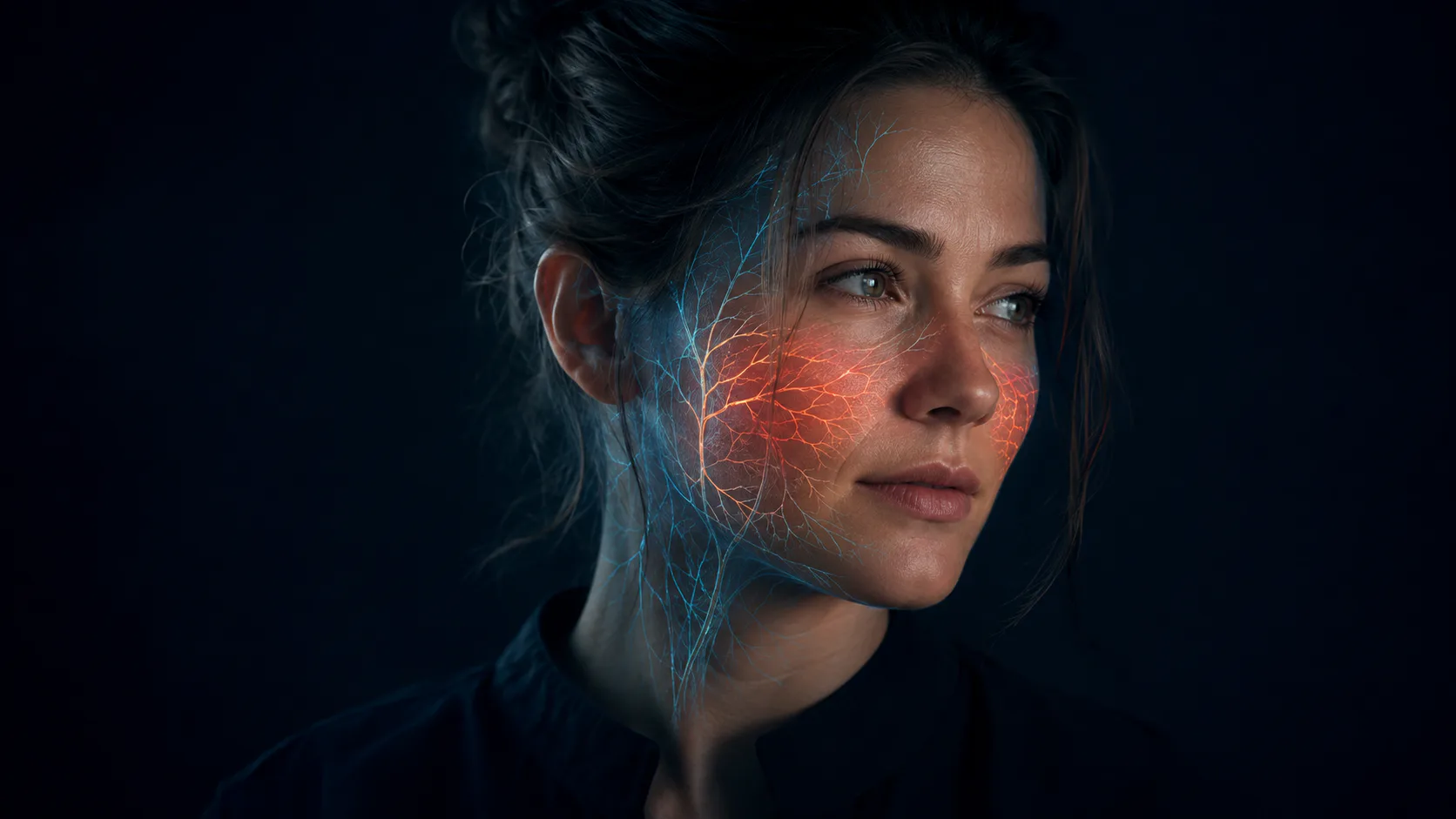
The same pattern can appear during fear, awe or a piece of music. Those triggers feel unrelated because the conscious experiences are different. Under the surface, however, they can converge on the autonomic nervous system and the small muscle attached to each hair follicle.
What happens under each bump
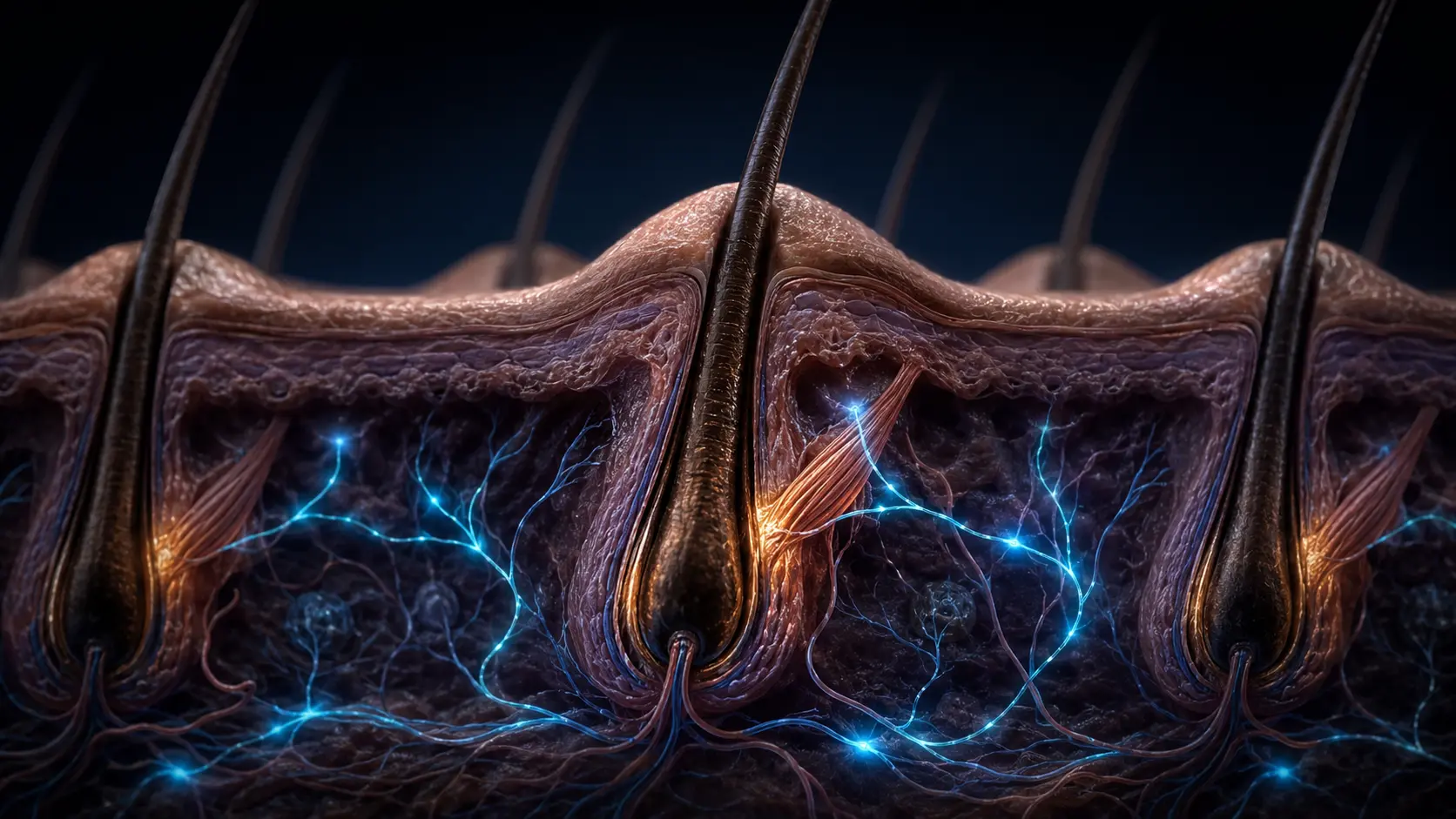
A hair does not stand up by itself. Its follicle extends into the skin at an angle, and a narrow band of smooth muscle connects the follicle to the upper dermis. This is the arrector pili muscle. When it shortens, it rotates the follicle and pulls the nearby skin inward, creating a small elevation around the hair shaft.
Smooth muscle operates without conscious instruction. You cannot normally decide to contract each arrector pili muscle as you would a finger. The response arrives through autonomic pathways before conscious choice has any role.
The sympathetic nervous system supplies those pathways. It is often introduced as the fight-or-flight system, but its work is broader: it adjusts blood vessels, sweating, pupil size and many other functions according to temperature, arousal and internal state. Piloerection is one small output within that coordinated network.
Why cold, fear and music can reach the same skin
Cold is the clearest trigger. Temperature-sensing circuits in the skin and central nervous system help organize heat conservation, shivering and changes in skin blood flow. In mammals with dense fur, piloerection lifts hairs and increases the layer of still air near the skin, improving insulation. Human body hair is too sparse for a comparable thermal benefit, but the motor machinery remains.
Threat recruits sympathetic arousal for a different reason. Raising fur makes many mammals appear larger and prepares the body for rapid action. A frightened cat provides an obvious example. Humans inherited the reflex even though a raised layer of arm hair no longer changes our silhouette in a meaningful way.
Emotional goosebumps are more complicated. Music, speech, film, memory and social connection can produce chills, but the subjective feeling of a chill is not identical to visible piloerection. Recent studies measure the skin directly because people sometimes report goosebumps without a detected hair-raising response, and sometimes show piloerection without noticing it.
The overlap suggests that intense emotional processing can recruit autonomic output, but it does not mean every music chill is a miniature fear response. Reward, anticipation, surprise, attention and social meaning can produce different internal states that happen to share a final route to the skin.
An old reflex with a deeper follicle connection
Piloerection is often called vestigial in humans because its original effects are much stronger in animals with thick coats. Vestigial does not mean useless or broken. It means a feature persists after its ancestral function has been reduced or altered. The muscles, nerves and follicles remain real, active tissues even if raised human hair provides little insulation or intimidation.
A 2020 study revealed a second layer in mice. Sympathetic nerve fibres formed close, synapse-like contacts with hair-follicle stem cells, while the arrector pili muscle helped create the physical niche linking nerve and follicle. Short-term activation contracted the muscle and produced goosebumps; prolonged cold-related signalling influenced stem-cell activity and hair regeneration.
That finding should not be turned into a human hair-growth promise. Much of the detailed experiment was performed in mice, whose coats and hair cycles differ from ours. The research shows that the goosebump apparatus is embedded in a living nerve–muscle–follicle system. It does not show that deliberately getting cold or chasing goosebumps will regrow human hair.
Why can music give you goosebumps?
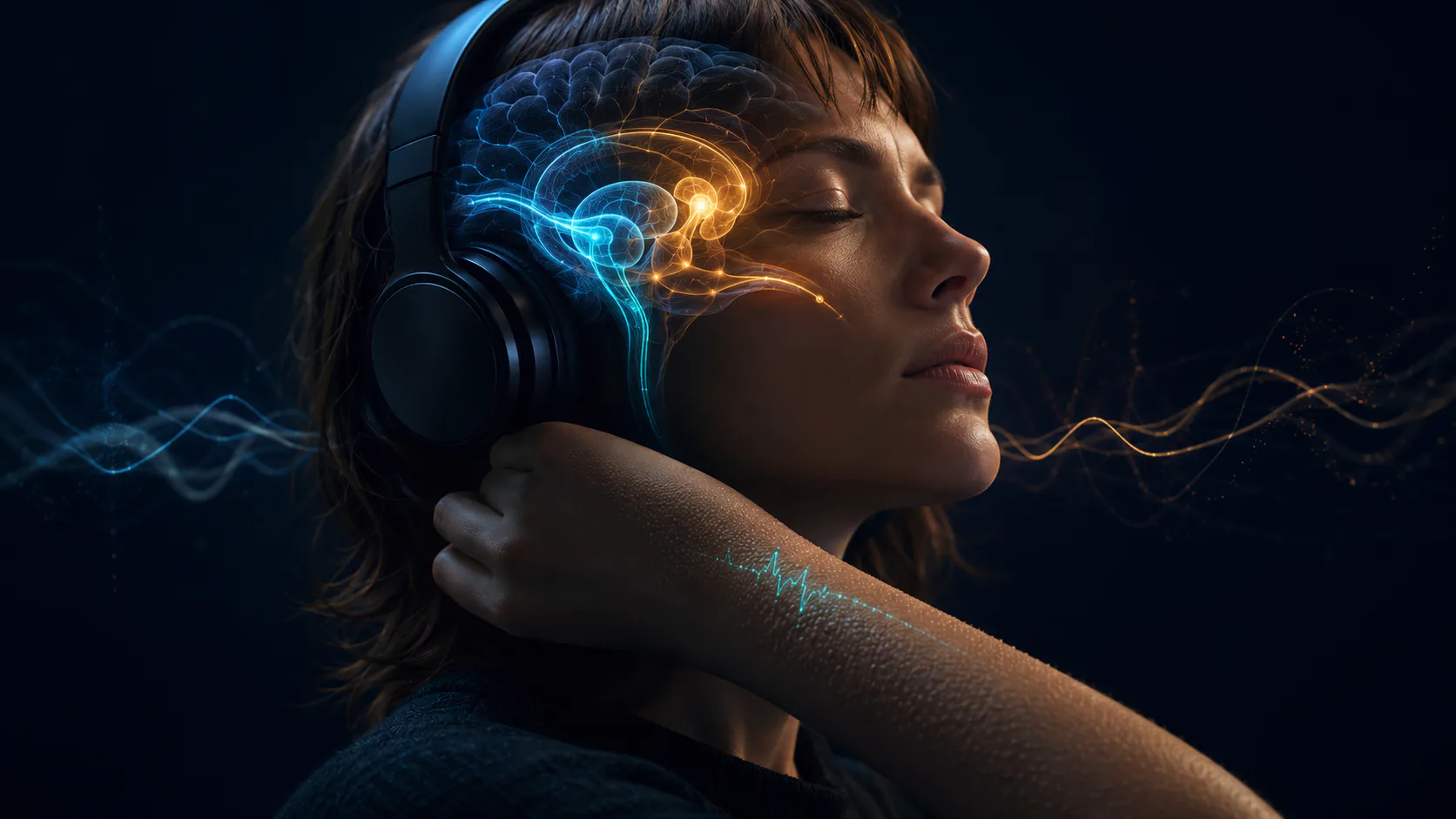
Music can build expectations and then delay, violate or fulfill them through changes in harmony, loudness, texture, rhythm or the entrance of a voice. When a moment becomes emotionally important, reward, attention and autonomic systems can shift together. The listener may feel a wave, tingling or shiver while sympathetic output reaches the skin and contracts arrector pili muscles.
The subjective chill and visible goosebumps are related but not identical. A person can report an intense musical chill without measurable piloerection, while a camera may detect hair raising that the listener did not identify as a peak. That is why researchers often record skin conductance, heart rate and piloerection alongside the person's own report.
This page explains the final route to the hair follicle. The companion story on musical chills follows the prediction, reward and emotion side in greater depth. Keeping those questions connected avoids pretending that every emotional chill has one trigger or that every goosebump reveals the same feeling.
From signal to raised hair
A thermal or emotional event changes activity in autonomic control networks. Sympathetic fibres in the skin release chemical signals near the follicle. The arrector pili muscle contracts, changes the follicle’s angle and pulls the surface into a bump.
The response can spread quickly because the nervous system coordinates many follicles in parallel. What looks like one wave across the arm is a large population of tiny muscle contractions occurring almost together.
NIH describes how arrector pili muscles raise hair and summarizes research on the sympathetic nerve–muscle–stem-cell connection.
Recent psychophysiology research found that piloerection can follow thermal, tactile and audiovisual stimuli.
Music research distinguishes the felt chill from objectively measured goosebumps and other bodily responses.
Try it yourself
Compare the feeling of a chill with the visible response.
- The next time familiar music naturally gives you a chill, notice the exact moment the sensation begins.
- Look at your forearm without rubbing the skin. Check whether visible bumps appear, how widely they spread and how long they last.
- Repeat on another occasion. A reported chill will not always produce a visible field of piloerection.
Do not use extreme cold, fear or pain to trigger the reflex. The observation is about normal variation, not endurance.
Why it matters
Goosebumps connect three scales of biology in one familiar moment: whole-body arousal, microscopic smooth-muscle movement and signalling around a single hair follicle. The skin is not a passive covering; it is an active interface supplied by nerves, vessels, glands and contractile cells.
The response also shows how evolution works with existing machinery. Humans can retain an automatic circuit after its most obvious ancestral benefits have faded. Emotional experience can then recruit that old output in contexts—music, awe and memory—that cannot be explained by insulation alone.
Every goosebump is a tiny muscle revealing a hidden nerve signal.
Sympathetic fibres activate arrector pili muscles, which raise hairs and pull the skin into bumps. The reflex is ancient, but its nerve–muscle–follicle structure is still biologically active.
Research behind this story
We link to the primary study or an authoritative indexed review wherever possible. Caveats in the text reflect the limits of that evidence.
01