
Quick answer
Babies cry because crying is an early communication and regulation system. Hunger, fatigue, temperature, discomfort, pain, overstimulation, separation or an unclear shift in arousal can all trigger it. Air from the lungs drives vibration in the larynx, while brainstem and emotional-control networks shape pitch, rhythm and intensity. Caregivers can often estimate how urgent the distress is, but a cry is not a precise code that reliably reveals one cause. Crying commonly rises during the early weeks and then changes as the nervous system, sleep organization and other forms of communication mature.
A newborn can change the behavior of an entire room with one sound. Adults turn, search for a cause and move closer. That response is not an accidental side effect of noise. Crying is one of the infant's earliest ways to convert an internal problem into action from someone else.
The signal is powerful because early regulation is unfinished. A young baby cannot get food, change position, reduce stimulation or reliably calm a rising state alone. Crying recruits a caregiver who can help regulate temperature, hunger, arousal and safety. It communicates that something needs attention, but the sound rarely identifies one exact cause by itself.
Crying is a graded distress signal before it is a language
An infant arrives with reflexes and behavioral signals but without words, pointing or independent movement. Crying closes part of that gap. It is difficult to ignore, travels across a room and quickly changes adult attention. Evolution does not require every cry to carry a separate label; it only needs the signal to make care more likely when the infant cannot solve a problem alone.
Research reviews describe infant crying as graded: features of the sound can convey the intensity of distress more reliably than its specific cause. A sharper or more forceful cry may indicate greater arousal, but hunger, pain and fatigue do not produce perfectly universal acoustic signatures. Context—when the baby last fed, slept, moved or became overstimulated—helps a caregiver interpret the sound.
That uncertainty is normal. Commercial claims that every cry can be translated like a fixed vocabulary simplify a flexible biological signal. Caregivers learn patterns in one baby over time, yet even attentive adults will sometimes soothe without ever discovering one clear trigger.
A cry is built from breath, pressure and a rapidly changing voice
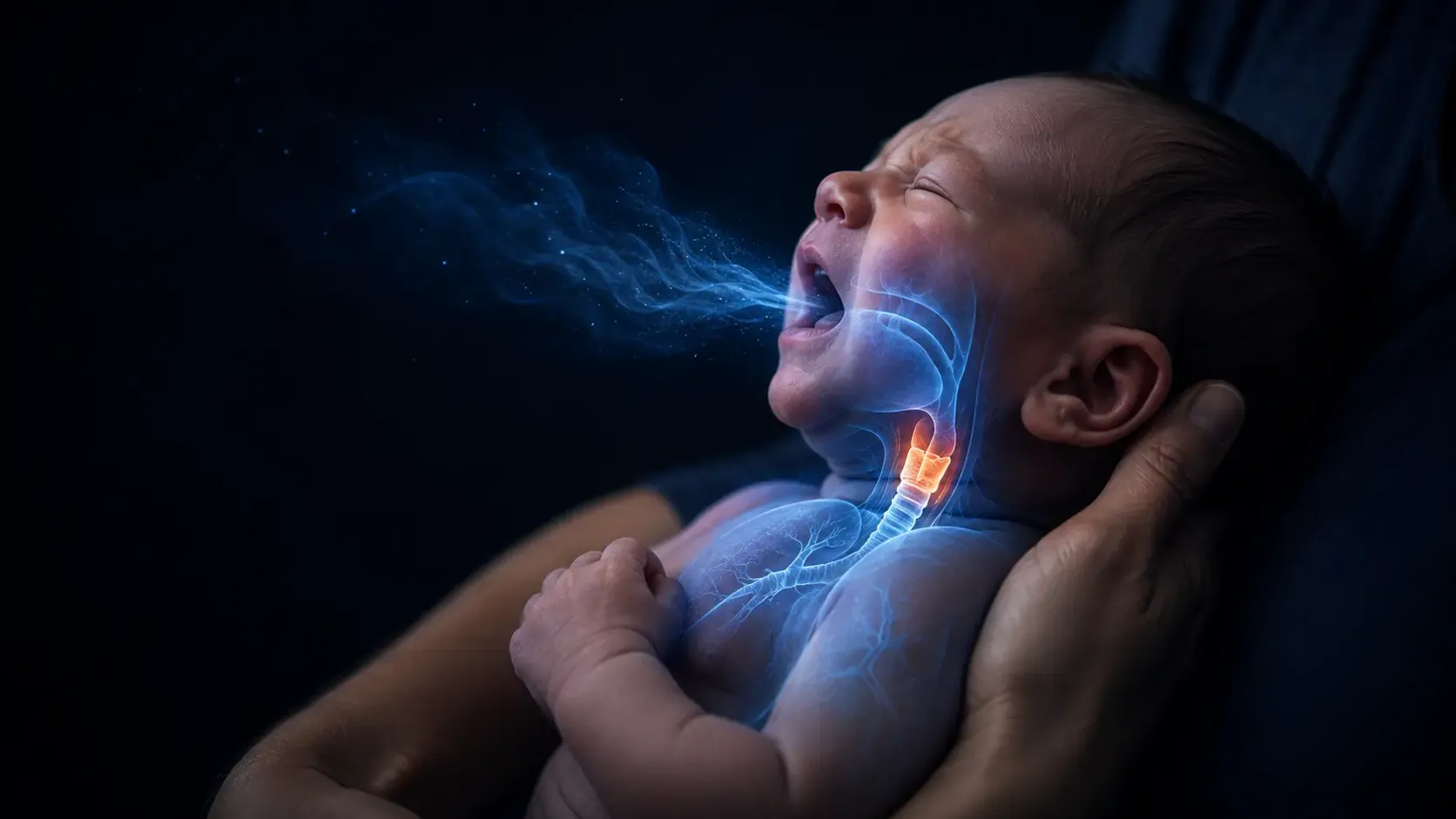
The physical sound begins when respiratory muscles move air from the lungs through the larynx. Vocal folds interrupt that airflow and create vibration. The throat, mouth and nasal spaces filter the sound, while changing muscle activity alters pitch, loudness and timing. The same basic instrument will later support speech, but early control is far less deliberate.
Brainstem circuits organize breathing and vocal output, and broader networks involved in arousal and emotion influence when the system activates. A baby who is becoming hungry or overloaded does not calmly choose a sound from a menu. A rising physiological state recruits a coordinated motor pattern that is highly effective at reaching another person.
Crying also changes the baby. Long exhalations, pauses, movement and sensory input from being picked up all feed back into the nervous system. Sometimes a caregiver can reduce the trigger quickly. At other times the arousal has gained momentum, so calming takes repeated, gentle regulation rather than one perfect maneuver.
Early crying follows development, not a simple parenting score
Many healthy infants cry more during the first weeks, often reaching a broad peak in early infancy before the amount gradually falls. Individual ranges are wide. Feeding patterns, sleep, temperament, sensory sensitivity, health and the surrounding environment all influence what a family experiences.
Several developmental changes arrive together. Wakeful periods become more organized, facial expression and non-cry vocalizations expand, and caregivers become better at recognizing the baby's patterns. Motor control and the capacity to shift attention also improve. Crying remains important, but it is no longer the only strong channel available.
A difficult evening therefore does not measure the quality of a parent-child bond. Healthy babies can cry even after reasonable needs have been checked, and caregivers can feel exhausted or frustrated without having failed. The safe response is to place the baby in a safe sleep space and step away briefly if an adult is becoming overwhelmed—never shake a baby.
The whole baby matters more than the sound alone
Most crying reflects ordinary needs or temporary dysregulation, but a sudden change deserves context. Trouble breathing, blue or gray color, marked weakness, a seizure, a bulging soft spot, repeated forceful vomiting, injury or a baby who is difficult to wake requires urgent medical assessment. Fever in a young infant also needs prompt guidance according to age and local medical advice.
Persistent crying accompanied by poor feeding, fewer wet diapers, unusual sleepiness or a caregiver's strong sense that something is wrong should be discussed with a pediatric professional. Audio alone cannot diagnose illness, and an online explanation cannot assess an individual infant.
The central mechanism is still reassuring: crying is not meaningless noise. It is a developmentally appropriate signal produced by a nervous system that depends on other people for regulation. Responding begins with safety and observation, not with decoding every sound perfectly.
From internal strain to caregiver response
Hunger, fatigue, discomfort or sensory overload changes arousal. Neural circuits recruit respiratory and laryngeal muscles, producing a graded sound whose intensity is hard for nearby adults to ignore.
The caregiver checks context, provides contact or meets a likely need. Warmth, movement, feeding or reduced stimulation can then alter sensory input and autonomic state, helping the infant return toward regulation.
The American Academy of Pediatrics describes crying as a way to call for help and manage overwhelming stimulation.
A review of infant crying characterizes it as a graded signal of distress rather than a precise cause label.
Why it matters
Understanding crying as communication reduces the pressure to discover one perfect translation. The aim is responsive, safe care while recognizing that some normal crying remains difficult to explain.
The same story shows how human development begins socially. Before infants can regulate many states alone, another person's body, attention and repeated response become part of the regulatory system.
Crying recruits regulation before language can request it.
It communicates distress powerfully but not with a one-sound, one-cause code. Context, safety and the baby's overall condition guide the response.
Research behind this story
We link to the primary study or an authoritative indexed review wherever possible. Caveats in the text reflect the limits of that evidence.
01