Quick answer
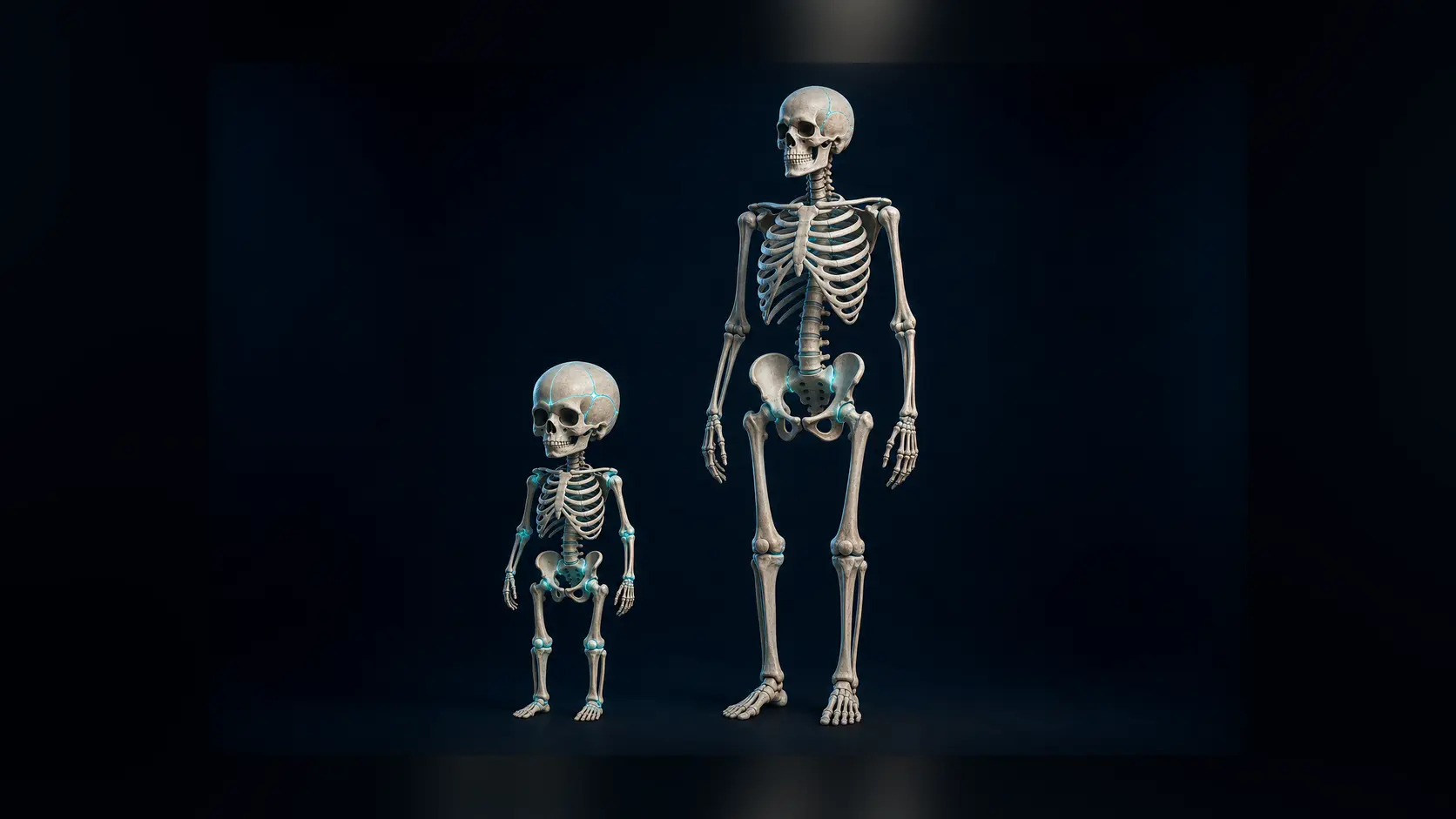
A newborn is often described as having about 270 bones, compared with about 206 in a typical adult. The difference is not a universal census: infant skeletons include many separately counted bony elements and ossification centers, while some structures are still largely cartilage. During growth, elements in the skull, pelvis, spine and long-bone ends unite into larger adult bones. Growth plates permit lengthening before the epiphysis and shaft fuse. Counts vary with age, anatomy and whether tiny accessory and sesamoid bones are included, so 270 and 206 are useful teaching approximations rather than exact numbers for every person.
Growing usually sounds like addition: more height, more muscle, more mass. The skeleton does something less intuitive. It begins with more separately counted pieces and turns many of them into fewer, larger structures.
That does not mean hundreds of finished miniature bones simply glue themselves together. Some structures are already bone at birth, some remain partly cartilage and many contain separate centers of ossification. The familiar count changes as development reorganizes those pieces.
The skeleton begins as a developmental framework
Most bones form through endochondral ossification. Cells first create a cartilage model, then blood vessels and bone-forming cells establish primary and secondary ossification centers. Bone gradually replaces much of the cartilage while the overall structure continues to grow.
Other bones, including much of the skull and part of the clavicle, form more directly within connective tissue through intramembranous ossification. Both routes produce living bone, but they begin from different templates.
At birth, ossification is far from finished. The ends of many long bones remain separated from the shaft by cartilage. Skull bones are separated by sutures and fontanelles that allow deformation during birth and make room for rapid brain growth.
Fusion turns separate pieces into adult bones
As a child grows, cartilage cells in growth plates multiply while bone is added behind them. This moves the ends of a long bone farther apart and lengthens the shaft. Near the end of growth, the cartilage is replaced and the epiphysis fuses with the shaft.
The pelvis offers a clear example of counting changing with development. The ilium, ischium and pubis begin as separate components on each side and meet around the hip socket. They fuse into the paired hip bones of the adult pelvis.
Skull development also reduces the number of separate elements. The frontal bone begins in two halves that usually unite, and other regions mature along sutures. The process balances protection with the need to accommodate a rapidly expanding brain.
The popular numbers are useful approximations, not identity tags. Adults can have accessory bones, fused variants or small sesamoid bones that alter a count. What matters biologically is the developmental direction: many separate regions become integrated structures.
The pelvis, spine and skull change the count in different ways
Each adult hip bone is one structure, but it develops from the ilium, ischium and pubis, which meet at the triradiate cartilage around the acetabulum. Fusion preserves a strong socket for the femoral head after the pelvis has expanded through childhood.
The sacrum begins as separate vertebrae and becomes a fused platform between the hip bones. The coccyx also commonly consists of segments that partly or completely unite. These changes reduce the number of separately named movable pieces without making material disappear.
In the skull, the story is not simply that every suture closes. Some elements unite, such as the two halves of the frontal bone in most children, while major cranial sutures remain fibrous joints for years and may stay visible through adulthood. Their early flexibility supports birth and rapid brain growth; their later architecture still allows the skull to distribute force.
Why the headline number is an estimate
Anatomical counting depends on definitions. A cartilage model is not yet the same as mineralized bone, and an ossification center can be counted as a developing element even though it will later become part of one named adult bone. Different references may therefore start from different totals.
Variation continues in adults. Sesamoid bones form within tendons, accessory ossicles may persist near joints, and some structures fuse differently among individuals. Even the familiar adult total of 206 describes a standard pattern rather than a biological rule.
The reliable answer to the search question is the mechanism, not a perfectly fixed subtraction: early skeletons contain more separate developmental components, and growth integrates many of them through ossification and fusion.
How a growing bone becomes one structure
Development uses temporary boundaries. Cartilage permits expansion, ossification centers build mineralized tissue and fusion closes the boundary when lengthening is nearly complete.
Different bones follow different schedules. Some skull regions unite in infancy, while certain growth plates and the clavicle can continue maturing into the early twenties.
An NCBI anatomy reference gives the common comparison of about 270 bones in infants and around 206 in adults.
Embryology references describe how ossification continues through growth and into early adulthood.
Why it matters
The changing count reveals that development is architectural. A body does not simply scale up; it changes how parts connect, where flexibility remains and how forces are distributed.
Doctors can use the appearance and fusion of ossification centers to estimate skeletal maturity, but that assessment requires appropriate imaging, context and professional interpretation.
Growing up means joining the skeleton as well as enlarging it.
Infants have more separately counted skeletal elements because development preserves flexible boundaries that later ossify and fuse into adult bones.
Research behind this story
We link to the primary study or an authoritative indexed review wherever possible. Caveats in the text reflect the limits of that evidence.
01