Quick answer
Newborns see best at close range and respond strongly to high contrast, edges, movement and face-like arrangements. Their visual acuity is much lower than an adult's, fine color discrimination is immature and the two eyes do not yet work together with adult precision. During the first year, rapid changes in the retina, pathways and visual cortex improve detail, tracking, color and depth perception. Individual development varies, so milestones are ranges rather than exact deadlines.
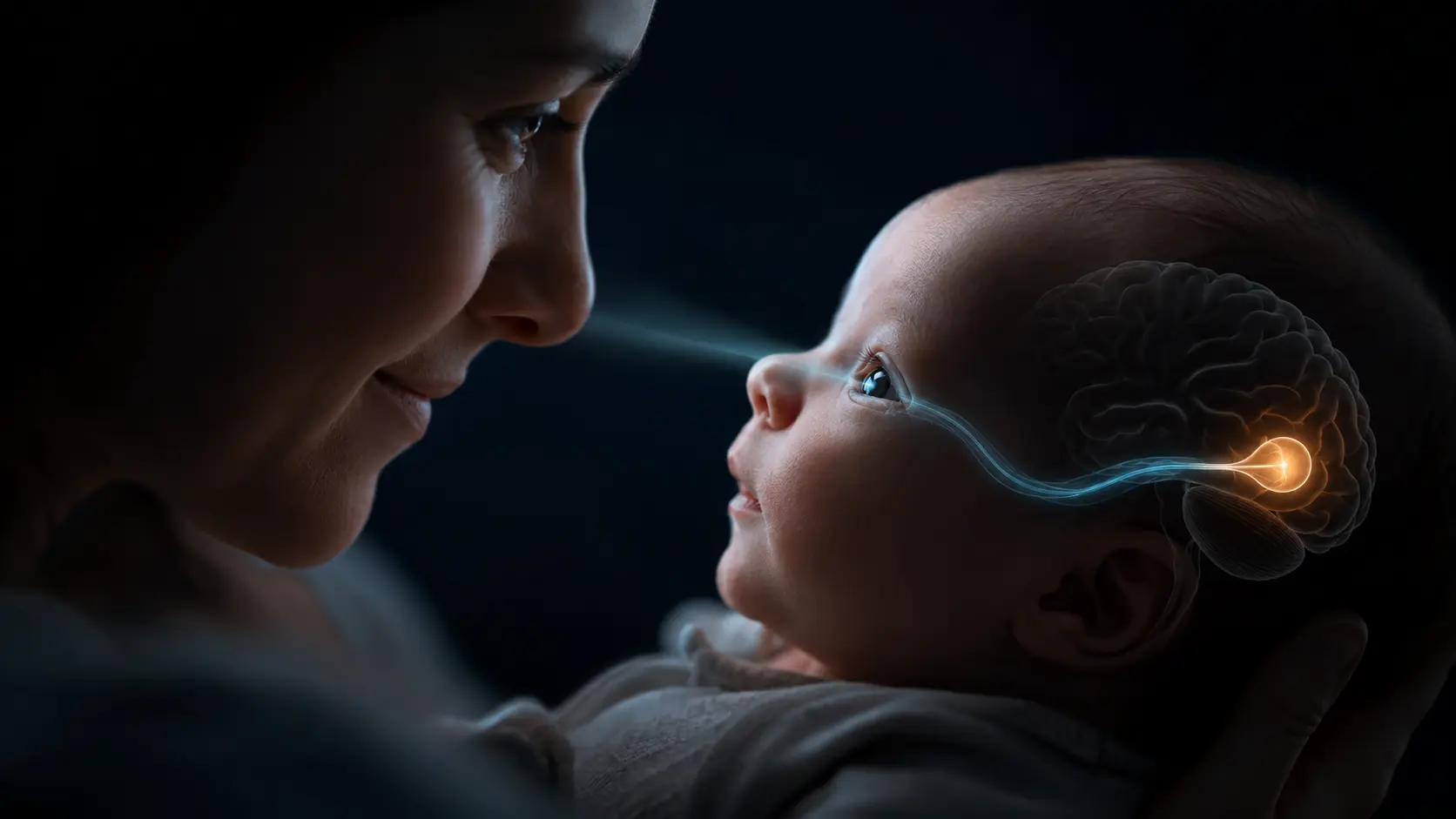
A newborn often settles on the face holding them, especially when it is close. That observation is more useful than the familiar claim that babies see only blur. Their vision is limited, but it is organized enough to guide attention, learning and social contact from the beginning.
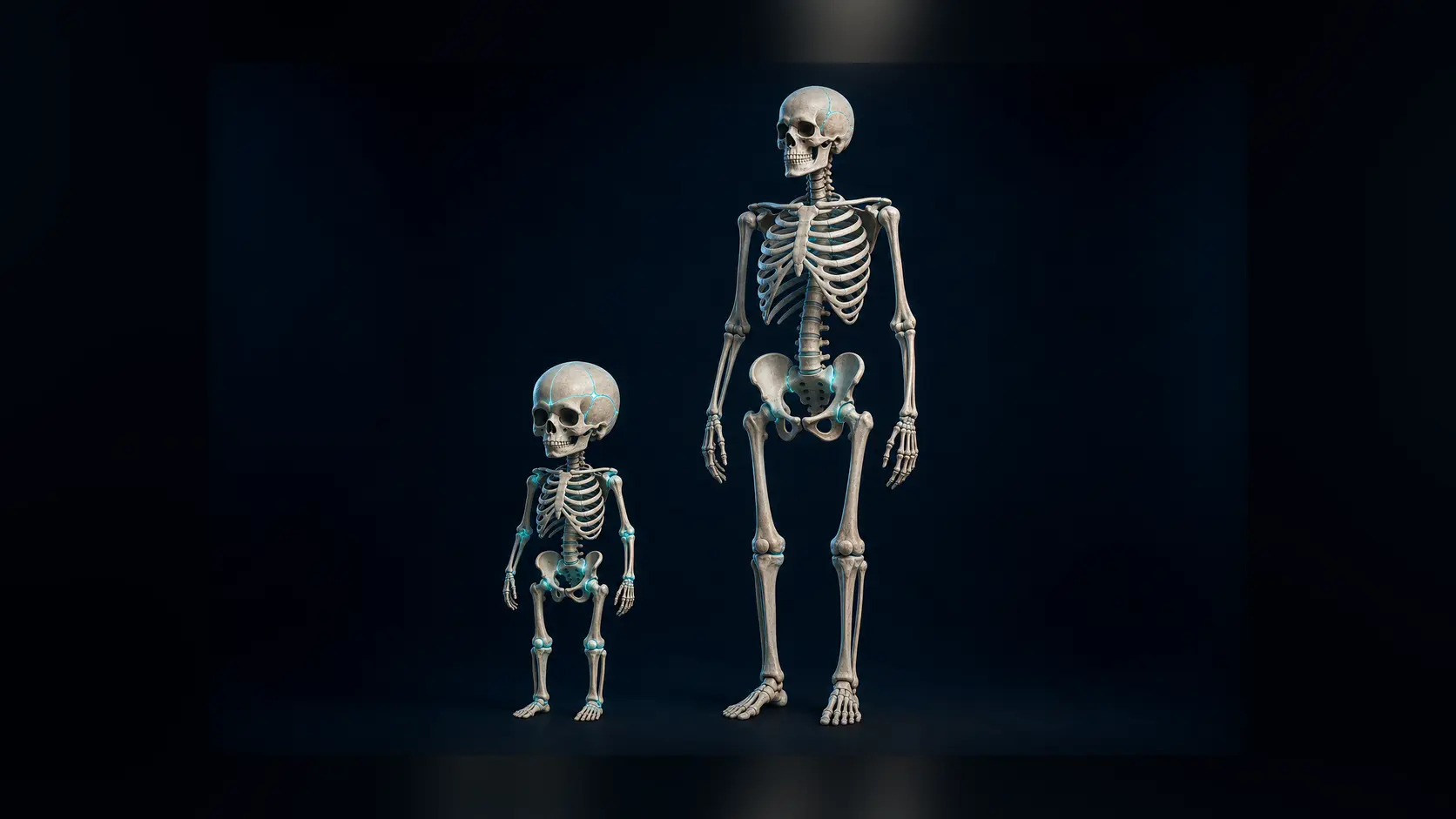
The eyes, optic pathways and visual cortex continue maturing after birth. Acuity improves, color discrimination expands, the two eyes coordinate more precisely and the brain learns which visual patterns matter. Development is a sequence, not a switch that suddenly turns clear vision on.
The image arrives before the system is finished
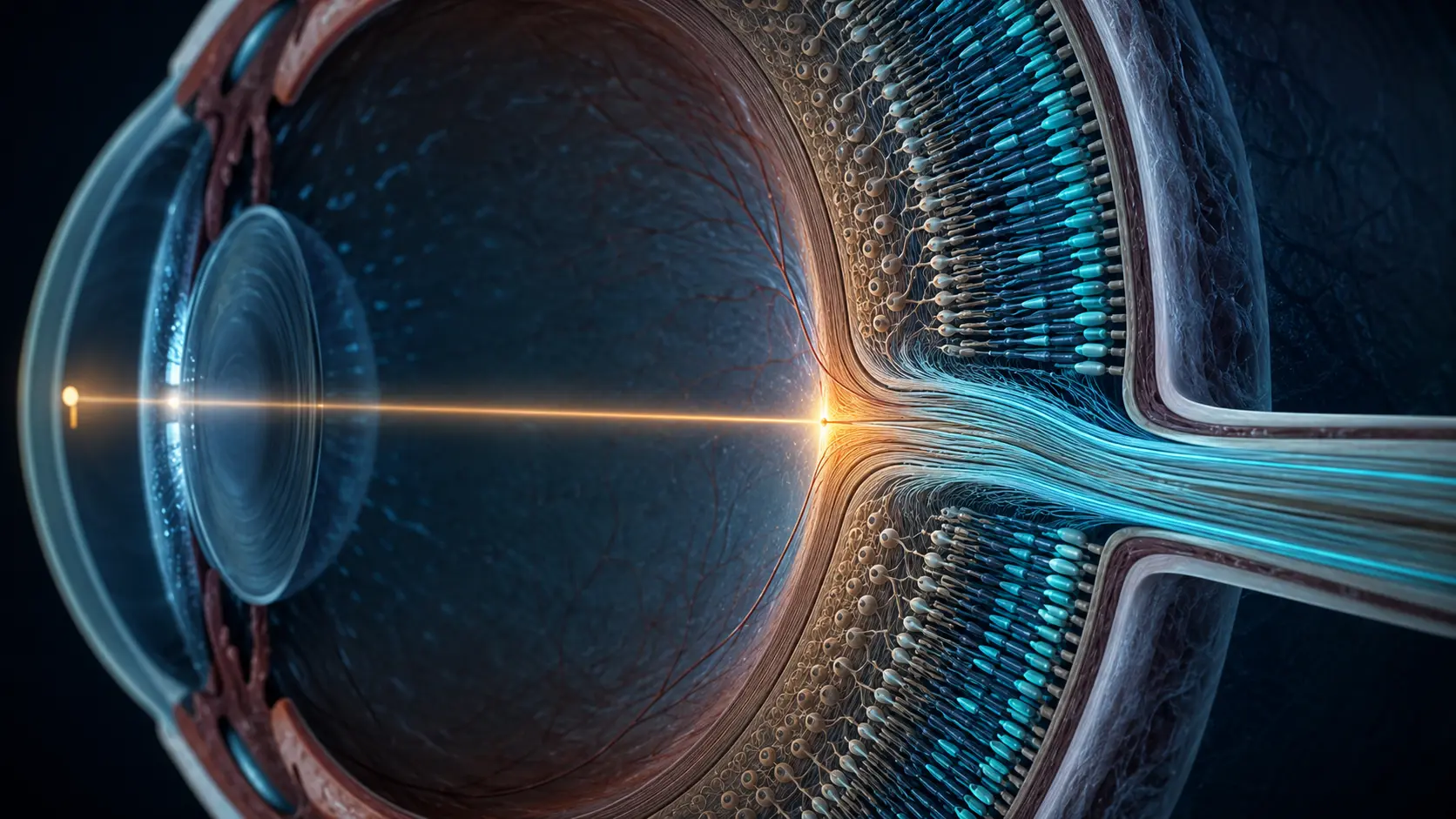
Light already forms an image on the newborn retina. Photoreceptors convert it into electrical signals, retinal circuits extract contrast, and the optic nerves carry information toward the brain. The basic route exists; its sampling, wiring and interpretation are still being refined.
Newborn acuity is commonly estimated as far poorer than adult acuity. Fine stripes merge together, while broad borders remain detectable. That is why bold changes between light and dark attract attention more reliably than delicate detail. The often-quoted distance of roughly a caregiver's face during feeding is a practical description, not a hard boundary beyond which nothing is visible.
Face preference begins with simple structure. Newborns orient toward top-heavy, face-like patterns and soon learn familiar faces. This does not mean they inspect every feature as an adult would. Low spatial detail, movement, outer contours and repeated exposure can all help recognition.
Experience helps tune a growing pathway
The fovea, the retinal region responsible for sharp central vision, continues developing after birth. Photoreceptors become more densely packed and their shape changes. Myelination and synaptic organization improve signal transmission, while visual cortex circuits become more selective for orientation, motion and binocular information.
Color vision also develops in stages. Newborns can discriminate some chromatic differences under suitable conditions, but thresholds and the range of reliably separated colors improve over the following months. Statements that newborns see only black and white flatten a more gradual process.
The two eyes occasionally wander because alignment and binocular control are immature. Persistent crossing, an eye that consistently turns, a white pupil in photographs, unusual light sensitivity or failure to track faces should be discussed promptly with a clinician. Early development is adaptable, which also makes timely assessment important when input from one eye is disrupted.
How early visual experience becomes sharper sight
The retina captures coarse contrast and motion, then developing pathways deliver the signal to visual cortex. Repeated, structured input helps stabilize useful connections while the eye's optics, retinal sampling and neural timing mature.
Binocular circuits compare the two views and gradually support more reliable depth judgments. The result is not a passive lens coming into focus; it is coordinated biological growth and activity-dependent calibration across the eye and brain.
A clinical review summarizes the rapid development of acuity, color, motion and binocular vision in infancy.
Research on early face perception examines what newborn preferences can and cannot establish.
Try it yourself
Meet vision where it is developing.
- Hold a calm, alert baby securely with your face nearby.
- Move slowly from side to side and watch for brief tracking rather than demanding sustained attention.
- Use ordinary faces and safe high-contrast objects; no special visual-training product is required.
Development varies. If you are concerned about a baby's eyes or visual responses, ask a pediatric or eye-care professional rather than relying on a home test.
Why it matters
Understanding the real limits prevents two errors: assuming newborns see nothing meaningful and expecting adult-like performance too soon.
Early vision also shows why developmental care matters. Clear input from both eyes during sensitive periods helps the brain build balanced visual pathways.
A newborn sees a useful, low-detail world.
Nearby contrast, movement and faces are visible from the start. Detail, color, depth and eye coordination improve as the eyes and brain mature together.
Research behind this story
We link to the primary study or an authoritative indexed review wherever possible. Caveats in the text reflect the limits of that evidence.
01