
Quick answer
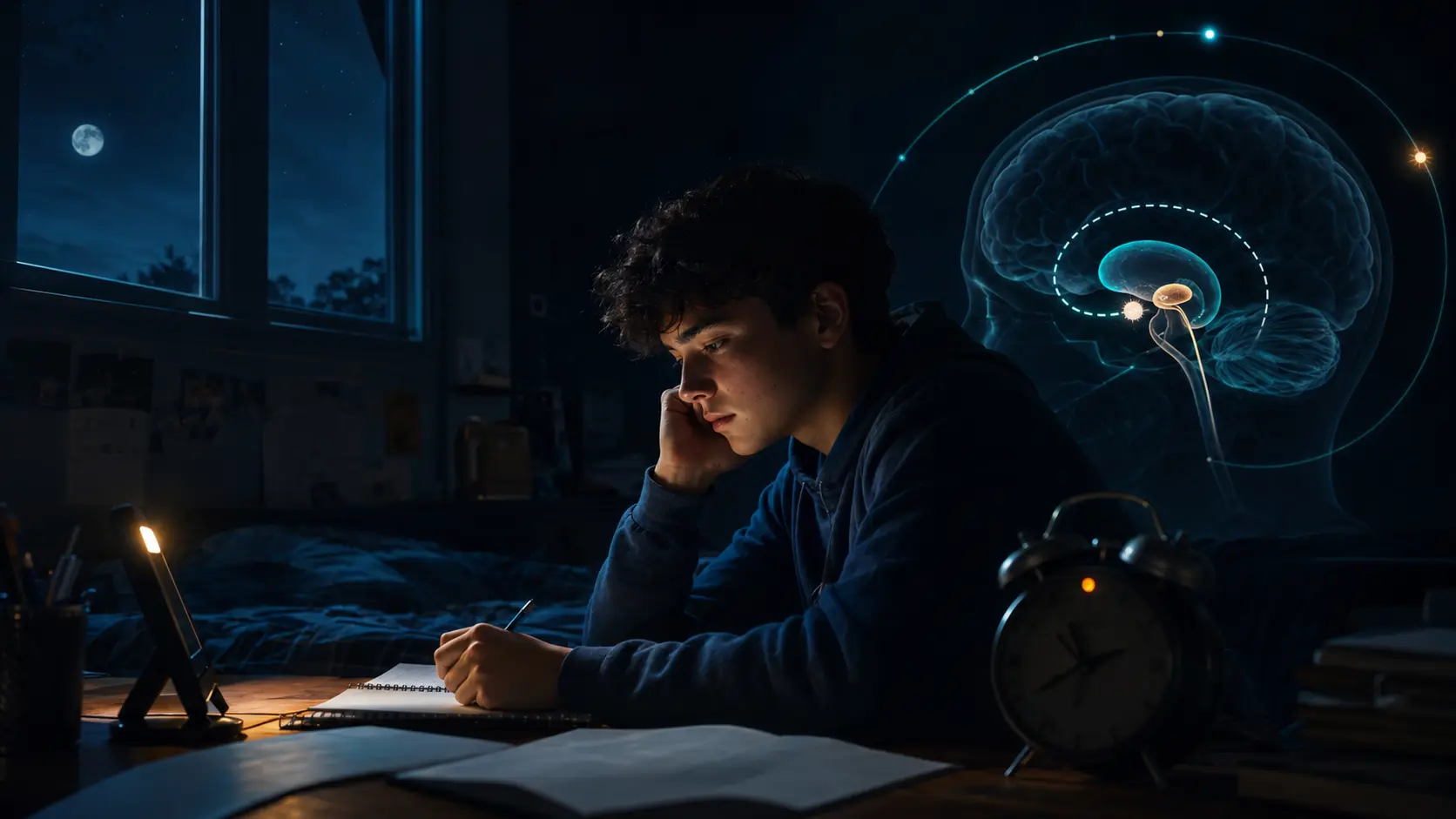
Teenagers tend to fall asleep and wake later because puberty delays circadian timing and changes how sleep pressure accumulates. Evening light, stimulating activities and irregular schedules can push the delay further, while early school start times force waking before enough sleep has occurred. Adolescents still generally need substantial sleep. The result is often a mismatch between biology and obligations, not laziness. Consistent timing, morning light and a darker, calmer evening can help, but cannot fully erase the developmental shift.
A teenager can be exhausted at seven in the morning and genuinely alert near midnight. It is tempting to describe the pattern as bad discipline. Screens, homework and social schedules matter, but adolescence also changes the biology that sets sleep timing.
Two systems work together: a circadian clock that places sleep within the day and a homeostatic pressure that rises across time awake. During puberty, the clock tends to shift later and sleep pressure may accumulate differently. An early alarm can then remove sleep from the biological night rather than simply ending a chosen late morning.
Two clocks must agree before sleep comes easily
Sleep pressure builds while a person is awake and falls during sleep. The circadian system, coordinated by the suprachiasmatic nucleus, supplies a daily alerting rhythm and helps time melatonin. Sleep begins most easily when high pressure meets the circadian night.
Adolescent studies consistently find later preferred and measured sleep timing compared with childhood. Melatonin onset can occur later, and the evening alerting signal may remain strong. At the same time, the buildup of homeostatic sleep pressure appears slower in more mature adolescents, allowing wakefulness to continue longer.
That biology operates inside a powerful environment. Bright evening light delays the clock, and phones can contribute through both light and engaging content. Weekend sleeping-in provides recovery but can move timing still later, making Monday resemble travel across time zones.
The problem appears in the morning
Most teenagers cannot simply start sleeping two hours earlier on command. Going to bed before the circadian system permits sleep can produce long wakeful periods. If school begins early, the fixed wake time shortens the night while the delayed clock stays in place.
Chronic short sleep affects attention, learning, mood, driving safety and metabolic health. These are population-level associations with many contributing factors, not a diagnosis from one late weekend. Still, the consistency of the pattern is why pediatric and sleep organizations have supported later secondary-school start times.
Practical support targets timing rather than blame: a reasonably stable wake time, outdoor morning light, dimmer evenings, caffeine kept away from late day and enough time in bed. Persistent insomnia, severe daytime sleepiness, loud snoring or major mood changes call for professional assessment because other sleep and health conditions can coexist.
How puberty creates a later sleep window
Development shifts the circadian phase and appears to change the rate at which sleep pressure rises. Evening light and social activity reinforce wakefulness, while an early alarm advances behavior without necessarily advancing the internal clock.
Repeated early waking then creates sleep debt. Weekend recovery relieves some pressure but may further delay timing, locking the adolescent into a weekly cycle of biological and social time zones.
A foundational review details the adolescent changes in circadian timing and sleep homeostasis.
School-schedule research describes the consequences of early starts during a delayed developmental phase.
Try it yourself
Measure timing before trying to fix it.
- Record bedtime, estimated sleep time and wake time for seven days.
- Note morning outdoor light, late caffeine and major weekend shifts.
- Aim first for a consistent schedule that allows enough sleep, then adjust in small steps.
This is an observation, not treatment. A healthcare professional can help with persistent sleep or breathing problems and major daytime impairment.
Why it matters
Treating a biological mismatch as a character flaw can hide workable changes at home, school and community level.
Sleep timing also influences safety and learning. A schedule that acknowledges adolescent physiology can improve the opportunity to arrive awake rather than merely present.
Teen sleep runs later, but the need for sleep does not disappear.
Puberty shifts circadian timing and sleep pressure. Evening habits can amplify the shift; early obligations turn it into chronic sleep loss.
Research behind this story
We link to the primary study or an authoritative indexed review wherever possible. Caveats in the text reflect the limits of that evidence.
01