Quick answer
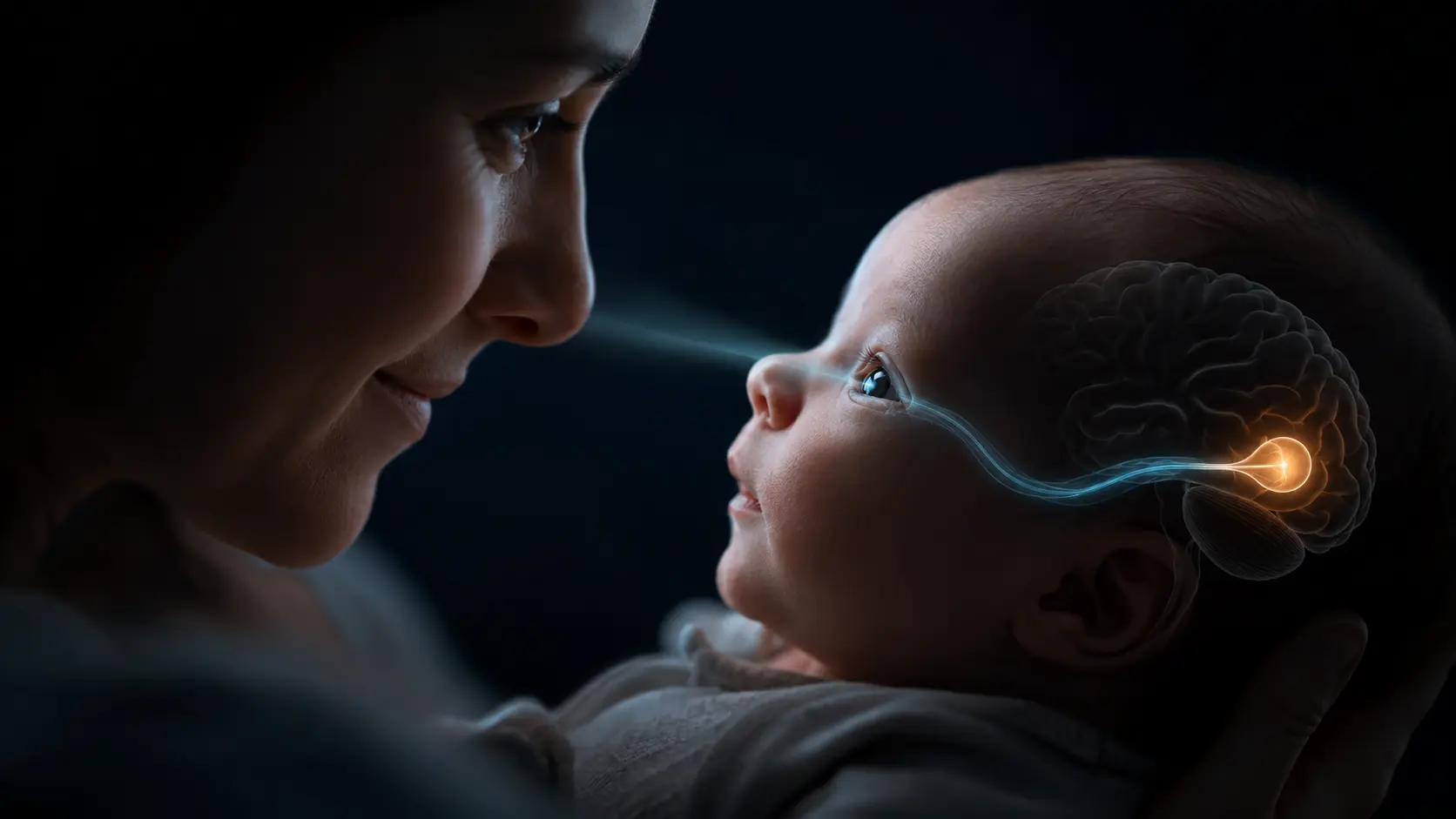
People cannot usually recall infancy because autobiographical memory depends on several systems that are still developing: hippocampal networks, language, a stable sense of self, narrative organization and social rehearsal. Infants can learn and retain information, but early memories may be encoded in forms that later retrieval systems cannot easily access. Rapid brain development and high rates of forgetting also contribute. There is no single birthday when memory starts; the boundary shifts gradually and varies across people and cultures.
Your first steps may exist in a family video and in stories repeated at dinner, yet the original experience is unavailable. Most adults have few autobiographical memories before about age three and patchy memories for several years after that.
The gap is called childhood or infantile amnesia. It does not mean babies are unable to learn or remember. They recognize caregivers, learn patterns, acquire skills and retain some events. The mystery concerns why those early episodes become so difficult to retrieve as a continuous personal past.
Learning survives even when autobiography does not
Memory includes many abilities. Procedural memory supports learned actions, semantic memory supports facts, and recognition can identify familiar people and objects. Autobiographical memory binds an event to a self, time, place and narrative. Losing access to one kind does not erase the others.
Infants demonstrate retention in age-appropriate experiments, including learned actions and responses over delays. Young children also report real events. Longitudinal studies show that these early reports become harder to retrieve as children grow, suggesting unusually rapid forgetting rather than complete failure to encode.
Adults' earliest memories are often fragments—an image, location or emotion—rather than full narratives. Dating is uncertain and family stories can become incorporated. A vivid scene may be authentic, reconstructed, or a mixture; confidence alone cannot prove its origin.
The remembering mind changes its format
The hippocampus and its connections mature over a long period. Studies in young children link changes in hippocampal structure and connectivity with differences in episodic-memory detail. Animal work also suggests that high early neurogenesis can make established memory patterns harder to retrieve as new neurons are integrated. How strongly that mechanism explains human childhood amnesia remains unsettled.
Language gives events labels, sequence and a form that can be rehearsed. A developing self-concept supplies the person to whom the event happened. Conversation with caregivers teaches children how to organize experience into a story. Memories encoded before those systems stabilize may not match the cues an older child uses to search.
Culture influences the average timing and content of earliest memories through conversational style and emphasis on personal experience. Elaborative caregiver conversations—asking for detail and connecting causes, feelings and sequence—are associated with richer later recall. That variation argues against a single anatomical switch. Childhood amnesia emerges from brain maturation, changing cognition and the social practice of remembering together.
The boundary is a slope, not a sealed wall
Adults often place their earliest memory somewhere around ages three to four, but the distribution is wide. Very few memories survive from the first two years, and recollection remains sparse through the preschool period before becoming denser.
The apparent boundary also moves as children age. A seven-year-old may report events from age three that the same child can no longer retrieve several years later. Prospective studies therefore show childhood amnesia developing through continued forgetting, not appearing all at once on a birthday.
People can know that an early event happened without re-experiencing it. Photographs, family stories and repeated facts may create semantic knowledge or a reconstructed scene. That is different from proving continuous episodic recall from infancy.
Early experience can matter without becoming a life-story scene
Infants retain skills, preferences, familiar voices and learned expectations on age-appropriate timescales. Emotional and perceptual learning can shape later behavior even when the original learning episode cannot be consciously narrated.
Researchers debate whether some inaccessible early traces remain latent and can influence later learning. Evidence from animals and indirect human measures makes persistence plausible, but it does not provide a method for recovering an accurate hidden movie of infancy.
That distinction protects two established findings at once: babies possess working memory systems, and adults generally lack reliable autobiographical access to infancy. Childhood amnesia describes the bridge between those facts rather than denying either one.
How a real early event becomes hard to retrieve
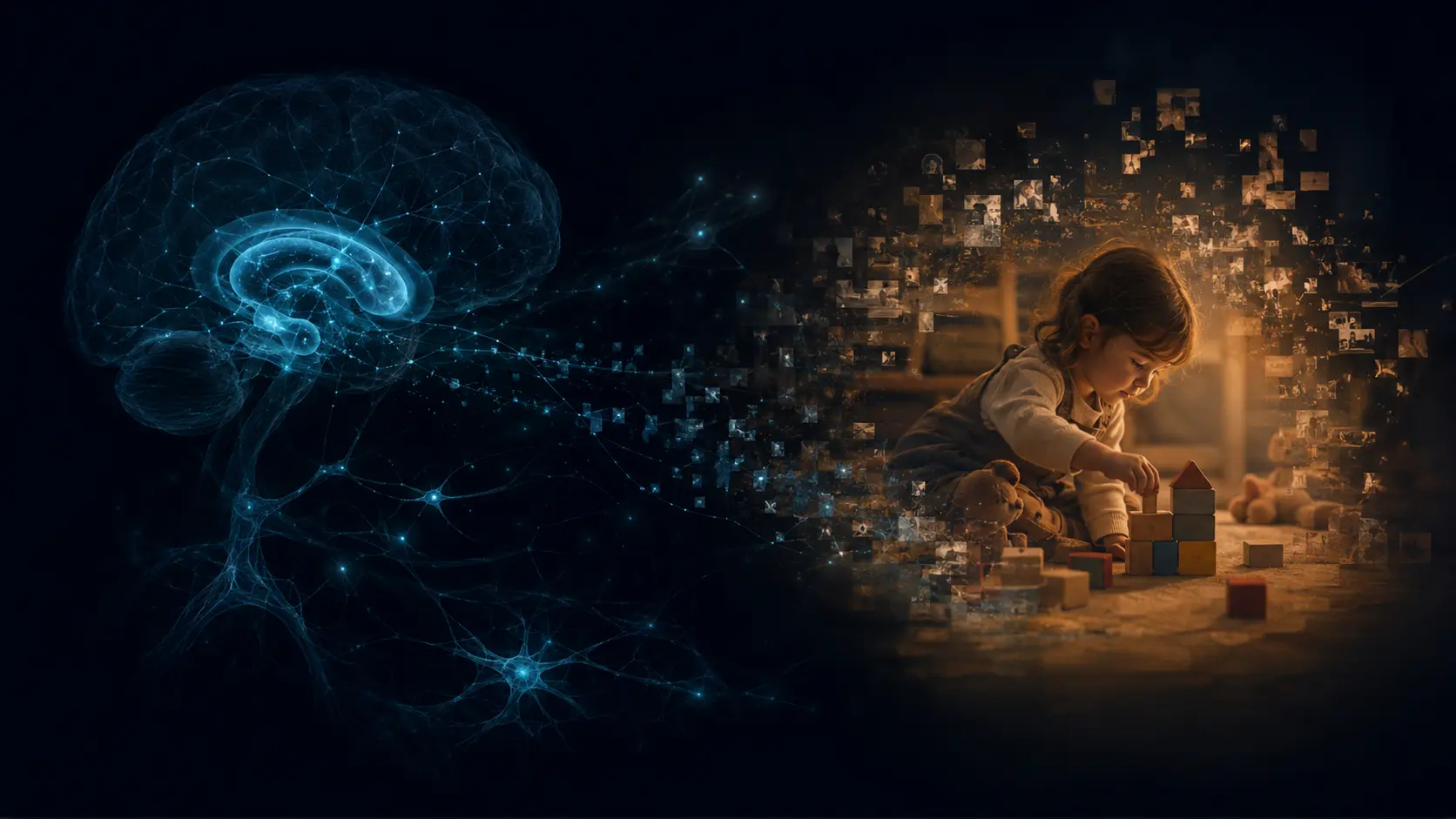
An infant encodes parts of an event using the memory systems available at the time. The brain then reorganizes rapidly, language expands and a more stable autobiographical self develops. Retrieval cues used years later may no longer match the original representation.
Without repeated, compatible cues, the trace weakens or becomes inaccessible. Family conversation can preserve elements, but it can also supply later details, which is why early-memory claims require humility rather than certainty.
Longitudinal work tracks how children's earliest memories move forward and disappear.
A developmental synthesis connects autobiographical memory with language, self and social conversation.
Why it matters
The phenomenon separates learning from conscious life-story recall. Experiences can shape attachment, expectation and skill without remaining as adult-accessible scenes.
It also cautions against treating vividness as a timestamp. Human memory reconstructs the past from traces, knowledge and retelling rather than replaying a protected recording.
Infancy is learned, but rarely remembered as autobiography.
Early memories are formed while the brain, language and sense of self are changing quickly. Later retrieval often cannot reach that earlier format.
Research behind this story
We link to the primary study or an authoritative indexed review wherever possible. Caveats in the text reflect the limits of that evidence.
01