Quick answer
Bacteria are single-celled organisms with membranes, ribosomes, metabolism and the ability to reproduce by cell division. Many live harmlessly or beneficially in and around us; some cause disease. Viruses are much smaller infectious particles made of DNA or RNA inside a protein coat, sometimes with a lipid envelope. They reproduce only by entering compatible host cells and redirecting cellular machinery. Antibiotics can treat selected bacterial infections, but they do not work on viruses. Antiviral drugs and vaccines target specific stages or structures, so prevention and treatment depend on the particular pathogen.
A sore throat can come from a bacterium or a virus, yet the two agents are separated by an enormous biological divide. A bacterium is a cell that takes in material, makes proteins and divides. A virus is genetic information inside a protective shell, sometimes wrapped in membrane, with no independent machinery for reproduction.
Symptoms alone often cannot reveal which one is responsible. Laboratory tests, the pattern of illness and clinical context may be needed. That matters because a drug aimed at bacterial ribosomes or cell walls has no equivalent target in a virus.
One is a cell; the other is a dependent genetic package
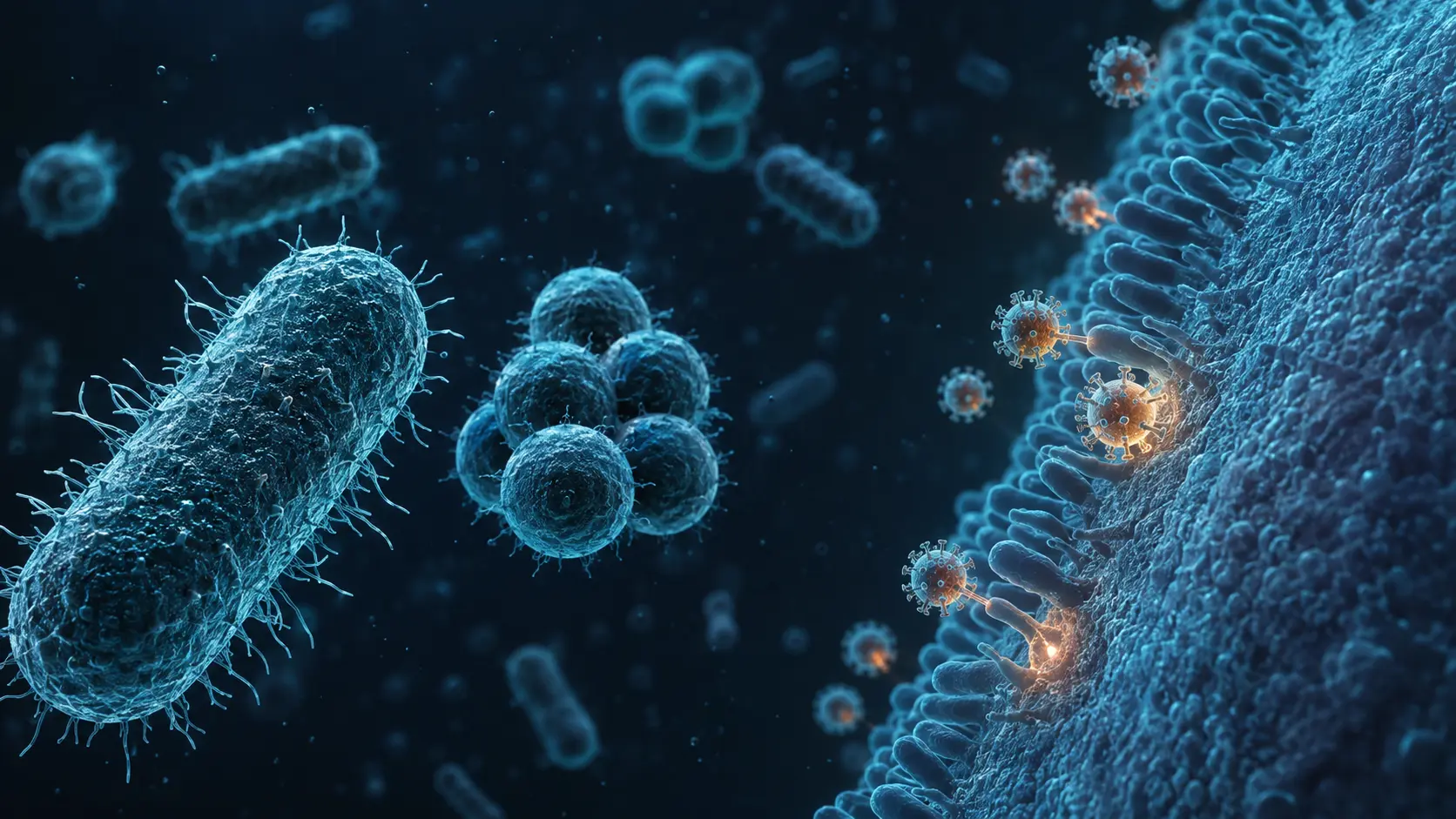
Most bacteria contain a chromosome, ribosomes and enzymes within a cell membrane; many also have a cell wall. They can sense conditions, use nutrients and divide on their own when the environment permits. Their shapes and lifestyles are diverse rather than variations on one disease-causing plan.
A virus has a genome and capsid. Enveloped viruses also carry a membrane acquired from a host cell. They do not make ATP, translate proteins or divide. Outside a suitable cell, a virion is a transmission package rather than a metabolically active organism.
The boundary of life is partly definitional, so whether viruses are 'alive' remains philosophical as well as biological. The experimentally stable point is that viral replication depends on host-cell machinery in a way bacterial division does not.
Their routes to more copies have different weak points
A bacterium generally grows and splits by binary fission. Antibiotics exploit bacterial features such as peptidoglycan cell walls, ribosomes or DNA-copying enzymes. Selectivity is possible because those targets differ from human counterparts.
A virus attaches to a compatible receptor, enters or delivers its genome, uses host resources to produce components, assembles new particles and exits. Antivirals may block attachment, genome copying, viral enzymes or release, but a target useful for one viral family may be absent in another.
Resistance can evolve in both groups. Susceptible variants are removed while resistant ones survive and spread. Correct drug choice, dose and duration are therefore public-health issues as well as individual treatment decisions.
The body can respond similarly to very different invaders
Fever, fatigue, swelling and mucus often come partly from immune signaling rather than direct microbial damage. That is why a bacterial and viral respiratory infection can feel alike. Color of mucus alone does not reliably identify the cause.
Bacteria can release toxins, invade tissue or trigger damaging inflammation. Viruses may kill infected cells, disrupt their function or provoke immune injury. Some infections remain localized; others spread through blood, lymph or nerves.
Many bacteria are normal members of the microbiome, and many viruses never cause severe disease. 'Bacteria are bad' and 'viruses are always dangerous' erase the ecology needed to understand real risk.
Treatment follows the organism, not the label 'infection'
Antibiotics do not shorten colds, influenza or other viral illnesses. Unnecessary use can cause side effects, disturb helpful microbes and select resistant bacteria. When a bacterial infection is suspected, clinicians may use examination, cultures, antigen tests or molecular tests to guide care.
Vaccines can prepare immunity against both bacterial and viral pathogens, but each vaccine presents specific antigens. Antivirals are likewise pathogen-specific. Supportive care can matter for either type while the immune system clears the infection.
This explainer cannot identify an infection from symptoms. Severe breathing difficulty, confusion, dehydration, persistent high fever or rapid worsening requires medical assessment rather than an online bacteria-versus-virus guess.
Why the drug target changes
A bacterial cell carries biochemical machinery that can be selectively disrupted. A virus carries fewer independent components and relies on a host cell.
Effective treatment must hit a feature essential to the pathogen without unacceptable damage to human tissue.
CDC guidance explains when antibiotics help and when they cannot.
Why it matters
The distinction explains why antibiotics cannot treat viral infections and why testing can change clinical decisions.
It also replaces the idea that every microbe is harmful with a more accurate ecological view.
Same word— infection; different biology.
Bacteria reproduce as cells. Viruses replicate through host cells. Prevention and treatment must match that machinery.
Research behind this story
We link to the primary study or an authoritative indexed review wherever possible. Caveats in the text reflect the limits of that evidence.
01