
Quick answer
Vision remains broadly stable during rapid eye movements because the brain treats a self-generated retinal shift differently from movement in the outside world. Around each saccade, sensitivity to some visual signals is reduced, limiting the perception of blur. A corollary discharge—an internal copy of the eye-movement command—helps visual areas predict how locations will change, while attention and memory preserve selected object information across the interruption. No single mechanism perfectly cancels the movement, and carefully timed experiments reveal brief distortions and missed displacements that ordinary viewing hides.
Look from one word on this page to another. Your eyes just made a saccade: a fast rotation that dragged the entire retinal image across the back of each eye. Yet you probably saw no smear and felt no lurch in the room.
Visual stability is not produced by freezing the eyes. It emerges from several partial solutions—reduced sensitivity during the movement, advance information about the motor command and a rapid comparison between the scene before and after the jump.
Saccades trade continuous detail for rapid sampling
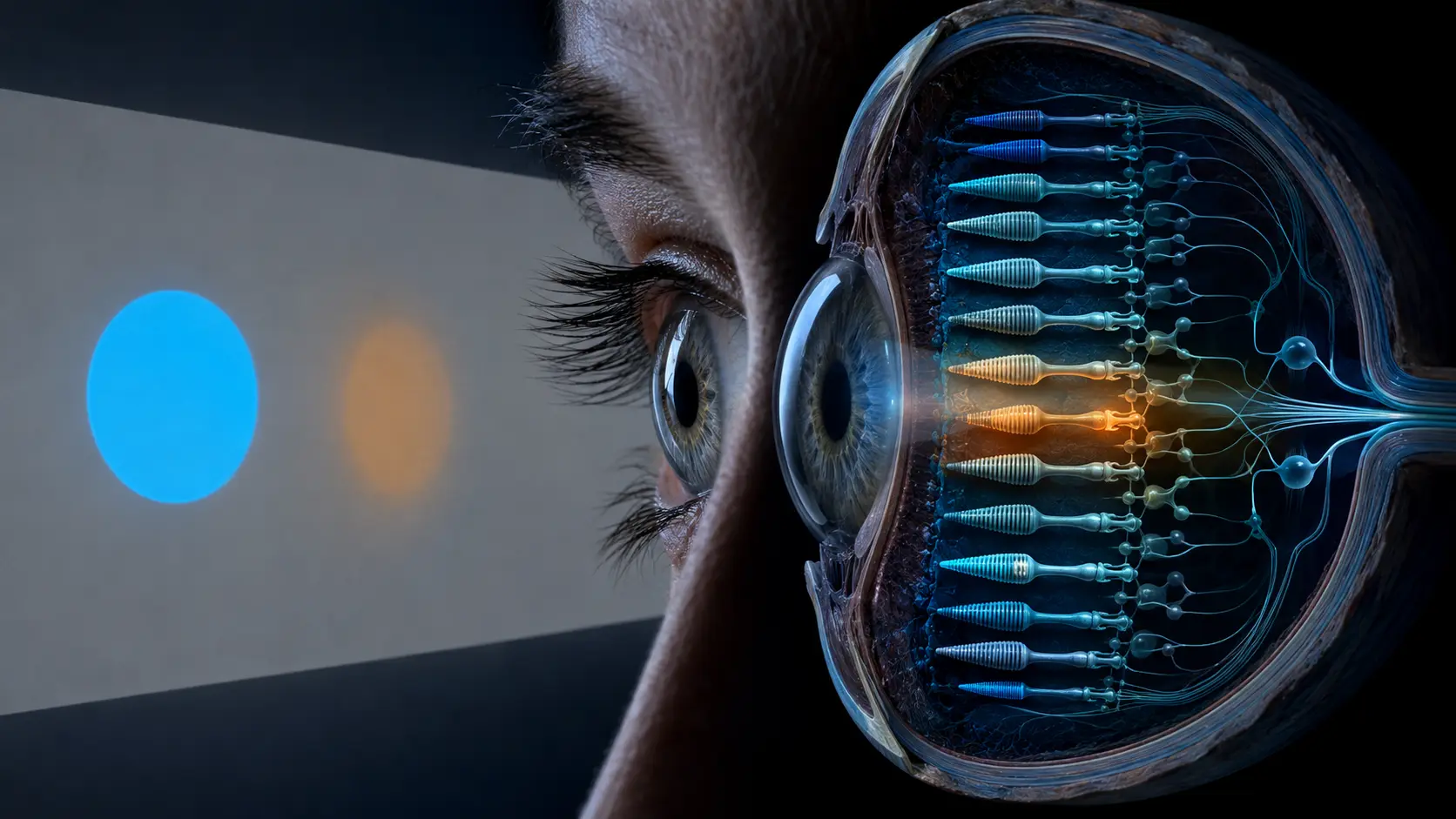
High-acuity vision is concentrated near the fovea, a small retinal region. To inspect a face, sentence or room, the eyes make several saccades per second so different details land there. Between jumps, brief fixations provide most of the useful fine-grained input.
A typical saccade is fast enough that the retinal image sweeps across photoreceptors in a fraction of a second. If an external camera moved the same way while recording, the result could be obvious blur. The visual system, however, knows when it ordered the movement.
Sensitivity falls around the time of a saccade, especially for low-spatial-frequency changes that would make broad motion conspicuous. This saccadic suppression begins before the eyes finish moving, showing that it cannot be explained only by blur on the retina.
A copy of the movement command predicts the shift
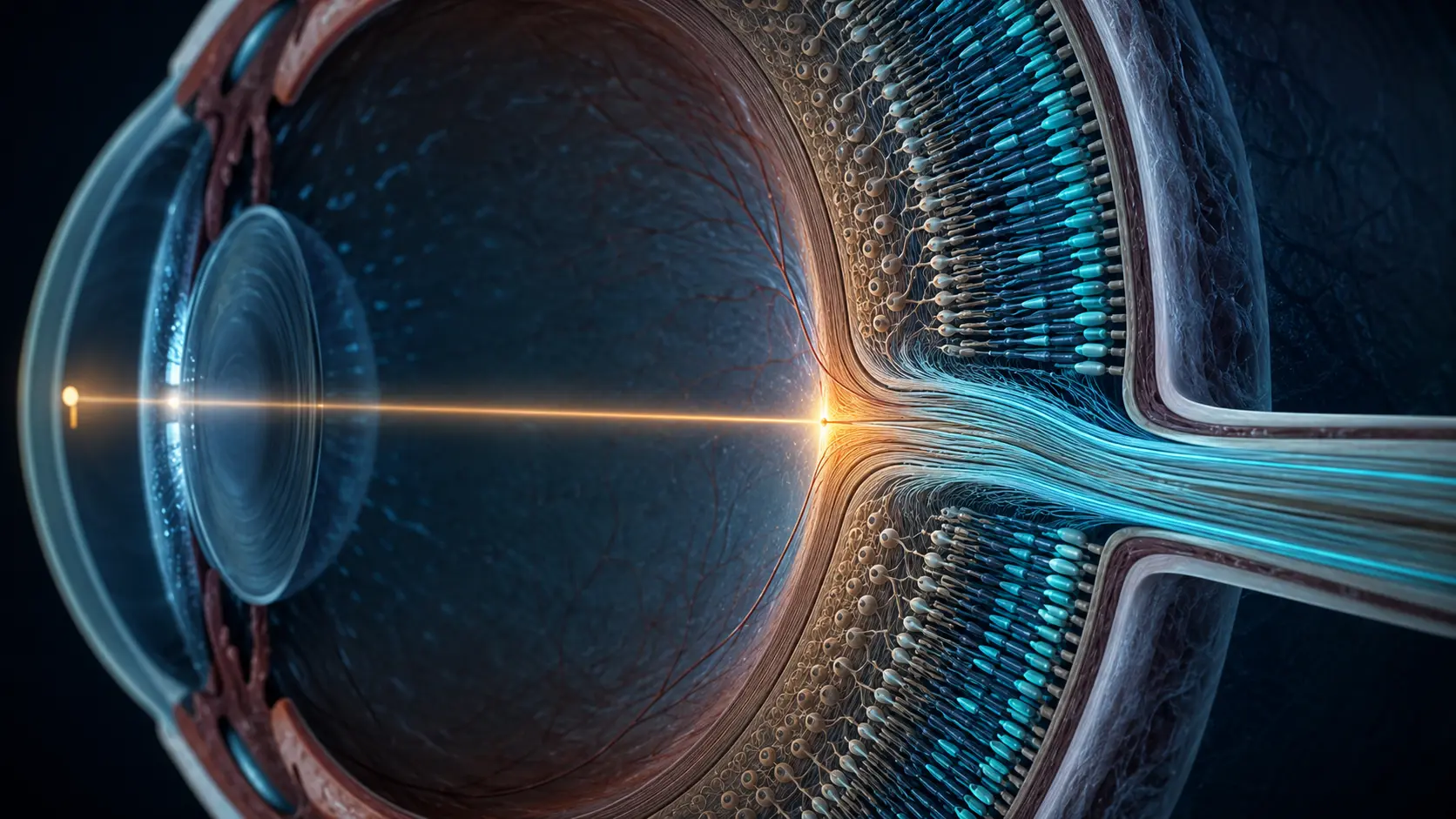
Motor systems can send corollary discharge to sensory circuits alongside the command sent to eye muscles. Experiments in primates have identified a pathway involving the superior colliculus, mediodorsal thalamus and frontal eye field that carries information relevant to upcoming saccades.
Before the eye lands, some visual neurons change which region of space influences them—a phenomenon called predictive remapping. The precise contribution of remapping remains debated, but the broader evidence supports internal movement information as one ingredient in stable perception.
The signal is useful rather than infallible. When researchers briefly move a target during the saccade, people often miss the displacement. Larger changes, meaningful targets and information available after landing can make the movement easier to detect.
Attention and memory bridge the before-and-after views
The brain does not retain a pixel-perfect photograph of the entire pre-saccadic scene. Instead, selected objects—especially the saccade target—receive priority. Their identity and expected location can be compared with new input after fixation.
That selective continuity helps explain change blindness: substantial alterations can go unnoticed when a visual disruption masks the transient signal and attention was not protecting the changed item. Stable experience therefore coexists with limited detailed memory.
Multiple accounts remain active in research. Suppression, corollary discharge, remapping, object correspondence and learned assumptions about a generally stable world probably contribute in different proportions. The settled fact is the problem itself; the exact division of labor is still being refined.
Across one rapid glance
An eye-movement command launches a saccade while visual sensitivity to some motion signals falls. An internal copy provides advance information about the direction and size of the movement.
After the eyes land, attended features and the new retinal input are matched. Usually the simplest interpretation is that the eyes moved while the world stayed put.
A major review describes how corollary discharge and neuronal responses contribute to visual stability across saccades.
Why it matters
Visual stability reveals perception as active inference coordinated with movement, not a continuous camera feed.
It also marks a scientific boundary: everyday stability is robust, but laboratory timing exposes compression, mislocalization and missed change rather than perfect internal cancellation.
A stable world is reconstructed across tiny visual gaps.
Suppression reduces the smear, motor prediction anticipates the shift, and attention links selected objects before and after each saccade.
Research behind this story
We link to the primary study or an authoritative indexed review wherever possible. Caveats in the text reflect the limits of that evidence.
01