
Quick answer
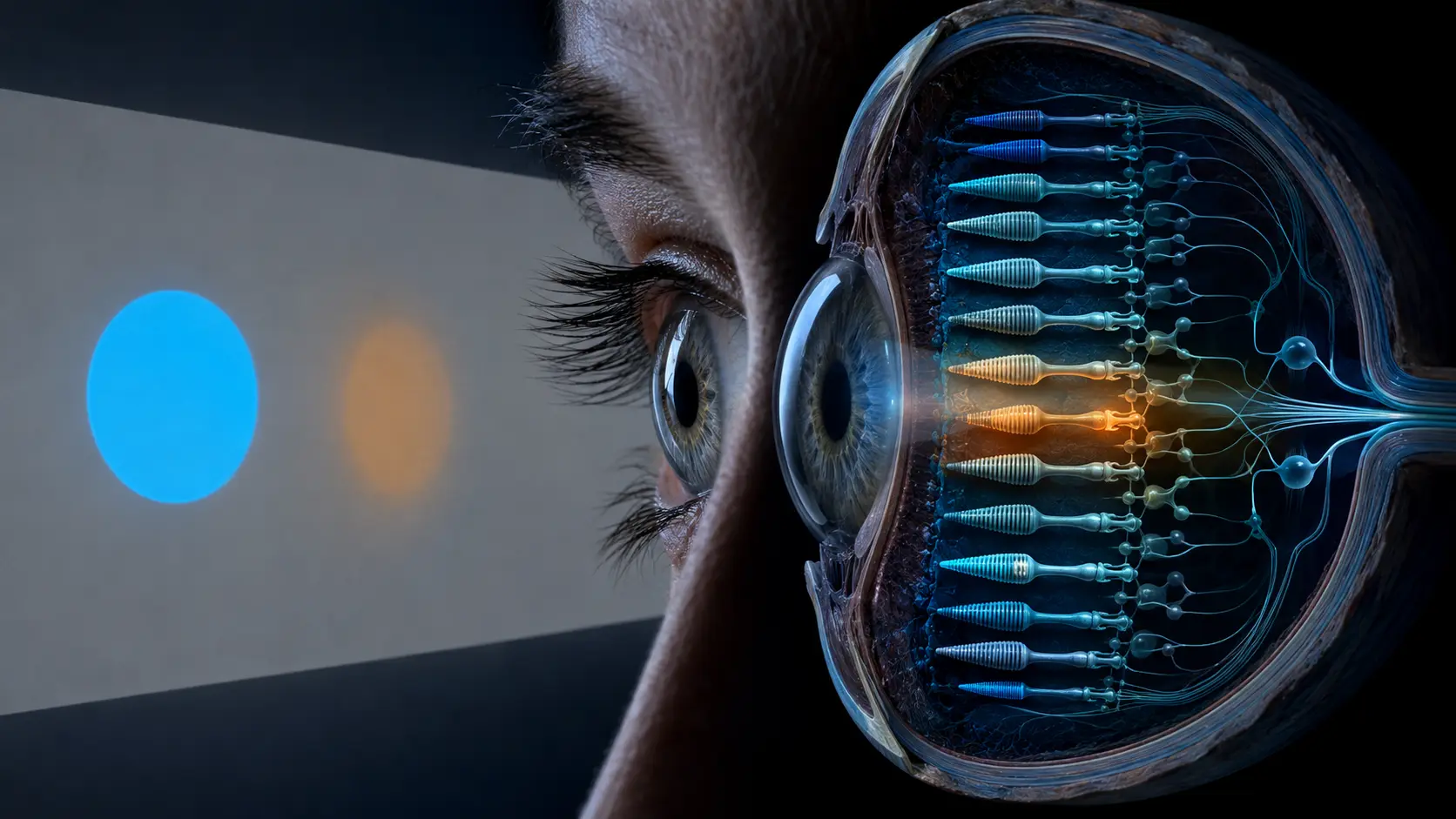
Optical illusions work because vision is an inference process, not a pixel-by-pixel copy of the world. Retinal signals are incomplete and ambiguous, so the brain estimates properties such as brightness, color, size, depth and motion using surrounding context, prior experience and built-in circuit responses. An illusion arranges cues so those normally useful rules support a perception that differs from a physical measurement. Different illusions arise at different stages—from adaptation in retinal and early visual circuits to higher-level assumptions about lighting, perspective, objects and faces.
Two identical gray squares can look different when their surroundings change. A still image can appear to move. Parallel lines can seem tilted. The retina records light, but the experience of surfaces, depth and motion is constructed after that light enters the nervous system.
Optical illusions isolate the rules behind that construction. They work because visual circuits use context, contrast, grouping and learned expectations to resolve signals that are normally ambiguous. The result is usually helpful; an illusion is a case where the same inference produces a mismatch.
The same retinal image can come from different worlds
A small retinal object could be a small nearby object or a large distant one. A dark patch could be dark material in bright light or pale material in shadow. The image alone does not uniquely identify the scene.
Visual systems combine multiple cues and favor interpretations that have worked in ordinary environments. Perspective, occlusion, texture and binocular disparity help infer depth. Light direction and local contrast help estimate surfaces despite changing illumination.
This is sometimes described as prediction, Bayesian inference or unconscious inference. The frameworks differ in detail, and no single equation explains every illusion. They share the established idea that perception depends on sensory evidence plus context and prior structure.
Neighboring signals change brightness and color
Neurons respond strongly to differences across space. Lateral interactions and receptive fields emphasize edges, which helps locate boundaries but also means an identical patch can look lighter against dark surroundings and darker against light surroundings.
Color constancy tries to separate a surface's reflectance from the illumination falling on it. When an image gives uncertain lighting cues, viewers may make different assumptions and report different colors without either retina receiving a simple label from the object.
Early neural processing contributes to these effects, yet context beyond a small receptive field also matters. 'The eye is fooled' is therefore too narrow; multiple visual levels collaborate in the percept.
Adaptation can make still scenes move
Motion-sensitive neurons adapt after sustained stimulation. When the stimulus stops, balanced populations do not recover at exactly the same rate, producing a motion aftereffect in the opposite direction. The waterfall illusion is a classic example.
Other static patterns create apparent motion through repeated luminance steps, tiny eye movements and timing differences in neural responses. The physical image remains fixed while the nervous system's changing response generates motion experience.
Not every viewer experiences every effect equally. Eye movements, viewing distance, attention, age and individual neural differences alter strength. Variability does not invalidate the illusion; it helps researchers locate the mechanisms involved.
Illusions are instruments, not just tricks
Scientists use controlled mismatches between stimulus and perception to test which cues the brain weights. If changing context flips the percept while the central image stays constant, the experiment isolates a contribution from surrounding information.
Illusions can also separate conscious perception from retinal input and behavior. Brain imaging, electrophysiology and psychophysics then measure where and when the competing interpretations emerge.
Most ordinary illusions are harmless. A sudden new visual distortion, flashing lights, a curtain-like shadow or vision loss is not an entertainment illusion and deserves prompt clinical attention.
From light pattern to perceptual guess
Retinal and early visual circuits encode contrasts, edges, color and motion. Later networks combine those features with depth cues, object structure and experience.
When an image supplies deliberately conflicting or incomplete cues, the system selects a plausible interpretation that can disagree with a ruler or light meter.
A recent review organizes visual illusions by the mechanisms they reveal.
Why it matters
Illusions make hidden visual computations observable without implying that perception is generally unreliable.
They show why seeing feels immediate even though the brain must solve ambiguity at every glance.
Vision delivers an interpretation, not a raw copy.
Optical illusions arrange cues so the brain's efficient assumptions produce a compelling perception that measurement contradicts.
Research behind this story
We link to the primary study or an authoritative indexed review wherever possible. Caveats in the text reflect the limits of that evidence.
01