Quick answer
Your kidneys maintain the internal composition of the body. About a million nephrons in each kidney begin by filtering water and small molecules from plasma at structures called glomeruli. Tubules then return most filtered water, glucose, amino acids and needed electrolytes to the blood, while secreting additional acids, ions and waste into the tubular fluid. The remainder becomes urine. Kidneys also help regulate blood pressure, produce erythropoietin for red-blood-cell production and activate vitamin D. Urine volume alone cannot show how well all of those functions are working.
A healthy pair of kidneys receives an enormous share of the heart's output. The blood does not enter two simple strainers and leave clean. Instead, microscopic units repeatedly filter fluid, reclaim almost everything the body wants to keep, secrete selected molecules and adjust the final mixture minute by minute.
Urine is the small remainder of that much larger editing process. The same organs also balance acid, water and electrolytes and participate in blood-pressure control, red-blood-cell production and vitamin D activation. Their quiet work stabilizes the chemical environment used by every nerve, muscle and cell.
The kidney filters first and chooses afterward
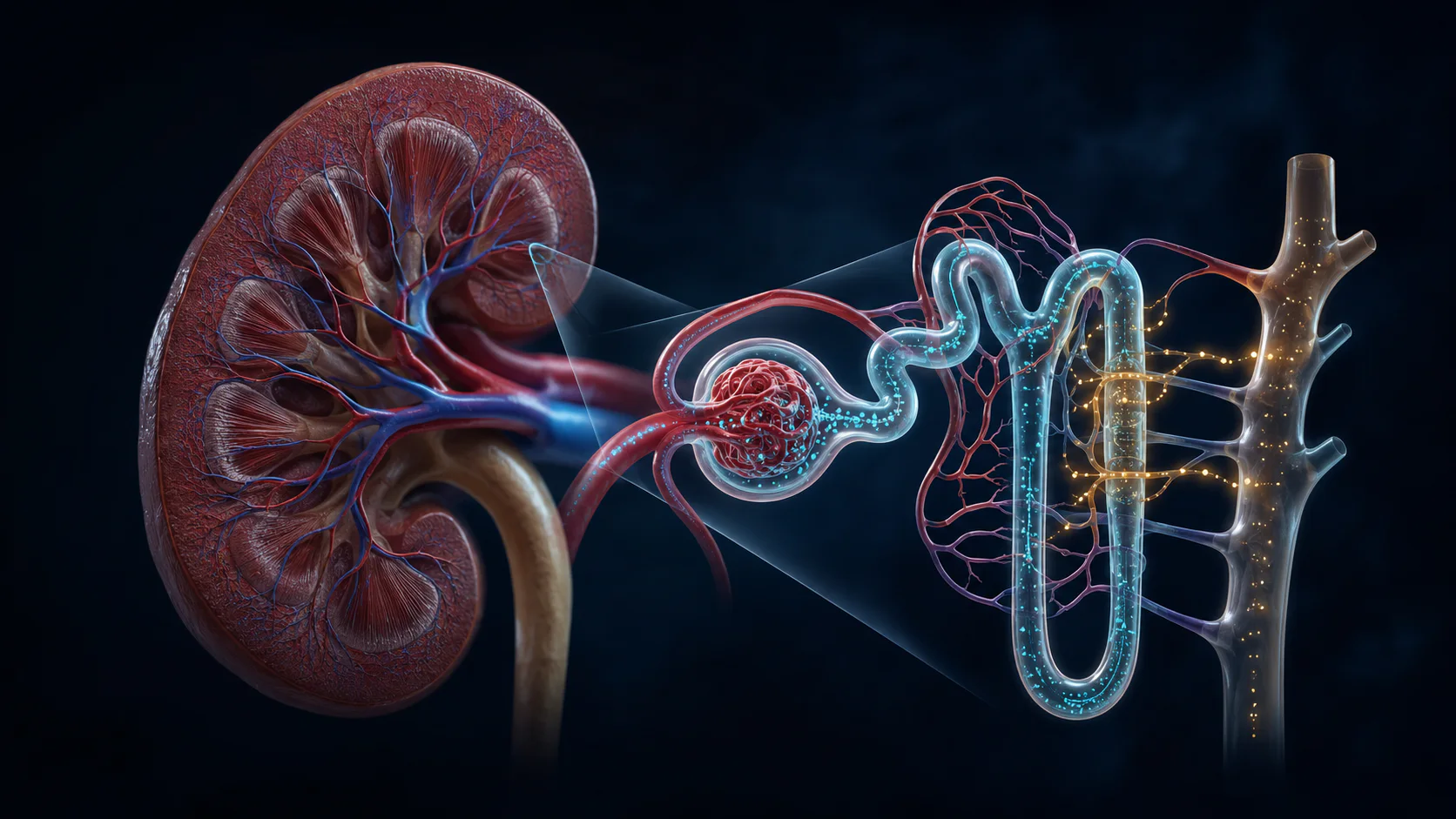
Blood reaches each glomerulus through an afferent arteriole. Pressure pushes water and small dissolved molecules across a three-layer filtration barrier into Bowman's space. Blood cells and most large proteins normally remain in the capillaries because of their size and the properties of the barrier.
The resulting filtrate contains useful molecules as well as waste. If the kidneys behaved like a kitchen sieve and discarded everything that crossed, the body would rapidly lose water, glucose, salts and other essentials. Filtration is therefore only the first pass.
The glomerular filtration rate describes how much fluid enters the nephrons over time and is a central measure of kidney function. The kidneys regulate pressure and resistance in small vessels to keep filtration relatively stable across ordinary changes in blood pressure, although severe illness or dehydration can disrupt that control.
The tubule edits a huge filtrate into a small volume of urine
Filtered fluid enters the proximal tubule, loop of Henle, distal tubule and collecting system. Transport proteins move sodium, glucose, amino acids and other solutes, and water follows changing osmotic gradients. Nearby capillaries receive the reclaimed material.
The loop of Henle helps build an osmotic gradient in the kidney medulla. Together with the collecting ducts and hormones such as antidiuretic hormone, that gradient allows the body to conserve water and produce concentrated urine when necessary—or release more dilute urine when water is abundant.
Tubules also secrete selected substances from blood into the forming urine. Hydrogen ions, potassium, organic acids, bases and many medicines can use these pathways. Reabsorption and secretion are regulated, which lets the kidney change the composition of urine according to the body's current needs rather than producing a fixed fluid.
Nerves and muscles depend on the balance kidneys defend
Sodium and water influence blood volume, while potassium strongly affects the electrical behavior of nerves and muscle, including heart muscle. Calcium and phosphate participate in signaling and bone structure. The kidneys continuously adjust the excretion and retention of these materials with help from hormones and other organs.
They also defend acid-base balance. Metabolism continually produces acids. Kidneys excrete hydrogen ions, regenerate bicarbonate and handle ammonium, complementing the faster carbon-dioxide control provided by the lungs. This slower renal work is essential for keeping blood pH within a narrow range.
That is why kidney failure affects much more than urination. Fluid can accumulate, potassium and acid can rise, and signaling between organs changes. A person may still make urine despite reduced kidney function, while another change in urine may have a cause unrelated to kidney failure.
The kidneys are also endocrine organs
Specialized kidney cells release renin when signals indicate reduced pressure, reduced sodium delivery or sympathetic activation. Renin begins a hormone cascade that influences blood-vessel tone, sodium handling and blood pressure. The pathway is useful for maintaining circulation but can contribute to hypertension when chronically overactive.
The kidneys produce most circulating erythropoietin in adults. When oxygen delivery is low, erythropoietin signals bone marrow to increase red-blood-cell production. The kidneys also convert vitamin D toward its active hormonal form, helping regulate calcium and bone metabolism.
Because these jobs are distributed, no home observation can test the whole organ. Blood creatinine, estimated filtration rate, urine albumin and other measurements answer different questions and must be interpreted in context. Persistent swelling, blood in urine, major urine changes or concerning pain deserves professional evaluation.
From plasma to precisely edited urine
The glomerulus filters water and small solutes into the nephron while retaining cells and most protein. Tubules then reclaim needed material and add selected substances to the fluid.
Hormonal and local signals adjust transport and water permeability. The final urine carries only a fraction of the original filtered volume to the ureter and bladder.
NIDDK explains the nephron as a two-stage system in which glomeruli filter and tubules return needed material.
A renal physiology reference details the pressures and barrier that create glomerular filtrate.
Try it yourself
Trace filtration and return as separate steps.
- Move water and small molecules from glomerular blood into the nephron.
- Return most water and useful solutes through the tubule to nearby capillaries.
- Send the remaining fluid through collecting ducts and ureters as urine.
Urine color or frequency cannot diagnose kidney function. Individual concerns need appropriate medical testing and interpretation.
Why it matters
The kidney reveals that biological filtration is not just removal. Precision comes from spending energy to recover what the body needs and adjust what remains.
Its endocrine work also connects apparently separate systems: kidney signals influence blood pressure, red-blood-cell supply and bone mineral regulation.
Your kidneys are chemical editors, not simple strainers.
Nephrons filter broadly, reclaim selectively and secrete precisely while kidney hormones coordinate blood, pressure and bone.
Research behind this story
We link to the primary study or an authoritative indexed review wherever possible. Caveats in the text reflect the limits of that evidence.
01