Quick answer
When you speak, you hear your voice through air conduction and through vibrations conducted by the bones and soft tissues of your head. Bone-conducted vibration changes the balance of frequencies reaching the inner ear and contributes a bodily sensation that is present only during live speech. A normal recording captures mostly the air-conducted sound. Microphone distance, room acoustics, compression, speakers and headphones alter it again, so playback is closer to the external voice others hear—but it is not a perfect copy.
You play back a voice note and hesitate. The words are yours, the rhythm is yours, yet the speaker sounds thinner, brighter or simply less familiar than the person you hear every day. The recording has not uncovered a secret voice. It has removed one of the routes by which you normally hear yourself.
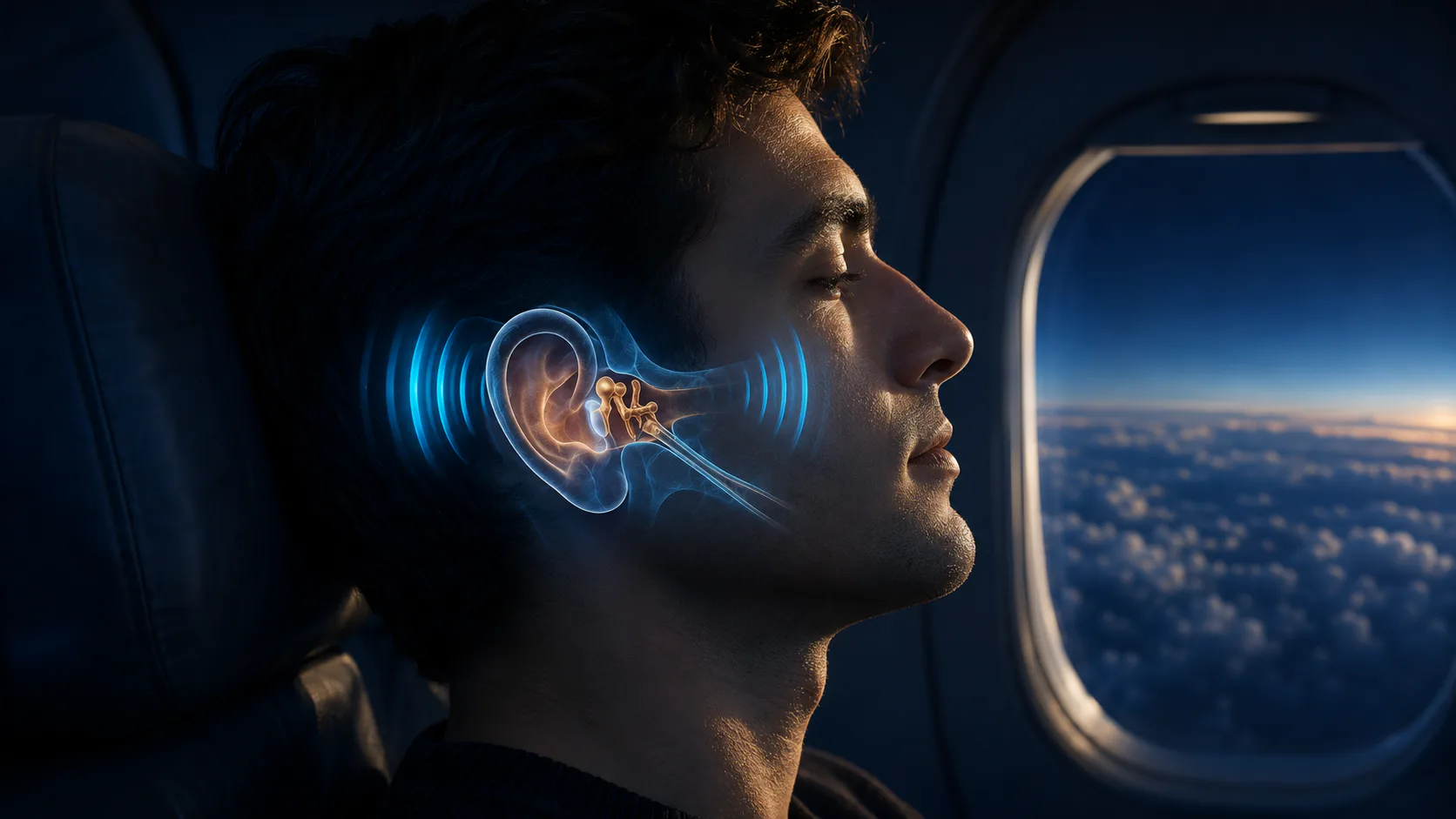
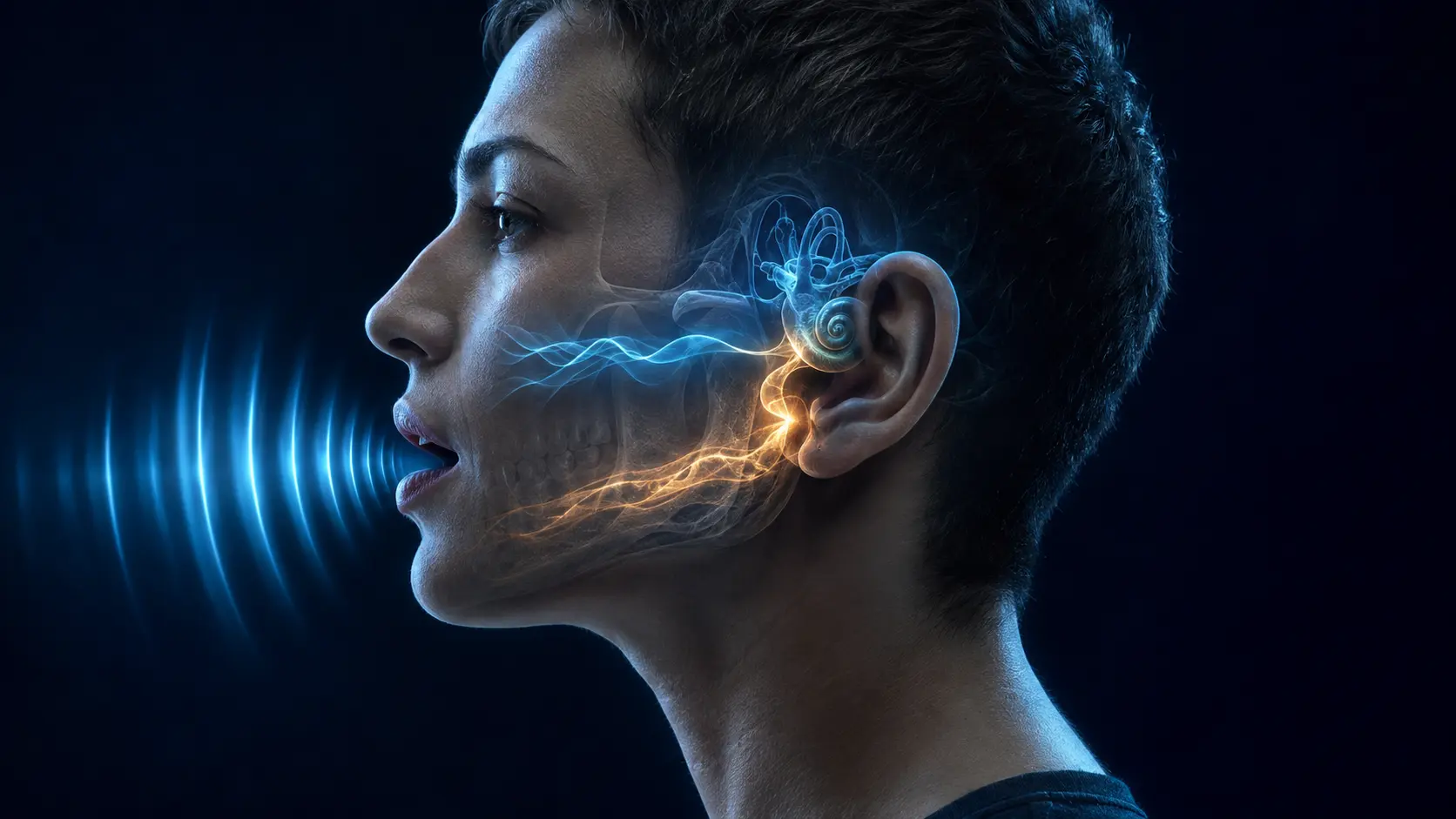
Other people receive your voice mainly through sound waves moving through the air. While you are speaking, your own auditory system receives those waves too, but it also receives vibrations traveling through your jaw, skull and other tissues. Your everyday self-voice is therefore a combined, multisensory signal. A microphone captures a different version.
Your voice takes two paths to your inner ear
Every spoken sound begins when air from the lungs sets the vocal folds vibrating. The throat, mouth and nasal passages shape that vibration into a changing pattern of frequencies. Some of the energy leaves the mouth, travels through the room and enters the ear canal. It vibrates the eardrum, moves the tiny middle-ear bones and reaches the fluid-filled cochlea. This is air conduction, the route used for nearly every voice around you.
At the same time, speech production vibrates structures inside your head. Those vibrations travel through bone and soft tissue toward the cochlea, bypassing some of the external and middle-ear route. They also provide subtle vibrotactile information from the face and head. The brain combines the airborne sound with this internally conducted input into the voice you recognize as your own.
Bone conduction is often summarized as making the voice sound deeper because internally transmitted energy can emphasize lower frequencies. That is useful shorthand, not a universal equalizer setting. The transfer depends on frequency, anatomy, articulation and the route taken through tissue. What matters most is that the live signal has a component ordinary playback does not reproduce.
Why the recording feels like someone else
A microphone sits outside the body. It converts pressure changes in the air into an electrical signal, leaving out the bone-conducted vibration that accompanies speaking. When that signal is played back, your auditory system receives it as it receives another person’s voice: through the air, a speaker or headphones. The familiar internal contribution is absent.
Research supports the idea that self-voice is fundamentally multisensory. In experiments that presented voice recordings through a bone-conduction headset, participants became better at distinguishing their own voice from another person’s. The effect was not explained simply by familiarity. Reintroducing an internally conducted route made the laboratory signal more like natural self-hearing.
The surprise also comes from learning. You have heard your live voice thousands of times while speaking, so the brain has built a stable expectation around that combined signal. Recordings occupy a less familiar acoustic category. Even when you know intellectually that the speaker is you, the mismatch between prediction and incoming sound can make the voice feel oddly detached.
Disliking the playback is not evidence that the voice is objectively unpleasant. Familiarity strongly affects preference, and recordings can expose speech habits you normally monitor through a different signal. The first reaction mixes acoustics, expectation and self-conscious attention; it is not a neutral quality test.
Is the recording what everyone else hears?
A clean recording is closer to the externally conducted voice other people receive, but no single recording is the final truth. Microphones have their own frequency responses. A phone held close to the mouth exaggerates some frequencies and reduces others. Distance changes the balance between direct sound and room reflections, while automatic noise reduction and compression reshape dynamics.
Playback creates another filter. Tiny phone speakers, studio headphones and a car stereo do not reproduce the same frequency range. The listener’s position, the room and even surrounding noise also matter. Two people standing at different angles can hear slightly different versions of the same sentence because the mouth and head radiate frequencies unevenly.
The most accurate conclusion is modest: other people do not hear the bone-conducted self-voice in your head. They hear an airborne voice shaped by the space between you. A decent recording approximates that external signal, but it also carries the fingerprints of the equipment and room.
From vocal folds to the voice you recognize
Speech produces one source but two streams of information. Airborne energy follows the familiar outer-ear pathway. Internally conducted vibration reaches the cochlea through the head and adds a tactile component. The brain integrates both with a lifetime of expectations about how speaking should feel.
Recording breaks that combination. Playback restores the airborne stream without recreating the original vibration in your skull. The signal is recognizably yours, yet it falls outside the prediction your nervous system has refined through years of speaking.
A 2023 experiment found that presenting recordings through bone conduction improved self-versus-other voice discrimination.
Earlier speech-perception work describes how self-produced speech is heard substantially through a bone-conducted pathway with a different transfer function.
Try it yourself
Change one part of the recording chain at a time.
- In a quiet room, record the same sentence with the phone about 20 centimetres from your mouth and again from roughly one metre away.
- Listen to both versions first through headphones and then through the phone speaker. Notice which differences follow the microphone distance and which follow the playback device.
- Finally, hum gently with your ears open and then lightly cover them. The stronger internal vibration is a simple reminder that self-hearing includes more than airborne sound.
Keep headphone volume comfortable. The comparison demonstrates the recording chain; it does not establish one recording as an objective measure of voice quality.
Why it matters
The unfamiliar recording reveals that hearing is not passive. The brain combines sound, vibration, motor information and expectation into a stable sense of ownership. Your own voice is an especially clear example of multisensory perception operating below awareness.
The distinction also matters in research, voice training and communication. A laboratory that studies self-recognition cannot assume that an ordinary recording reproduces natural self-voice. A speaker reviewing a presentation should separate useful observations about clarity or pacing from the automatic discomfort of hearing an unfamiliar acoustic version of the self.
The recording is not wrong. It is missing your internal route.
Live self-hearing combines airborne sound with vibration conducted through the head. Playback removes that combination and adds the microphone, room and speaker—so a familiar voice arrives in an unfamiliar form.
Research behind this story
We link to the primary study or an authoritative indexed review wherever possible. Caveats in the text reflect the limits of that evidence.
01