Quick answer
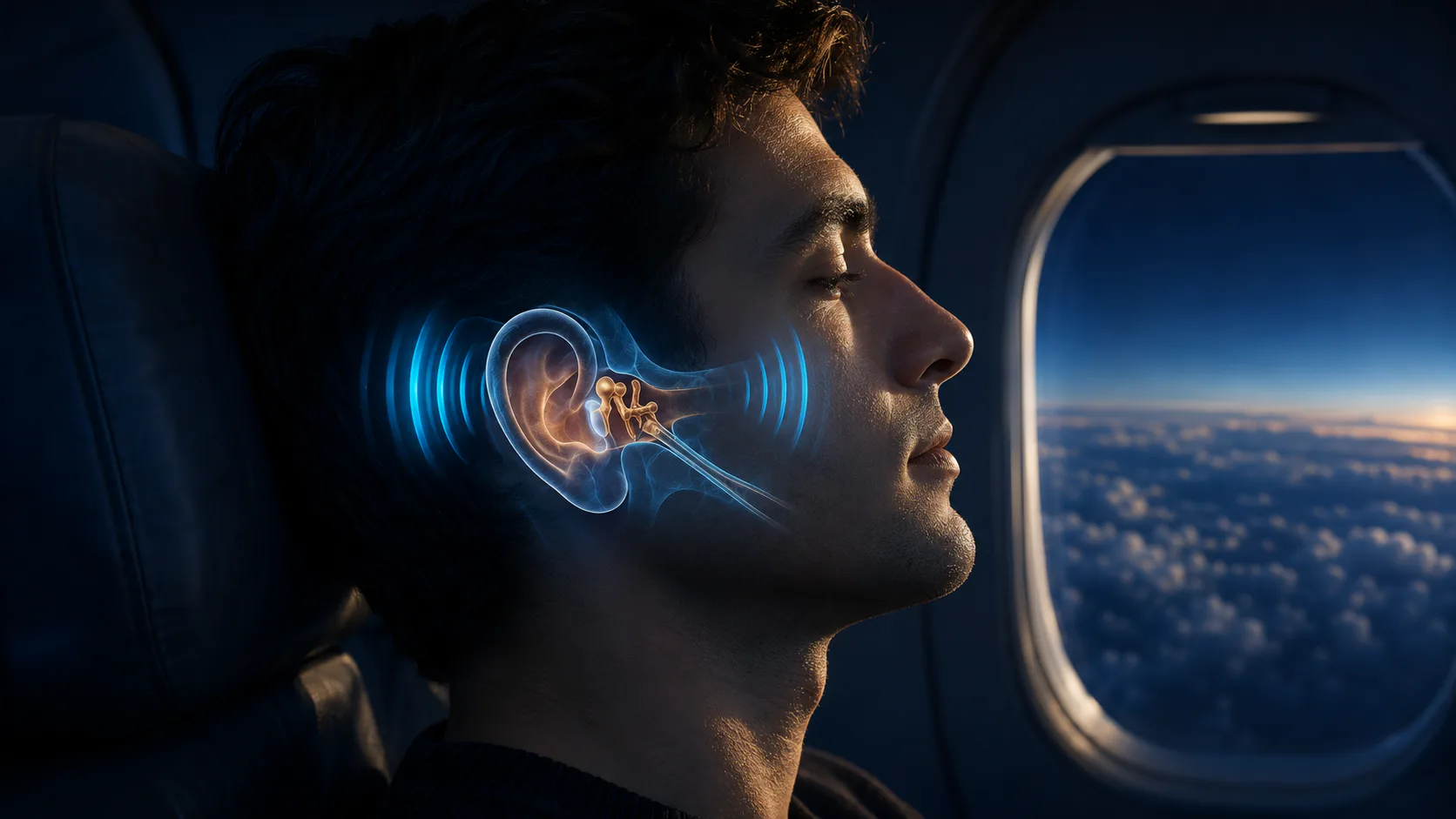
Your middle ear is an air-filled space behind the eardrum. During ascent and descent, cabin pressure changes while the pressure in that space may lag behind. Swallowing or yawning briefly opens the Eustachian tube, allowing air to move and the pressures to equalize. That sudden adjustment feels and sounds like a pop.
The aircraft begins to descend. Voices sound muffled, one ear feels full, and then a swallow produces a tiny click followed by relief. The cabin did not become silent; your eardrum was temporarily working under uneven pressure.
The ear is sensitive to pressure because part of it is sealed behind a flexible membrane. Flying changes the outside pressure quickly enough to expose that design.
Two air spaces, one flexible membrane
The eardrum separates the ear canal from the middle ear. For it to vibrate freely, air pressure on both sides should be close to equal. The ear canal follows cabin pressure directly, while the middle ear depends on a narrow passage connecting it to the back of the nose.
That passage is the Eustachian tube. It usually stays closed and opens briefly during swallowing, yawning and some jaw movements. Each opening lets a small amount of air pass, which is why chewing or sipping can help during altitude changes.
Why descent is often harder
During ascent, cabin pressure falls and the relatively higher-pressure air in the middle ear can often escape outward. During descent, cabin pressure rises. Fresh air must move through the Eustachian tube into the middle ear, but the pressure difference can press the tube closed and make that direction less automatic.
Until the pressures equalize, the eardrum bends and sound transmission changes. You may notice fullness, reduced hearing or discomfort. The pop marks air movement and a rapid return toward balance—not the eardrum itself snapping.
A cold, allergy flare or sinus inflammation can narrow the tube opening, which is why the same flight may be easy one week and painful the next.
Children can have more difficulty because their Eustachian tubes are shorter, more horizontal and functionally less mature. They also may not know to swallow on purpose. That anatomy contributes to childhood middle-ear problems generally; it does not mean every child will have severe pain on every flight.
The muffled quality has a mechanical explanation. A pressure difference stretches the eardrum away from its most mobile position, so it transfers vibration through the middle-ear bones less efficiently. Once pressure equalizes, the membrane moves more freely and ordinary sound seems to return all at once.
The equalization sequence
Pressure changes alter the force across the eardrum. Jaw and throat muscles briefly pull the Eustachian tube open, air crosses the passage, and the eardrum returns toward its neutral position.
If the pressure difference becomes large and equalization fails, the result can be barotrauma. Severe or persistent pain, fluid or blood from the ear, vertigo, or hearing loss after a flight needs medical assessment.
The FAA’s aviation guidance explains why descent often requires active Eustachian-tube opening.
Try it yourself
Equalize early and gently.
- Stay awake for descent so you can respond as pressure changes.
- Swallow, yawn or chew before discomfort becomes strong.
- If needed, pinch your nose and swallow gently. Avoid forceful pressure, especially when pain is severe.
Infants may swallow more often when feeding. People with ear disease or recent surgery should follow their clinician’s advice before flying.
Why it matters
Airplane ear is a practical lesson in how hearing depends on mechanics. The eardrum must move freely, and a pressure mismatch changes its tension before anything is wrong with the sound source.
Most episodes resolve quickly. Knowing the route helps you act before the pressure difference grows and recognize when symptoms are more than an ordinary pop.
Your ear pops when an air lock briefly opens.
The Eustachian tube connects the middle ear to the throat. When it opens, pressure on both sides of the eardrum catches up.
Research behind this story
We link to the primary study or an authoritative indexed review wherever possible. Caveats in the text reflect the limits of that evidence.
01