
Quick answer
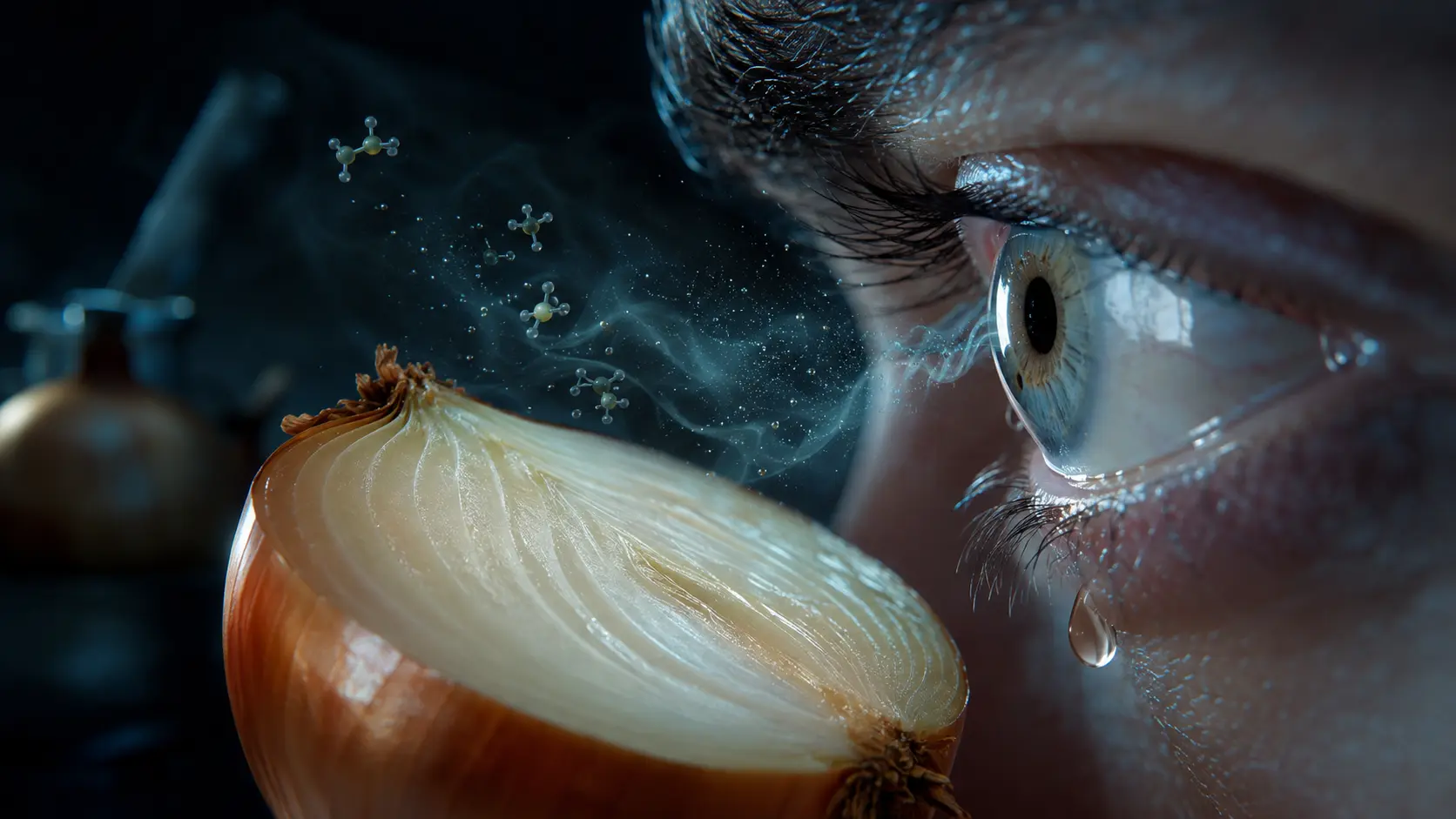
Cutting an onion breaks open cells and allows the enzyme alliinase to act on sulfur-containing precursors. A second enzyme, lachrymatory-factor synthase, helps form propanethial S-oxide, a volatile compound that reaches the eye. It activates irritation-sensitive nerves on the ocular surface, and the lacrimal glands release tears to dilute and wash the chemical away.
The first slices are easy. Then the air above the cutting board becomes invisible trouble: your eyes sting, blinking accelerates and tears spill before you feel remotely sad. The reaction is chemistry, not emotion.
Onions store reactive ingredients in separate parts of their cells. A knife ruptures those compartments. Molecules that were safely divided meet, an enzyme-driven chain begins, and a small volatile compound escapes into the air toward the wet surface of your eyes.
The irritant is built after the cut
An intact onion is not continuously leaking tear gas. Its sulfur chemistry is compartmentalized. When cells are crushed, alliinase gains access to amino-acid-derived sulfoxides and produces unstable sulfenic acids. Lachrymatory-factor synthase redirects part of that chemistry toward propanethial S-oxide.
The compound is small and volatile enough to leave the damaged tissue. Cutting creates droplets and vapor, while airflow carries them upward. The amount that reaches you depends on onion variety, freshness, knife action, ventilation and distance from the board.
Once dissolved in the thin tear film over the cornea and conjunctiva, the irritant stimulates branches of the trigeminal nerve. Those sensory pathways report chemical threat and recruit a reflex that increases blinking and tear production.
Why tears help—and why some tricks work
Reflex tears are different in purpose from the emotional tears associated with strong feeling. Both leave through the same drainage system, but onion tears begin with surface irritation. Their immediate job is to dilute the compound and move it toward the inner corner of the eye and the nasolacrimal duct.
A sharp knife crushes fewer cells than a blunt one, which can reduce—but not eliminate—the chemical release. Cooling an onion slows enzyme activity and volatility. Strong ventilation moves the compound away from the face. Running water may capture some vapor, although it also makes handling a knife less safe.
Goggles work for the simplest reason: they interrupt the route between airborne molecules and the ocular surface. Holding bread in your mouth or arranging matches nearby has no equally clear mechanism. The best strategies change chemistry, airflow or exposure rather than relying on kitchen folklore.
From damaged plant cell to reflex tear
Cell rupture mixes an enzyme with sulfur-rich precursors. Lachrymatory-factor synthase helps create propanethial S-oxide, which becomes airborne and dissolves in the tear film. Sensory nerves detect irritation and drive the lacrimal glands.
The tears do not neutralize every molecule instantly, so discomfort may continue while you remain over the board. Step away or improve airflow and the source falls, allowing blinking and drainage to clear what remains.
Structural biology has resolved the enzyme that produces the onion lachrymatory factor.
Plant experiments show that silencing this enzyme produces onions with dramatically less tear-inducing activity.
Try it yourself
Change one exposure factor safely.
- Chill one onion before cutting and leave another at room temperature.
- Use the same sharp knife and similar cuts with good ventilation.
- Notice whether onset and intensity differ without putting your face close to either onion.
Protect your fingers first. Never cut under water or use an unstable surface simply to prevent tears.
Why it matters
The reaction shows how plants use compartmentalized chemistry as defense. Damage activates a signal that discourages the animal doing the damage, even though humans have turned the same plant into a kitchen staple.
It also separates three things people often merge: emotional crying, protective reflex tears and the continuous basal tear film that keeps the eye optically smooth and nourished.
The cut creates the chemical that reaches your eye.
Broken onion cells assemble a volatile sulfur irritant. Trigeminal nerves detect it, and tears arrive as a rapid cleaning response.
Research behind this story
We link to the primary study or an authoritative indexed review wherever possible. Caveats in the text reflect the limits of that evidence.
01