Quick answer
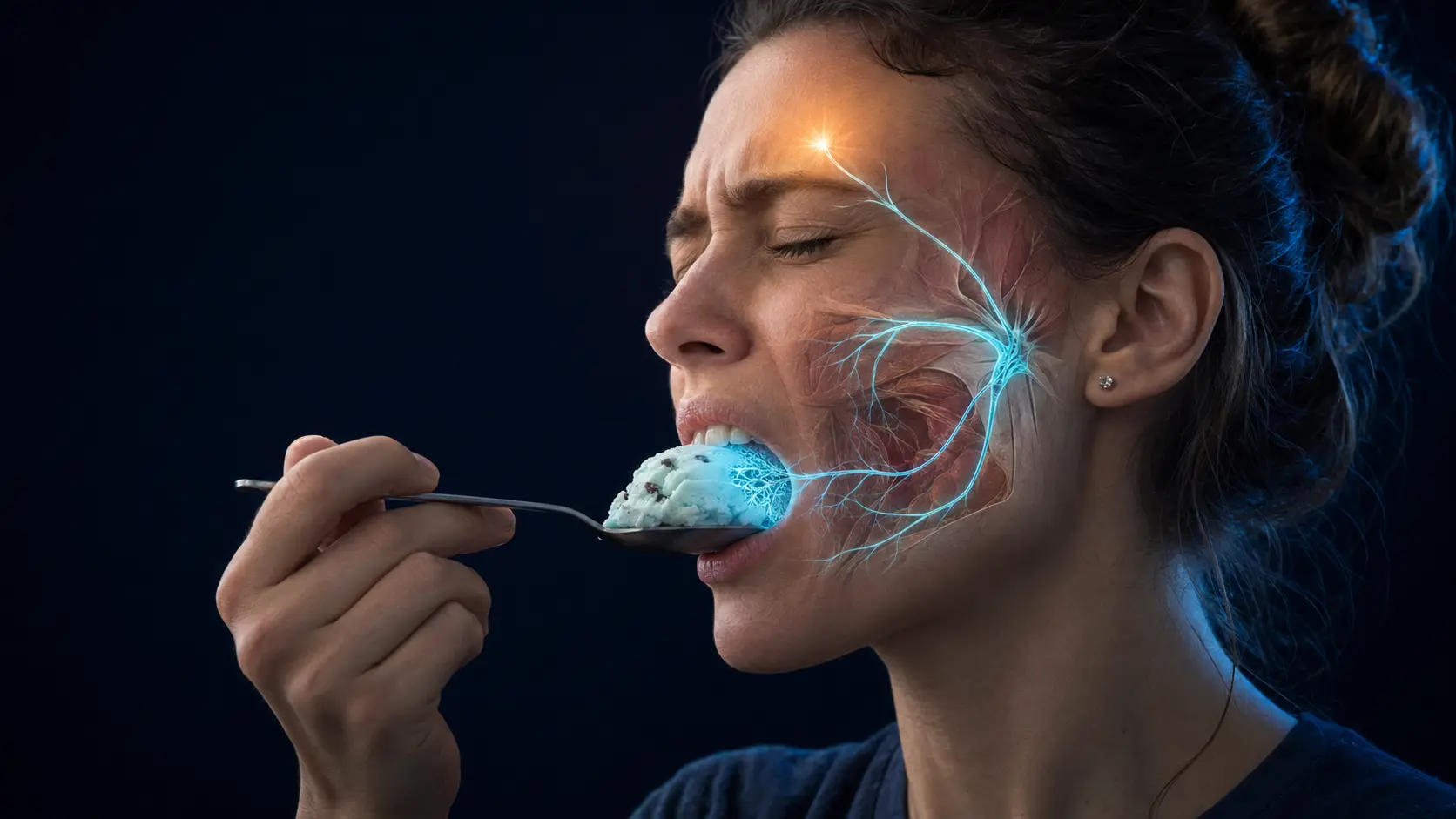
Brain freeze happens when very cold food or drink rapidly cools the palate or pharynx. Cold-sensitive endings and the trigeminal nerve are activated, and a trigeminal-parasympathetic reflex may change blood flow in cranial vessels. The brain refers the resulting signal to the forehead or temple. Slowing down and warming the palate usually ends the brief headache.
A cold drink goes down too quickly and a narrow bolt of pain appears behind the forehead. It rises fast, feels strangely internal and usually vanishes before you can decide whether to worry. The brain itself was never frozen.
The recognized medical name is headache attributed to ingestion or inhalation of a cold stimulus. That wording is less memorable than brain freeze, but it points to the mechanism honestly: the trigger is cold material crossing the palate or back of the throat, while the exact chain from cold receptor to pain is still being studied.
The pain is referred away from the trigger
The roof of the mouth and upper throat are supplied by branches that feed into the trigeminal sensory system. This large cranial nerve also carries sensation from the face and structures associated with headache. A sudden cold stimulus therefore enters a network capable of producing pain somewhere other than the exact chilled spot.
Referred pain occurs when the central nervous system receives converging signals and assigns the sensation to a more familiar territory. In brain freeze, people commonly feel the forehead or temples even though the cold material never touched those regions.
Researchers have recorded changes in cerebral blood-flow velocity during ice-water provocation. Stronger changes occurred in participants who developed pain, especially when tearing accompanied it. That supports involvement of a trigeminal-parasympathetic vascular reflex, but it does not prove that vessel expansion alone creates every episode.
Why speed matters more than total cold
Rapid ingestion exposes a larger area to a steep temperature change before local tissues can warm the food. Controlled studies provoke cold-stimulus headache more reliably with fast drinking or fast eating than with cautious consumption. The intensity and susceptibility vary widely.
People with migraine report cold-stimulus headache more often in many studies, suggesting some overlap in trigeminal sensitivity. Brain freeze is still classified as its own trigger-linked headache and is usually harmless and short-lived.
Stopping the cold exposure is the main intervention. Pressing the tongue against the palate or sipping something warmer may speed rewarming, but the episode often resolves on its own within seconds or a few minutes. A new severe headache that is not clearly tied to cold, persists, or comes with neurological symptoms should not be labelled brain freeze.
From icy palate to forehead pain
Cold receptors and trigeminal endings react to a sudden temperature drop. Brainstem pathways coordinate sensory and parasympathetic activity, vascular conditions shift, and the combined signal is perceived in a forehead territory.
Because the source is brief and superficial, rewarming removes the trigger quickly. The pain ends as the cold-sensitive pathway and associated reflex settle.
The International Headache Society classifies this as headache attributed to a cold stimulus.
Provocation studies found that ice water can increase middle cerebral artery flow velocity during the headache.
Try it yourself
Change the speed of cold exposure.
- Take smaller bites or sips of very cold food and drink.
- Let each mouthful warm slightly before swallowing.
- If pain starts, pause and allow the palate to rewarm.
Do not deliberately provoke headache. Seek medical care for a sudden severe headache, especially with weakness, confusion, fainting, fever or neck stiffness.
Why it matters
Brain freeze is a compact lesson in pain mapping. Where pain is felt does not always identify where the triggering signal began.
It also shows good scientific restraint: trigeminal activation is well supported, while the precise role of vascular change and individual susceptibility remains incomplete.
Your palate gets cold; your forehead receives the message.
A rapid cold stimulus activates trigeminal pathways and short-lived cranial reflexes. The result is referred pain, not a frozen brain.
Research behind this story
We link to the primary study or an authoritative indexed review wherever possible. Caveats in the text reflect the limits of that evidence.
01