
Quick answer
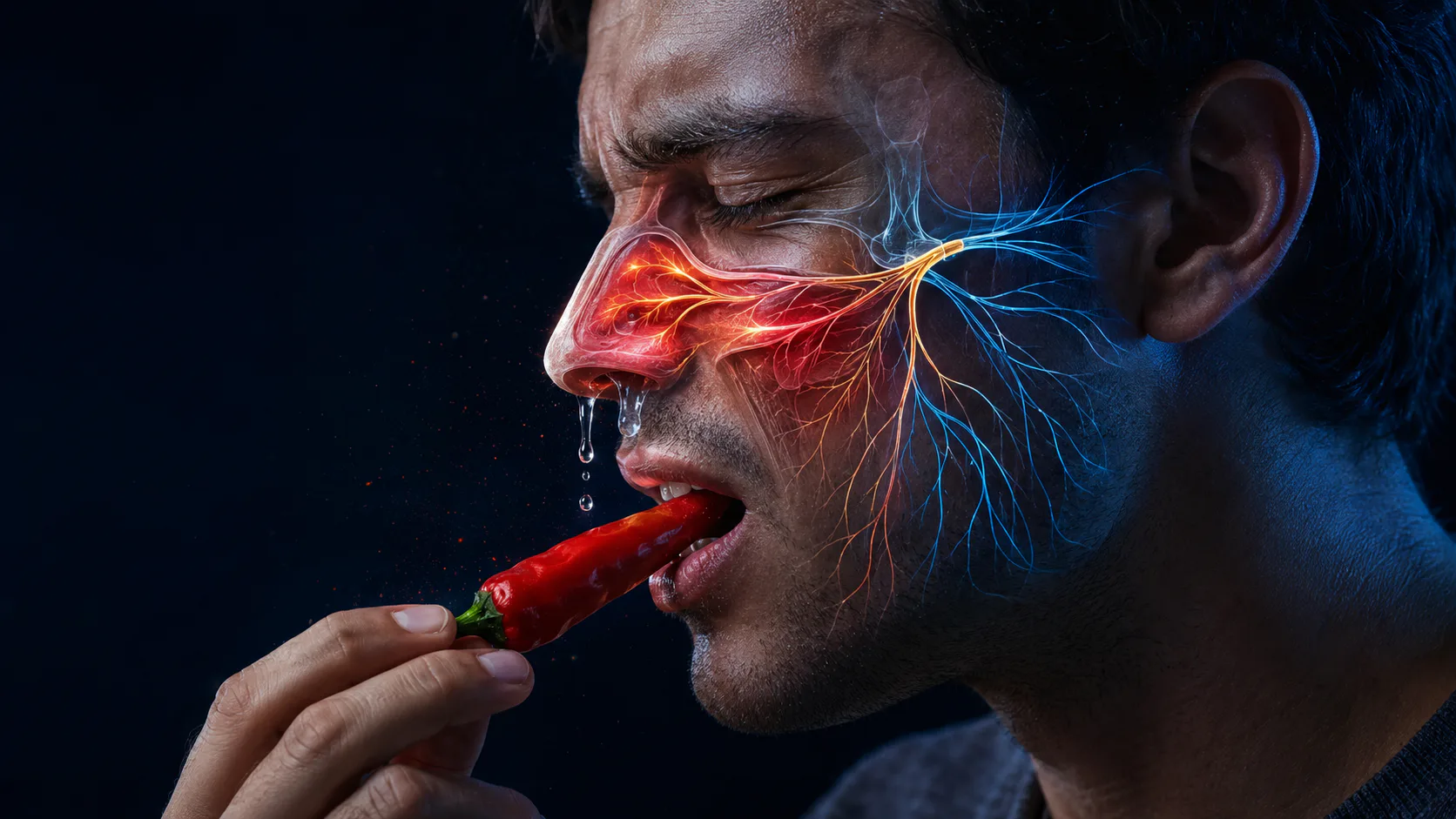
Spicy food can make your nose run because capsaicin, the molecule that makes chilies feel hot, activates heat-and-irritation receptors called TRPV1 on sensory nerves. Autonomic reflexes then increase watery nasal secretions. Food-triggered nasal dripping is called gustatory rhinitis, a nonallergic response. A runny nose during a meal does not by itself rule out a food allergy or another cause, especially if other symptoms occur.
The first bite tastes bright. A few seconds later your upper lip tingles, your eyes water, and your nose starts running as if you have stepped into cold air. Nothing has entered your nose, yet it behaves as though it needs to wash something out.
That reaction can begin with a chemical heat signal, even when the food's temperature is not hot. Capsaicin stimulates part of your temperature-and-pain system, and the protective responses arrive anyway. Food that is physically too hot can still burn; chili heat and temperature are different triggers.
The heat is a nerve signal
Capsaicin binds to a protein channel called transient receptor potential vanilloid 1, or TRPV1. These channels normally respond to potentially damaging heat, acidity and some inflammatory signals. When capsaicin opens them, electrically charged particles flow into the sensory nerve ending and the nerve fires.
Many of the signals from the face travel through branches of the trigeminal nerve. That is why chili heat is more than a taste. It is part of chemesthesis: the sense that lets you feel chemical irritation, cooling menthol and the fizz of carbonation through touch-and-pain pathways.
What is gustatory rhinitis, and why does eating trigger it?
Sensory irritation can recruit autonomic reflexes that control glands and blood vessels in the nasal lining. The glands release a thin fluid, while increased blood flow can make the nose feel stuffy. Tears and saliva may increase at the same time because the response is built to dilute and clear irritants from exposed surfaces.
Clinicians call food-triggered watery nasal discharge gustatory rhinitis. It is usually most obvious with hot or spicy foods, and it is classified as a form of nonallergic rhinitis. The word rhinitis can sound like an infection, but in this setting the immediate trigger is neural rather than viral or allergic.
The reflex is useful even when the threat is mostly an illusion. Thin fluid can dilute an irritant and carry it toward the nostrils or throat. The same protective logic helps explain the watering eyes and increased saliva that often accompany a very hot bite: several wet surfaces are being asked to clear the signal at once.
Cooling the mouth with plain water is often disappointing because capsaicin does not mix well with water and can spread across the surface. Fat-containing foods may remove it more effectively, but the burning still fades mainly as capsaicin leaves receptors and sensory neurons adapt. That adaptation is temporary, not evidence that the tissue has become invulnerable.
Is a runny nose after spicy food always an allergy?
No. Gustatory rhinitis describes watery nasal discharge triggered by eating, often hot or spicy foods, without an allergic mechanism. Timing is a clue: a familiar drip that begins during a meal is different from a runny nose that continues throughout the day. Timing alone is not a diagnosis, and several causes can coexist.
Do not use the chili-reflex explanation to dismiss hives, swelling, wheezing or trouble breathing after food. Those symptoms can indicate an allergic reaction and need prompt medical attention. Persistent nasal symptoms outside meals also deserve a separate assessment rather than being attributed automatically to capsaicin.
From chili molecule to runny nose
The pathway is fast because it does not need the immune system to identify an invader. A sensory channel opens, the trigeminal system reports irritation, and autonomic output changes secretion in the nasal lining.
People vary in sensitivity, and repeated capsaicin exposure can temporarily desensitize the pathway. That helps explain why the same sauce can feel overwhelming to one diner and merely warm to another.
A clinical review of rhinitis describes how capsaicin activates TRPV1 and increases nasal secretion.
The distinction from allergy is described in a review of food-triggered gustatory rhinitis.
Try it yourself
Notice the order of the response.
- Take a modest bite of a spicy food you already tolerate.
- Notice whether mouth heat appears before tears or nasal dripping.
- Compare it with a strongly flavored but non-spicy food. Flavor alone does not usually trigger the same reflex.
Do not deliberately eat food that causes pain, breathing symptoms or a known allergic reaction.
Why it matters
A runny nose during a spicy meal is usually a normal protective reflex. It is different from a food allergy, which can involve hives, swelling, wheezing, vomiting or a dangerous systemic reaction.
Understanding the route also reveals something useful about flavor: eating is a multisensory event. Taste buds contribute, but temperature, smell and trigeminal irritation shape what a meal feels like.
Chili heat borrows your alarm system.
Capsaicin activates heat-sensitive nerves, and your nose responds with a cleansing reflex. The drip is the visible end of a fast neural circuit.
Research behind this story
We link to the primary study or an authoritative indexed review wherever possible. Caveats in the text reflect the limits of that evidence.
01