Quick answer
Some people inherit a tendency to sneeze when moving suddenly into bright light. The leading explanations involve cross-activation or summation between the visual response to brightness and trigeminal or parasympathetic pathways that control nasal sensation and sneezing. Studies support a genetic component, but no single mechanism explains every case and the reflex is usually harmless.
You leave a dim building, look toward a bright sky and feel the unmistakable tickle of an approaching sneeze. There is no dust cloud and no pepper in the air. Light itself has somehow activated a reflex designed to clear the nose.
The phenomenon is called the photic sneeze reflex. It is common enough to be ordinary and unusual enough that its neural route remains debated. Genetics clearly contributes, but the popular explanation of crossed wires is a useful model rather than a fully mapped circuit.
A sneeze is a coordinated defensive program
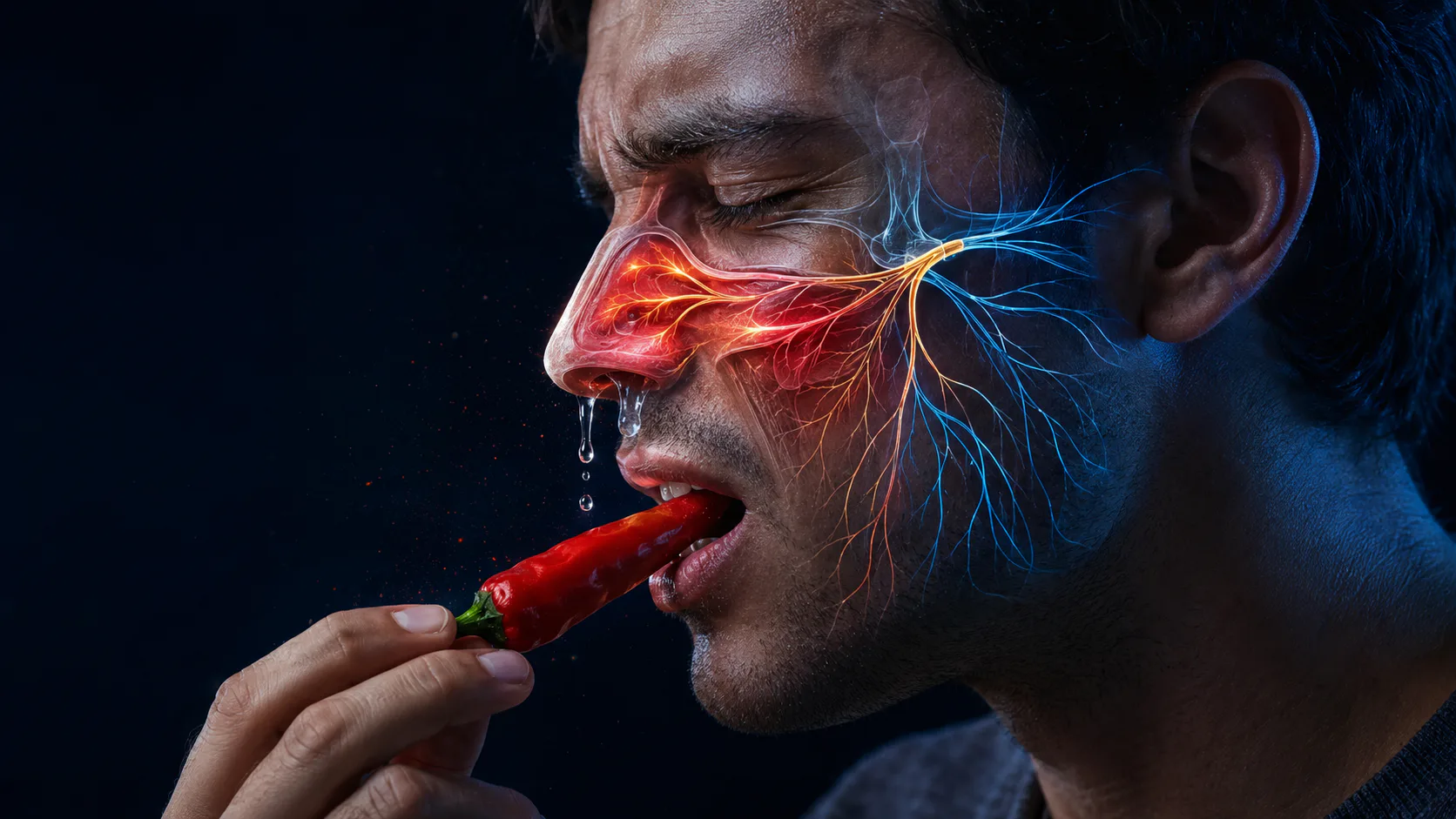
Ordinary sneezing begins when sensory endings in the nasal lining detect an irritant. Signals travel through trigeminal pathways to brainstem networks that coordinate a deep breath, closure of the glottis and a forceful burst through the nose and mouth.
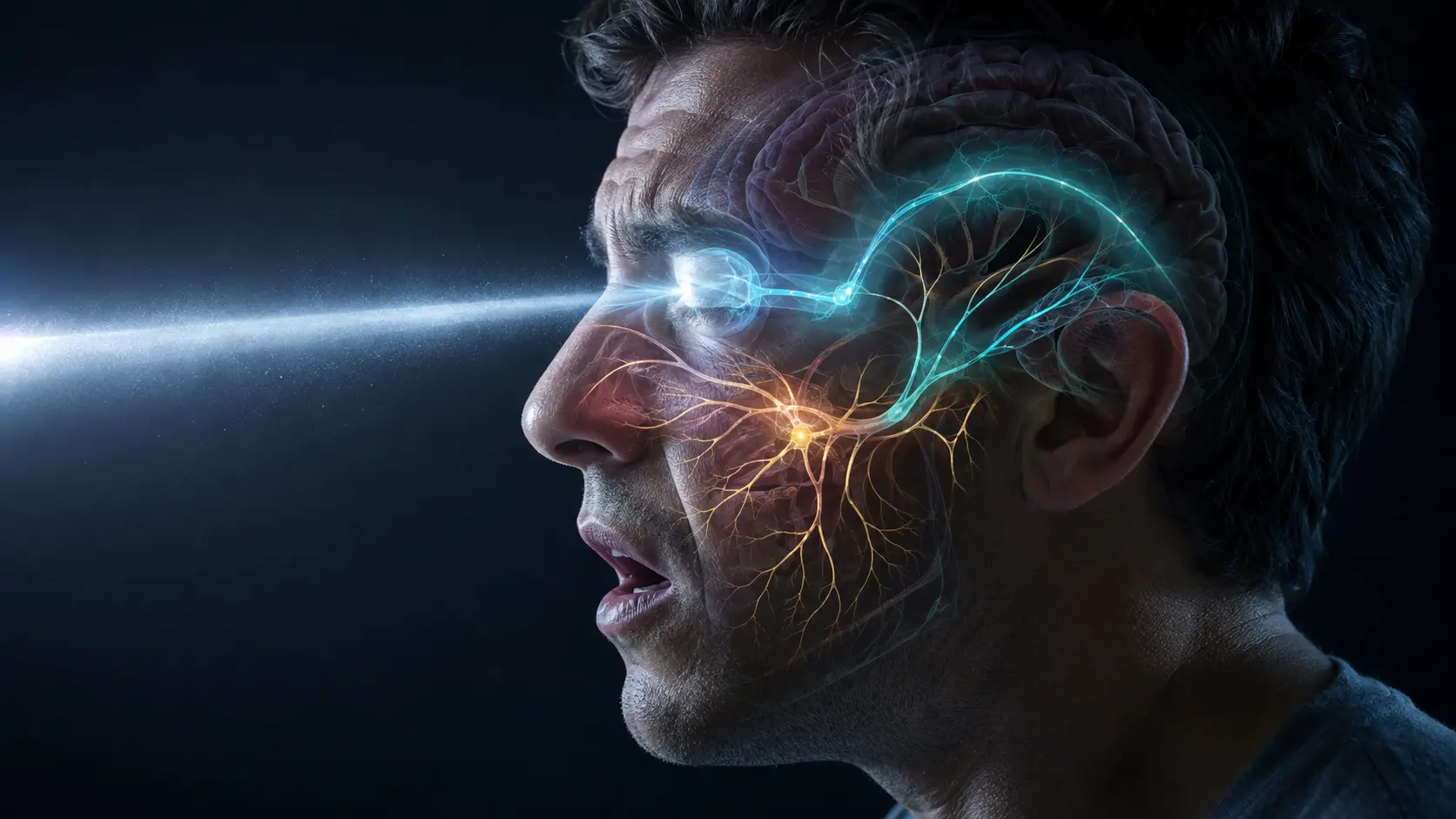
In a photic sneezer, the trigger can be a rapid increase in illumination. The pupil constricts and autonomic activity changes as the visual system adapts. One hypothesis proposes that this activity spills into nearby parasympathetic routes, increasing nasal secretion or tickle. Another proposes summation between optic and trigeminal signals in the brainstem.
Those explanations are neuroanatomically plausible but not conclusively demonstrated. Laboratory researchers have found it surprisingly difficult to provoke the reflex consistently, even in people who report it in the real world. Sunlight may combine brightness, heat, ultraviolet exposure and expectation in ways a lamp does not reproduce.
Why it runs in families
Family studies and genome-wide association studies support inherited susceptibility. The playful acronym ACHOO—autosomal dominant compelling helio-ophthalmic outburst—suggests a simple dominant trait, but modern genetic findings point toward multiple associated regions rather than one universal sneeze gene.
Estimates of prevalence vary with population and how the question is asked. Around one person in five to one in three is often reported, but the number should not be treated as a worldwide constant. Some people sneeze once; others produce a short series.
The reflex is usually a curiosity, yet timing can matter. A sudden sneeze while driving from a tunnel, piloting or handling equipment can briefly interrupt vision and control. Sunglasses and avoiding a direct look toward intense light can reduce the trigger without testing it deliberately.
From brightness to an unexpected nasal reflex
A large increase in light activates retinal and pupil-control pathways. In a susceptible person, autonomic or trigeminal activity may cross the threshold of the brainstem sneeze network. Respiratory muscles then execute the same motor sequence used for nasal irritation.
Because the uncertain step lies between visual input and the sneeze center, researchers describe competing models rather than one proven wire. The inherited tendency may alter excitability at more than one point.
A genome-wide study found multiple loci associated with photic sneezing.
A large participant-driven genetics project also detected regions associated with the self-reported reflex.
Try it yourself
Record the natural trigger safely.
- If the reflex happens naturally, note whether you moved from shade to strong light.
- Notice whether sunglasses or looking down changes the response.
- Compare sudden brightness with simply spending time outdoors.
Never stare at the sun or another intense source. Do not deliberately provoke a sneeze while driving or operating equipment.
Why it matters
The photic sneeze reflex demonstrates that sensory systems are not isolated cables. Vision, autonomic control and protective respiratory programs share crowded brainstem territory.
It is also a useful example of scientific uncertainty: a familiar experience can have strong genetic evidence while its moment-to-moment neural mechanism remains unresolved.
Bright light can cross the threshold of a sneeze circuit.
Inherited susceptibility makes a sudden visual response recruit nasal and respiratory pathways. The bridge is plausible, measurable and not yet fully mapped.
Research behind this story
We link to the primary study or an authoritative indexed review wherever possible. Caveats in the text reflect the limits of that evidence.
01