
Quick answer
Hiccups are brief reflex events involving sudden contraction of the diaphragm and other inspiratory muscles followed almost immediately by closure of the glottis. The reflex can be triggered by stomach distension, rapid eating, carbonated drinks, alcohol or abrupt temperature and emotion changes. Most episodes stop on their own; hiccups lasting more than 48 hours or causing serious difficulty need medical evaluation.
One hiccup is funny. Ten are distracting. A long series can make conversation and eating feel like negotiations with a reflex you did not ask to start. The sharp sound is not a spasm in the throat alone.
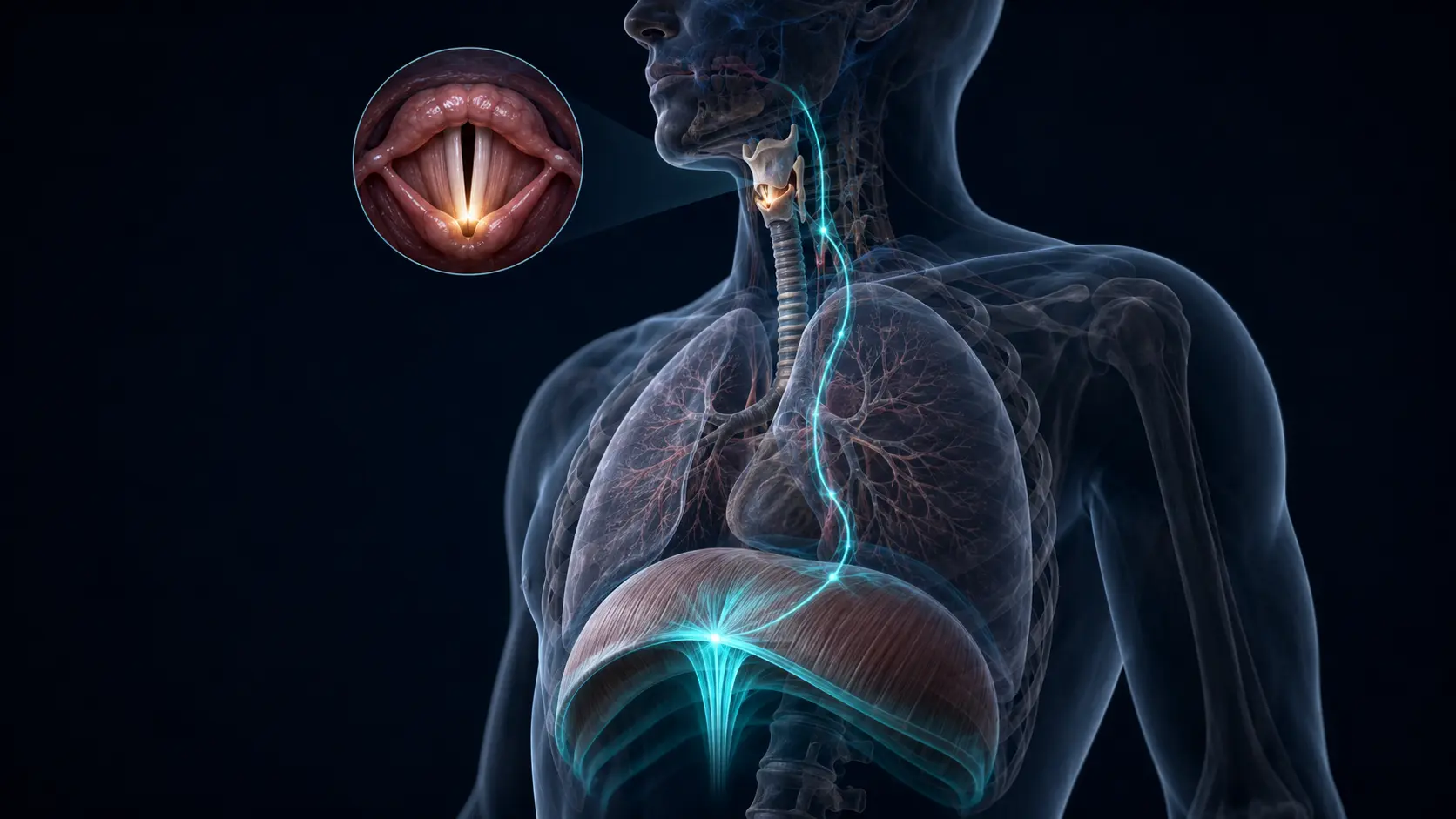
A hiccup begins deeper in the breathing system. The diaphragm and often the intercostal muscles contract abruptly, drawing air inward. A fraction of a second later, the glottis closes and cuts off that flow. The collision produces the hic.
The hic is a timed two-part event
The diaphragm is the broad muscle separating the chest from the abdomen. When it contracts normally, it moves downward and enlarges the chest cavity so air enters the lungs. During a hiccup, inspiratory muscles contract suddenly and without the smooth timing of an ordinary breath.
The glottis—the opening between the vocal folds—then closes. That closure stops the incoming air and makes the characteristic sound. Hiccups can involve one side of the diaphragm more strongly than the other, which is one reason the event is not simply a whole-body breathing reset.
The proposed reflex arc includes sensory input through the vagus and phrenic nerves and sympathetic pathways, processing in brainstem and spinal regions, and motor output through the phrenic nerve to the diaphragm. The network is described better than its evolutionary purpose.
Why a full stomach can start the reflex
Eating quickly, overeating and carbonated drinks can distend the stomach and irritate structures connected to vagal or diaphragmatic pathways. Alcohol, sudden temperature shifts, laughter and strong emotion are also common reports. These triggers do not prove one single starting receptor; they reveal that several inputs can push the same network over threshold.
Home remedies aim to interrupt the pattern by changing breathing, swallowing or sensory input. Breath holding raises carbon dioxide; sipping water organizes repeated swallowing; a brief Valsalva-like strain changes chest pressure. Evidence for individual tricks is limited, and most episodes would have stopped without intervention.
Persistence changes the meaning. Hiccups lasting more than 48 hours are called persistent, and those lasting more than a month are sometimes termed intractable. Medication effects, irritation along the reflex arc and neurological or metabolic disorders become more relevant, so prolonged hiccups deserve professional assessment rather than increasingly extreme remedies.
From trigger to the hic sound
A sensory disturbance recruits the hiccup reflex network. Phrenic motor output makes the diaphragm contract abruptly, other inspiratory muscles may join, and the glottis closes just after air begins moving inward.
The sequence can repeat rhythmically until the network settles. Because the central generator is not under simple voluntary control, deciding to stop is rarely enough, although breathing and swallowing maneuvers can sometimes disrupt the rhythm.
Clinical reviews define the event as inspiratory muscle contraction followed by laryngeal closure.
A broader review maps the proposed afferent, central and efferent parts of the hiccup reflex.
Try it yourself
Use a low-risk interruption.
- Pause eating or drinking and sit upright.
- Take slow controlled breaths or sip water normally.
- Wait a few minutes rather than stacking forceful maneuvers.
Do not use choking hazards, extreme breath holding or frightening tactics. Seek care for hiccups lasting more than 48 hours, disturbing sleep or eating, or occurring with neurological or severe chest symptoms.
Why it matters
Hiccups expose a normally hidden rule of breathing: several muscles and airway structures must be timed precisely, and a tiny timing error becomes instantly audible.
They also show why a common symptom can have two contexts. A short episode is usually benign; persistence can signal irritation or illness elsewhere along a long reflex pathway.
A hiccup is a breathing reflex cut short.
Inspiratory muscles contract suddenly, then the glottis closes against the airflow. The sound is the final fraction of a coordinated reflex.
Research behind this story
We link to the primary study or an authoritative indexed review wherever possible. Caveats in the text reflect the limits of that evidence.
01