Quick answer
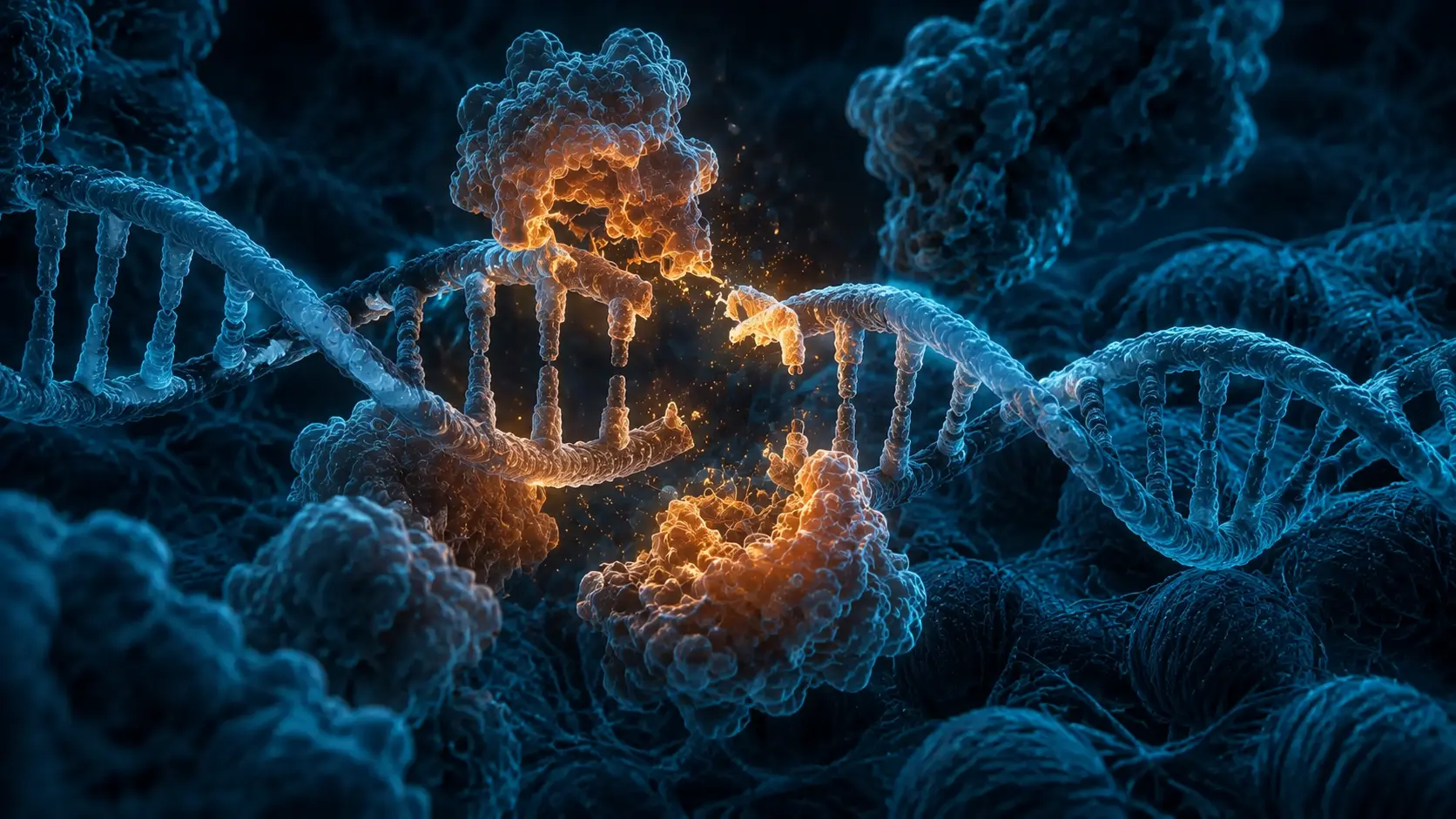
Cells repair DNA with specialized pathways matched to different lesions. Direct reversal fixes a few chemical modifications; base-excision repair replaces individual damaged bases; nucleotide-excision repair removes a short stretch around bulky distortions such as UV photoproducts; mismatch repair corrects some replication errors. Single-strand breaks can be processed and sealed, while double-strand breaks are repaired mainly by nonhomologous end joining or homologous recombination. Checkpoints can pause the cell cycle, and badly damaged cells may enter senescence or die. Repair greatly limits mutation, but it is not perfectly accurate or unlimited.
DNA is chemically stable enough to preserve information for a lifetime, but it is not inert. Water, oxygen metabolism, ultraviolet light, radiation, chemicals and ordinary copying can alter bases or break the backbone.
A cell therefore treats genome maintenance as continuous work. It detects abnormal structures, signals the problem, pauses division when needed and chooses among repair systems. The choice is powerful but not guaranteed to restore the original sequence perfectly.
Damage has many shapes, so repair is a network
A changed base may still leave the double helix mostly intact. A bulky adduct can bend it. Replication can pair the wrong bases or stall at a lesion. Breaks can sever one strand or both, and double-strand breaks risk chromosome loss or rearrangement if their ends are joined incorrectly.
Cells recognize consequences as much as causes: unusual chemistry, distorted helix geometry, exposed strand ends or a polymerase mismatch. Sensor and mediator proteins then recruit enzymes, modify nearby chromatin and activate signaling kinases such as ATM or ATR.
The damage response is broader than repair chemistry. Cell-cycle checkpoints buy time before DNA is copied or chromosomes separate. Transcription and replication may be reorganized locally, and the cell can choose senescence or programmed death when continued division would be unsafe.
Excision pathways remove damaged letters and short passages
In base-excision repair, a DNA glycosylase recognizes a particular altered base and removes it. Additional enzymes cut and process the site, a polymerase fills the missing nucleotide or short patch, and a ligase seals the backbone.
Nucleotide-excision repair handles bulky, helix-distorting lesions. A protein complex opens the region, cuts on both sides of the damage and removes an oligonucleotide. DNA synthesis uses the undamaged complementary strand as a template before ligation closes the gap.
Mismatch repair patrols newly copied DNA for some mispaired bases and small insertion or deletion loops. It identifies the newly synthesized strand, removes a tract containing the error and resynthesizes it. Together, polymerase proofreading and mismatch repair make replication far more accurate than base pairing alone.
A broken chromosome presents a harder choice
Nonhomologous end joining, or NHEJ, can bind and rejoin double-strand-break ends through much of the cell cycle. It is fast and does not require a matching template, but end processing can remove or add a few nucleotides. That makes it potentially mutagenic even when it restores chromosome continuity.
Homologous recombination, or HR, uses an intact homologous sequence—usually the sister chromatid after DNA replication—as a template. It can restore information with high fidelity but is restricted by cell-cycle timing and requires extensive processing and strand exchange.
Pathway choice depends on the structure of the break, cell-cycle stage, chromatin and regulatory proteins. NHEJ is not simply 'bad' and HR 'good'; both are essential, and failures in either can produce disease. Defects involving BRCA1, BRCA2, mismatch repair proteins or nucleotide-excision repair illustrate how repair biology connects to inherited cancer risk and other syndromes.
Repair prevents many mutations, not all of them
If a lesion is copied before repair, the altered information can become a stable mutation. Repair itself can also introduce sequence changes or chromosome rearrangements, particularly when a clean template is unavailable.
Most mutations are neutral or harmful to the cell rather than beneficial to a tumor. Cancer emerges through selection across many cellular generations, often combining growth advantages with failures in checkpoints, apoptosis and genome maintenance.
Researchers continue to refine how pathway choice works inside different chromatin environments and during replication stress. The stable principle is that DNA damage is constant and repair is indispensable; the unresolved frontier is how cells prioritize competing routes in real tissues over time.
From lesion to restored backbone
Sensors recognize altered chemistry or structure and assemble a damage response. Checkpoints can slow the cell cycle while enzymes expose or remove the damaged region.
Polymerases rebuild missing DNA when a template is available, and ligases restore the phosphodiester backbone. Double-strand breaks require a choice between end joining and template-guided recombination.
The National Cancer Institute lists the major damage-response routes, including base and nucleotide excision, mismatch repair, homologous recombination and end joining.
Why it matters
DNA repair explains how genomes remain usable despite relentless chemical damage and billions of cell divisions.
Its limits matter just as much: repair defects can create distinctive disease risks, while therapies may exploit repair dependencies in cancer cells under specialist care.
DNA survives because cells repair by lesion type.
Specialized pathways excise damaged bases, correct copying errors or reconnect broken strands, but every route has conditions and tradeoffs.
Research behind this story
We link to the primary study or an authoritative indexed review wherever possible. Caveats in the text reflect the limits of that evidence.
01