Quick answer
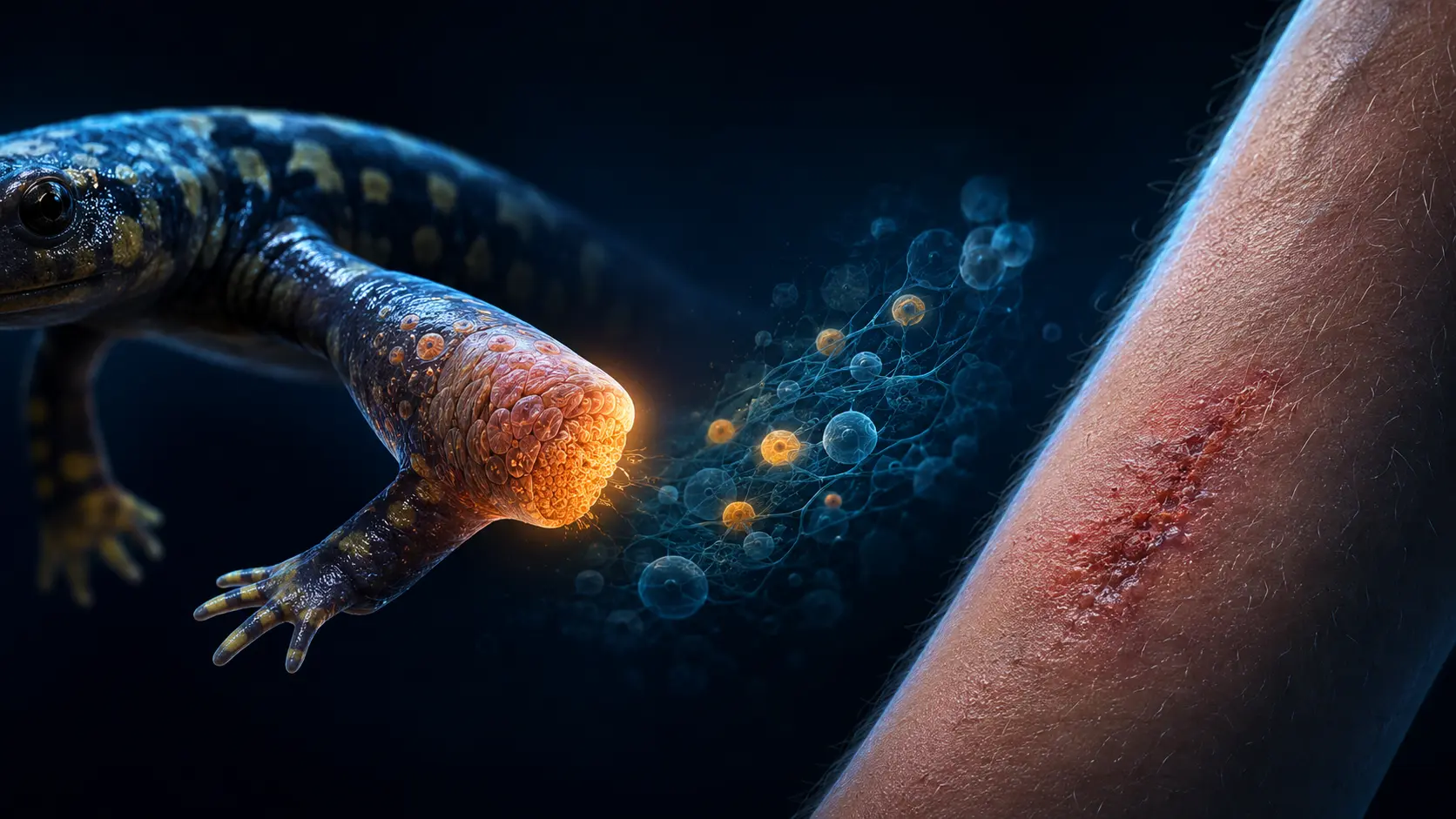
Humans cannot regrow complete limbs because adult injury responses favor rapid wound closure, inflammation and scar formation rather than building a regenerative blastema with positional instructions. Salamanders reorganize local cells, maintain nerve-dependent growth signals and coordinate bone, muscle, skin, vessels and connective tissue into a correctly patterned structure. Humans retain limited regenerative abilities, and young fingertips can sometimes regrow tissue under specific conditions, but no safe method currently reactivates full limb regeneration.
Human skin closes, bone remodels and the liver can restore mass, yet an amputated arm does not begin constructing another elbow and hand. Salamanders can perform that larger feat. The contrast is not a single missing stem cell or one gene waiting to be switched on.
A limb is a spatial problem. Regrowth must know what is missing, preserve orientation, produce several tissue types, reconnect nerves and vessels, and stop at the correct size. Regenerating animals create a specialized wound environment and a mass of progenitor cells called a blastema that carries out this coordinated program.
Repair and regeneration solve different problems
Repair restores a barrier and mechanical stability. Blood clots, immune cells clear damage, fibroblasts deposit extracellular matrix and epithelium closes the surface. The resulting scar may not reproduce the original architecture, but it reduces infection and fluid loss quickly.
Epimorphic regeneration rebuilds the missing structure. In a salamander, wound epidermis covers the stump without forming a conventional scar. Cells near the injury change state and contribute to a blastema. Signals from nerves and other tissues sustain growth, while positional information tells cells whether to form upper arm, forearm or digits.
The blastema is not an undifferentiated soup that can become anything without rules. Lineage tracing shows that many cells retain restrictions related to their tissue of origin. Regeneration succeeds because multiple populations coordinate within a permissive signaling environment.
Why evolution did not preserve one universal ability
Regenerative capacity varies widely across species, life stages and tissues. That pattern does not support a simple ladder in which complex animals merely lost a superior trait. Immune responses, body size, metabolism, developmental programs and cancer control may all shape the trade-offs, but no single evolutionary explanation has been proven sufficient.
Mammals do preserve clues. The liver restores mass, skeletal muscle uses satellite cells, bone can heal and remodel, and the tips of young digits sometimes regenerate when the nail-associated tissue and suitable wound environment remain. These examples show that regenerative components survive, but they do not add up automatically to an entire limb program.
Research aims to improve specific outcomes—scar reduction, nerve repair, muscle restoration, bone growth and engineered tissues—while learning from regenerative animals. Claims that a supplement, frequency or unapproved stem-cell product can regrow a human limb are not supported. Converting insight into coordinated, safe regeneration must also control infection, abnormal growth and cancer risk.
The missing step is a whole regenerative system
Salamander regeneration begins with a wound epidermis that becomes a specialized signaling surface rather than sealing the stump with a mature scar. Beneath it, connective-tissue cells and other local populations enter a blastema state. The established difference is therefore an organized tissue response, not the absence of one magical human cell.
Nerves are essential to that response. Signals from peripheral nerves and associated Schwann cells help blastema cells survive and proliferate, while connective tissue retains positional information about where it came from along the limb. Removing nerve input can stop outgrowth even when other components remain.
Humans show a narrow exception at the distal fingertip, especially when nail-associated tissue and an appropriate wound environment are preserved. That can restore combinations of skin, nail and underlying tissue; it is not evidence that an adult arm contains a dormant full-limb program ready for activation.
Researchers are still resolving which differences are causes, consequences or species-specific solutions. A safe human therapy would have to coordinate immunity, nerves, vessels, patterning and growth termination—not merely increase cell division.
What a regenerating limb must coordinate
The wound surface closes in a regeneration-permissive way, nerves deliver essential signals and local cells generate a blastema. Molecular gradients and remembered positional identity organize outgrowth along the correct axes.
Cells proliferate, redifferentiate into appropriate tissues and reconnect across the stump. Growth stops once the missing pattern is restored. In humans, ordinary healing diverts early toward matrix deposition and scar, so this integrated sequence does not begin.
A broad review compares the cellular logic of appendage regeneration across animals.
Research on salamanders explains the role of blastema cells, nerves and tissue memory.
Why it matters
The comparison replaces the idea of a single regeneration switch with a systems problem involving immunity, development, mechanics and precise spatial control.
That makes present research more realistic. Restoring one tissue or reducing fibrosis can be valuable progress even before full limb regeneration becomes possible.
Humans heal; salamanders rebuild a coordinated map.
Full limb regeneration needs a scar-free wound environment, a nerve-supported blastema and positional instructions across many tissues. Adult humans do not naturally assemble that program.
Research behind this story
We link to the primary study or an authoritative indexed review wherever possible. Caveats in the text reflect the limits of that evidence.
01