
Quick answer
Taste buds are clusters of specialized epithelial cells located mainly within papillae on the tongue, with additional buds in parts of the palate and throat. Chemicals dissolved in saliva enter a small taste pore and activate receptors or ion channels on taste cells. Sweet, bitter and umami rely largely on G-protein-coupled receptor pathways, while sour depends on proton-sensitive channels; human salt sensing remains more complex and is not fully settled. Activated cells release chemical signals onto sensory nerve fibers. Cranial nerves carry the activity to the brainstem and onward to networks that identify taste quality, intensity and value. Smell and other mouth sensations then turn basic taste into the richer experience called flavor.
A grain of salt has no taste while it is dry on a plate. The sensation begins when molecules and ions dissolve, reach living receptor cells and are converted into signals the nervous system can use.
Taste buds perform that first translation. They do not identify a complete food by themselves; they report a small set of chemical qualities that the brain combines with smell, temperature, texture and irritation to construct flavor.
Papillae are the terrain; taste buds are the sensors
The visible surface of the tongue is covered by papillae, but a papilla is not the same thing as a taste bud. Fungiform papillae near the front, foliate folds along the sides and large circumvallate papillae near the back can contain taste buds in their walls. The numerous filiform papillae that give the tongue much of its texture mainly handle touch and friction and do not contain taste buds.
Each taste bud is an onion-shaped group of receptor, supporting and precursor cells embedded in the epithelium. Their narrow tips face a small opening called the taste pore. Saliva carries dissolved food chemicals into this space, where microscopic projections from taste cells sample them.
Taste buds also occur beyond the tongue, including regions of the soft palate and throat. Their distribution already disproves the familiar schoolbook tongue map: sweet, salty, sour, bitter and umami are not confined to five separate tongue zones.
Different chemicals open different molecular routes
Sweet molecules, many bitter compounds and the glutamate associated with umami activate families of G-protein-coupled receptors. These receptors start intracellular signaling cascades that raise calcium and ultimately cause a taste cell to release a messenger.
Sour taste begins with acidity. Work on OTOP1 identified a proton-selective channel that allows acid-related electrical changes in sour-sensing cells. Salt is less tidy: sodium entry explains an important salt pathway in several mammals, but the exact contribution of candidate channels and high-salt pathways in humans remains under investigation.
The five established qualities are therefore not five flavors and not five identical sensors. They are broad information channels. Other proposed qualities, including fat-related taste, continue to be studied, and evidence for a receptor in one experiment does not automatically establish a separate basic taste in people.
Taste cells talk to nerves without all using the same synapse
Taste receptor cells are epithelial cells, not ordinary neurons, yet they can become electrically active. Cells associated with sweet, bitter and umami release ATP through specialized channels. Sour-responsive cells use a more conventional synaptic arrangement and can release neurotransmitters onto nearby sensory fibers.
Those differences matter because a taste bud is a small community rather than a row of independent labeled buttons. Supporting cells manage the local chemical environment, receptor cells communicate with afferent fibers and precursor cells replace cells lost through normal turnover.
Taste cells are regularly renewed throughout life. Replacement does not mean the sense resets every few days: new cells must differentiate, connect functionally with incoming fibers and join an already operating circuit. Exact lifespans vary among cell types and measurement methods.
Three cranial nerves carry taste toward the brain
The facial nerve carries much taste information from the front of the tongue, the glossopharyngeal nerve serves much of the rear tongue and the vagus nerve contributes from regions around the throat and epiglottis. These fibers first converge in the nucleus of the solitary tract in the brainstem.
Signals then pass through additional relays toward the thalamus and gustatory regions of the insula and frontal operculum. Other connections link taste with swallowing, salivation, appetite, learning and aversion. A bitter signal can therefore affect behavior before someone has found the word for it.
The pathway preserves useful information about quality and intensity, but perception is not a direct readout of one receptor. Attention, temperature, adaptation, expectation and prior experience can change how the same chemical stimulus is judged.
Most of what you call taste is multisensory flavor
When chewing releases volatile molecules, air carries them from the back of the mouth into the nasal cavity. This retronasal smell helps distinguish foods that share similar basic tastes. A blocked nose can leave sweetness or saltiness detectable while making coffee, fruit or herbs seem strangely flat.
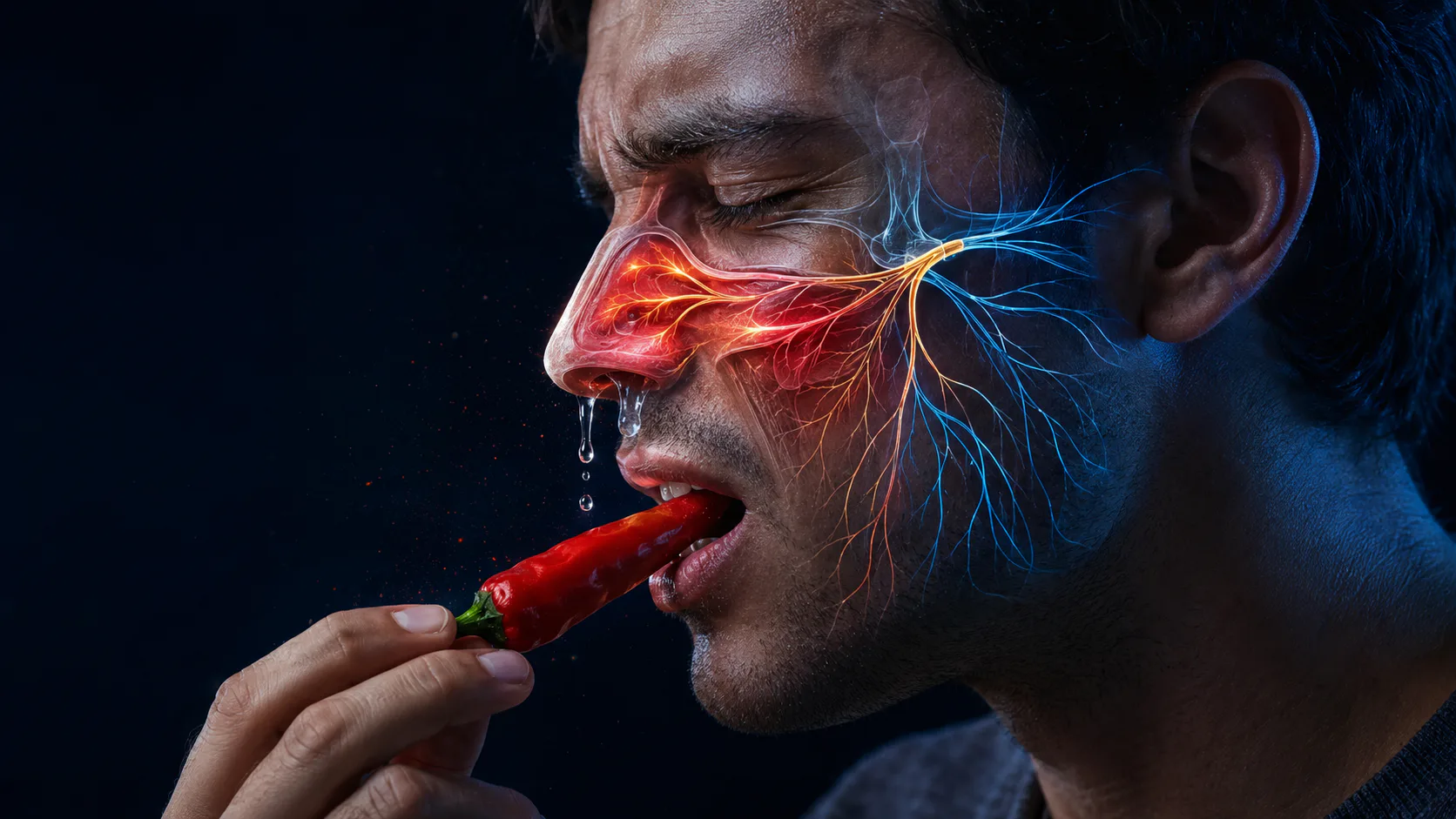
Touch and temperature add creaminess, crunch, warmth and viscosity. The trigeminal system contributes irritation and cooling: capsaicin in chili activates heat-and-pain pathways, while menthol recruits cold-sensitive channels. Spicy is therefore a real oral sensation, but it is not one of the five established basic tastes.
The brain binds these streams into a single food experience so smoothly that the components are easy to confuse. That is why many people who report losing taste are found to have a smell disorder instead, although true taste disorders also occur.
A persistent change in taste has more than one possible source
Taste can change with oral or dental problems, respiratory illness, medications, injury and some ear, nose or throat procedures. Because smell contributes so much to flavor, the first question is often whether basic tastes themselves are reduced or whether aromas have become hard to perceive.
A sudden or persistent loss, a distorted metallic or foul taste, difficulty eating or an unexplained change that affects nutrition deserves professional assessment. Medication should not be stopped on the assumption that it caused the symptom without guidance from the clinician who prescribed it.
This article explains normal sensory biology and common distinctions; it cannot diagnose an individual change. The molecular pathways for several taste qualities are well supported, while human salt coding, additional proposed tastes and the full integration of taste with appetite remain active research areas.
From food molecule to perceived taste
Saliva dissolves ions and molecules and carries them into taste pores. Receptors or ion channels change the electrical state of specialized taste cells, which release chemical messengers onto nearby afferent fibers.
Cranial nerves deliver the pattern to the brainstem and higher sensory networks. Smell, texture, temperature and expectation join that pattern to create flavor.
NIDCD explains how taste cells, cranial nerves and smell combine during eating.
A major cellular review details the different taste-bud cell types, signals and synapses.
Why it matters
Taste buds reveal how a sheet of renewing epithelial cells can function as a chemical sensor connected to the nervous system.
Separating taste from flavor also explains why a blocked nose changes food so dramatically without switching off every receptor on the tongue.
Taste begins on the tongue; flavor is assembled by the brain.
Taste cells convert a few chemical qualities into nerve signals, then smell and other oral senses turn those signals into the food experience you recognize.
Research behind this story
We link to the primary study or an authoritative indexed review wherever possible. Caveats in the text reflect the limits of that evidence.
01