Quick answer
We dream because the sleeping brain remains active and can generate perceptions, emotions and narratives without normal sensory input. Vivid dreams are often recalled from REM sleep, but dreaming also occurs during non-REM sleep. Research links content to recent experiences, older memories and emotional concerns. Theories propose roles in memory consolidation, emotional processing, threat simulation or predictive modeling. These ideas have supporting evidence, but none explains every dream or proves that the dream narrative—rather than underlying sleep processes—is required for one function.
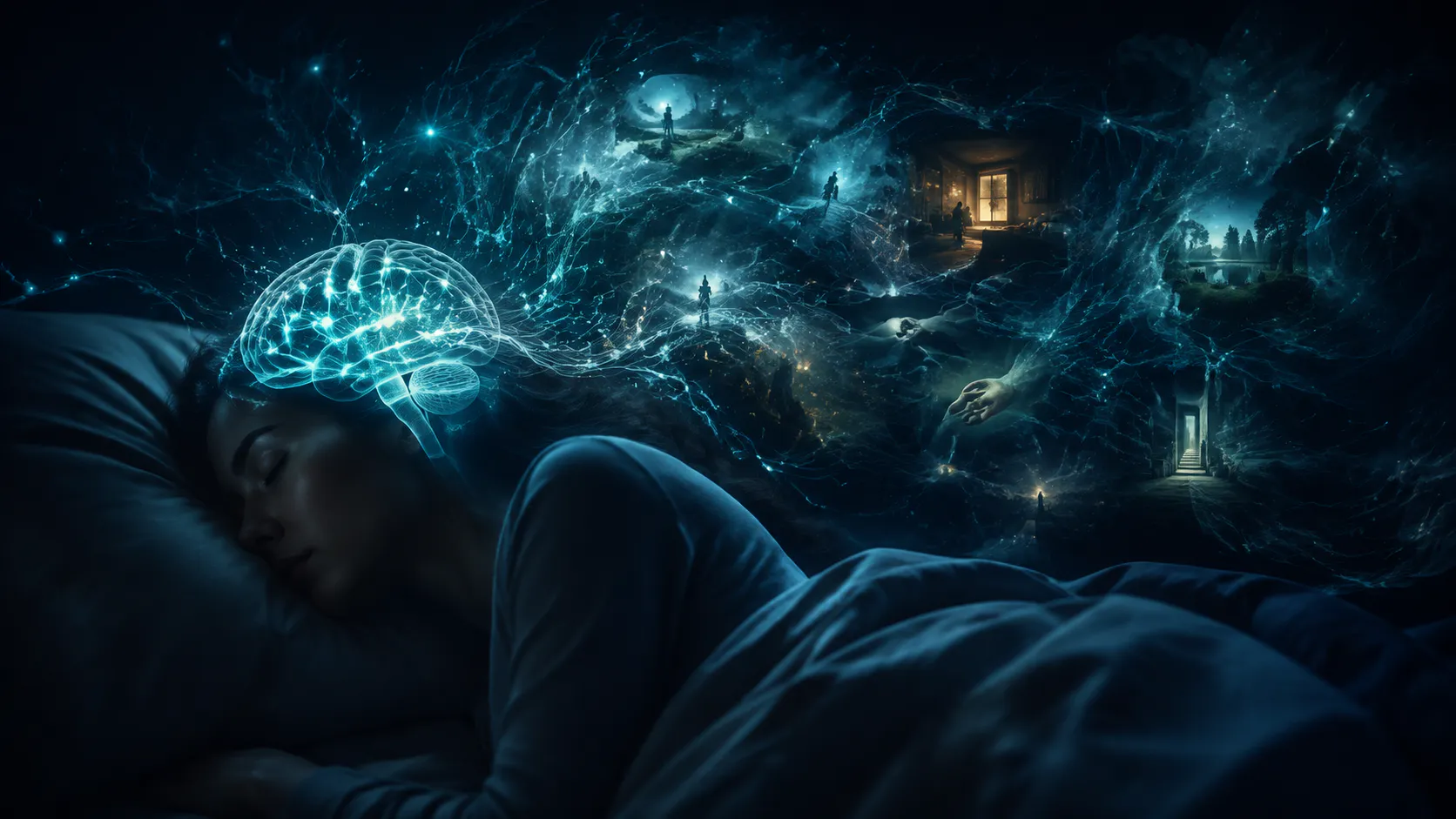
A dream can borrow your childhood home, place it beside a street you saw yesterday and populate it with someone who has never been there. While it lasts, the mixture may feel coherent. Only after waking do the joins become obvious.
Science can measure sleep stages, brain activity and reports collected after awakening. It can test which experiences appear and whether dreaming changes with memory or emotion. It cannot yet point to one universally proven purpose for every dream.
Dreaming is common in REM sleep, but not confined there
REM sleep combines rapid eye movements, muscle paralysis and a waking-like pattern of brain activity. Awakenings from REM often produce vivid, emotional and visually rich reports, making REM and dreaming seem nearly synonymous.
Laboratory awakenings also collect dreams from non-REM sleep. These reports can be shorter or more thought-like on average, especially in deeper sleep, but the distributions overlap. Dreaming and REM are related states, not identical processes.
A night cycles through non-REM and REM repeatedly. Awakening time, memory strength and a person's attention to dreams all affect what gets reported the next morning.
The sleeping brain builds experience from the inside
External sensory input is reduced, yet visual, memory and emotion networks can remain active. The brain generates people, places and movement using stored models rather than a live stream from the environment.
Systems involved in checking contradictions may operate differently. That helps explain why impossible transitions are accepted. In lucid dreams, some metacognitive awareness returns, but lucidity is a special case.
Dream content is not a faithful replay. Fragments are recombined and transformed: a recent conversation can supply one element while an older place or concern supplies another.
Memory and emotion are leading ideas, not a verdict
Sleep clearly supports memory consolidation, and learning experiences can later appear in dreams. Some experiments associate dreaming about a task with improved performance, but this does not prove that the conscious narrative causes the improvement.
Emotional processing is another candidate. Dream reports often incorporate salient concerns, and recent work links dream affect with later emotional-memory processing. Effects vary, and causal direction remains difficult to establish.
Other theories frame dreams as simulations that test threats, social situations or predictions. They explain some patterns, but no theory shows that every bizarre scene serves one purpose.
Personal meaning is possible; universal decoding is not established
Dreams draw on personal memories, so reflection may feel useful. That differs from claiming one object has the same hidden meaning for everyone. Scientific evidence does not support universal symbol dictionaries.
Frequent nightmares can accompany stress, trauma, medicines or sleep disorders, but a dream alone is not a diagnosis. Recurrent distress, injury during sleep or major daytime impairment deserves professional assessment.
The careful answer remains useful: dreams reveal that the brain constructs a compelling world from memory, emotion and prediction while largely disconnected from current sensory reality. The single reason it does so remains open.
From sleeping networks to a remembered dream
Across REM and non-REM sleep, internally generated activity activates fragments of memory, emotion and perception and integrates them into an experience.
If awakening leaves a strong memory trace, the dream can be reported. Otherwise it may vanish quickly even though dreaming occurred.
A review emphasizes that dreaming and REM use overlapping but distinct mechanisms.
Experimental work suggests a possible role in emotional-memory processing.
Why it matters
Dream research separates what sleep demonstrably does from whether the felt dream has its own necessary function.
Uncertainty is productive: competing theories make testable predictions without pretending the case is closed.
Dreaming is real brain activity; its single purpose is unproven.
Dreams combine memory, emotion and internally generated perception across sleep stages while several functions remain under study.
Research behind this story
We link to the primary study or an authoritative indexed review wherever possible. Caveats in the text reflect the limits of that evidence.
01