
Quick answer
Muscles often become sore hours after unfamiliar exercise because mechanical loading starts a delayed tissue response. Lengthening, or eccentric, contractions can produce microscopic structural disruption and changes in calcium handling, membranes and connective tissue. Local immune and repair signals then alter the sensitivity of pain-sensing nerve endings, so pressure and movement hurt more the next day. Soreness commonly develops within 12 to 24 hours and is often strongest around 24 to 72 hours, although timing and severity vary. Lactate rises and falls far too quickly to explain this delayed pattern. DOMS usually resolves over several days, and the same workout often causes less soreness when repeated after recovery.
The workout ends, breathing settles and the muscles may feel almost normal. The next morning, stairs reveal a different story. A thigh that worked yesterday now feels tender, stiff and temporarily weaker.
This pattern is delayed-onset muscle soreness, or DOMS. It is most common after unfamiliar or unusually demanding exercise, especially movements that load a muscle while it lengthens. The soreness reflects a changing interaction among stressed muscle tissue, local chemical signals and sensory nerves—not lactic acid waiting overnight inside the muscle.
The exercise starts the process, but nerves report it later
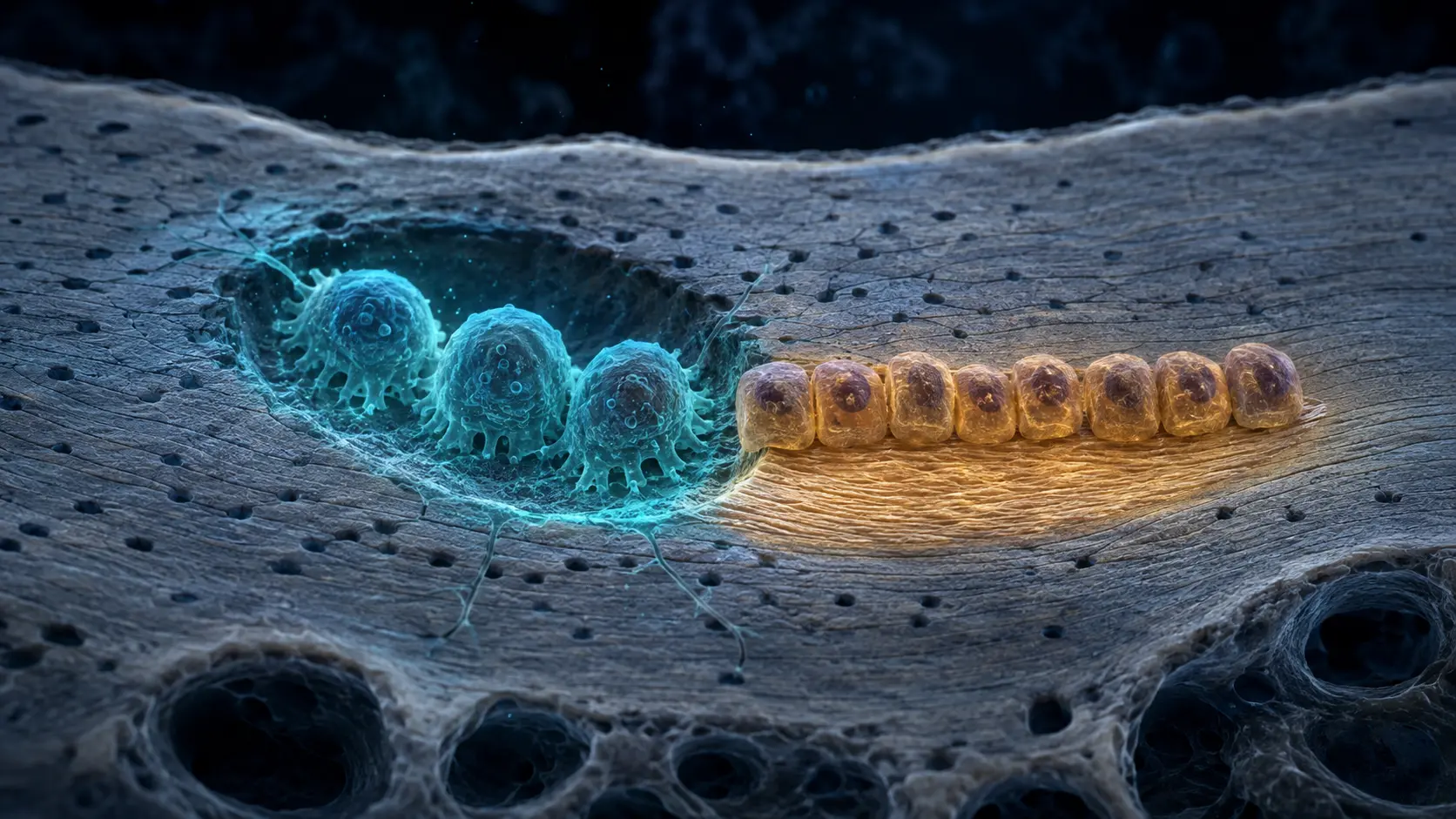
During strenuous loading, individual sarcomeres—the repeating force-producing units inside a muscle fiber—do not all lengthen evenly. Some regions experience more strain than others. Researchers observe disrupted contractile structures, altered membrane behavior and changes in the machinery that controls calcium after damaging exercise, but the pattern is patchy rather than a muscle being uniformly torn.
Those early changes do not map neatly onto soreness. Blood markers, imaging findings, swelling, strength loss and perceived pain can rise on different schedules and correlate only imperfectly. A person can feel sore without dramatic structural damage, while another can show measurable changes with modest pain.
The delay is partly sensory. Mechanical stress triggers local signaling involving inflammatory mediators and growth factors that can sensitize thin sensory fibers. Ordinary pressure, stretching or contraction then generates a stronger pain signal than it did immediately after the workout.
Lengthening contractions create unfamiliar strain
A muscle contracts concentrically when it shortens, as the biceps does while lifting a weight. It contracts eccentrically when it remains active while lengthening, as the biceps does while lowering that weight. Descending stairs, downhill running and the lowering phase of resistance exercise all contain substantial eccentric work.
Eccentric contractions can produce high force with relatively low energy demand. That makes them useful for movement and training, but an unaccustomed dose can concentrate mechanical strain within fewer active fibers and vulnerable sarcomeres. Exercise does not need to be extreme to cause DOMS; novelty, range of motion, load and an individual's recent training history all matter.
Soreness is therefore not a reliable score of workout quality. A session can stimulate useful adaptation without severe DOMS, and becoming less sore after a familiar workout does not mean the exercise has stopped working.
Lactate does not wait until the next day
Working muscle produces lactate as it manages carbon and energy during exercise. Lactate can circulate, be oxidized by other tissues and contribute carbon to glucose production. It is a usable metabolite and signal, not simply a toxic waste product.
Its timing does not fit DOMS. Blood and muscle lactate can rise during hard exercise and then decline during recovery, while soreness usually begins much later and may intensify over the next one to three days. The burning felt during a demanding set and the tenderness felt tomorrow are different phenomena.
The full cause of DOMS is still being refined. Mechanical strain, cellular disturbances, connective tissue, immune activity and sensory sensitization contribute, but no single marker explains every person's pain. Claims that one molecule or one recovery trick completely controls DOMS go beyond the evidence.
A repeated workout usually causes less disruption
After recovery from an unfamiliar bout, repeating a similar movement often produces less soreness, strength loss and leakage of muscle enzymes. This is called the repeated-bout effect. It can persist for weeks, although its strength depends on the muscle, movement, load and interval between sessions.
No single adaptation accounts for the whole effect. Proposed contributors include changes in motor-unit recruitment, stronger connective and cellular structures, remodeled sarcomeres and a modified inflammatory response. Even a relatively mild first exposure can provide some protection.
The effect explains why gradual progression works better than repeatedly shocking the body. It also explains why a trained runner can become sore after an unfamiliar downhill route or why a lifter can feel DOMS after changing exercise length, tempo or range despite being generally fit.
Not every pain after exercise is ordinary DOMS
Typical DOMS is centered in muscles that were loaded, appears after a delay and gradually improves. Gentle movement may temporarily reduce stiffness, but soreness is not permission to repeat maximal loading before normal movement and strength return.
Sharp pain during exercise, a sudden pop, marked one-sided swelling, joint instability, major loss of function, dark urine or worsening symptoms do not fit a simple educational description of DOMS. They can indicate injury or, rarely, severe muscle breakdown and need appropriate medical assessment.
Studies of recovery methods find variable, often modest effects, and results depend on timing and protocol. Sleep, adequate food and fluids, and sensible training progression support recovery; no supplement or device can guarantee that soreness will disappear or prove that repair is complete.
From unfamiliar load to next-day tenderness
Active muscle lengthens under load, creating uneven mechanical strain and local cellular disturbance. Repair and immune signals develop over the following hours rather than producing their full effect at the instant of exercise.
Those signals sensitize muscle sensory fibers, making compression, stretch and contraction feel painful. Remodeling and neural, cellular and connective-tissue adaptation then reduce the response to a similar later bout.
A mechanistic review follows exercise-induced muscle damage from mechanical strain through inflammatory signaling.
Experimental work shows how bradykinin and growth-factor signaling can sensitize muscle afferents after lengthening contractions.
Try it yourself
Separate delayed soreness from pain during movement.
- Recall whether the movement was new, heavier or involved more lowering or downhill work than usual.
- Notice when tenderness begins and whether ordinary motion improves over the next several days.
- Progress the movement gradually after function returns instead of using soreness as a target.
This is not a diagnostic test. Sudden pain, substantial swelling, dark urine, severe weakness or symptoms that worsen need medical evaluation.
Why it matters
The delayed mechanism replaces the persistent-lactic-acid myth with a more accurate picture of mechanical stress, local signaling and sensory sensitization.
It also separates adaptation from punishment. Soreness can accompany a useful training stimulus, but severe soreness is neither required nor a reliable measure of progress.
Yesterday's load changes what your nerves feel today.
DOMS develops as stressed muscle and local signals sensitize sensory endings. Lactate clears too early to explain the next-day ache.
Research behind this story
We link to the primary study or an authoritative indexed review wherever possible. Caveats in the text reflect the limits of that evidence.
01